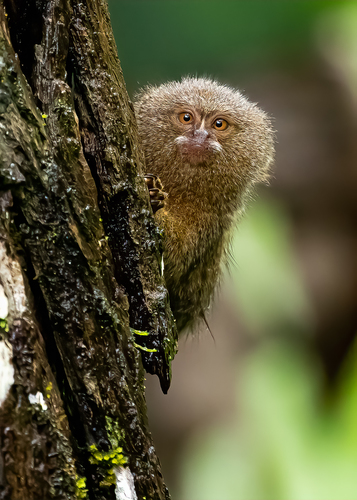
The pygmy marmoset is a small New World monkey. The genus consists of two species, the Western pygmy marmoset, and the Eastern pygmy marmoset,. The smallest monkey in the world at just over 100 g (3.5 oz), it is native to rainforests of the western Amazon Basin in South America. It is generally found in evergreen and river-edge forests and is a gum-feeding specialist, or gummivore.
🛡️ Conservation Status
vulnerable
vu
📌 Evolution and taxonomy
Debate has arisen among primatologists concerning the proper genus in which to place pygmy marmosets. An examination of the interstitial retinol binding protein nuclear gene (IRBP) in three marmoset species showed that Callithrix as constructed in the 1990s also needed to include C. pygmaea to be monophyletic, and that the times of separation of C. pygmaea and the C. argentata and C. jacchus species groups from one another are less than 5 million years ago, as might be expected for species of the same genus. However, subsequent separation of the argentata and jacchus species groups into different genera (the argentata group having been moved to Mico) justifies maintaining a separate genus for the pygmy marmosets, as Callithrix is no longer paraphyletic.
The two species described of the pygmy marmoset are:
The evolution of this genus diverged in terms of body mass from typical primates, with a high rate of body-mass reduction. This involves large decreases in prenatal and postnatal growth rates, furthering the thought that progenesis played a role in the evolution of this animal.
📌 Physical description
Pygmy marmosets are the smallest true monkeys, with a head-body length ranging from and a tail of . The average adult body weight is just over with the only sexual dimorphism of females being a little heavier. The fur colour is a mixture of brownish-gold, grey, and black on its back and head and yellow, orange, and tawny on its underparts. Their tails have black rings and their faces have flecks of white on the cheeks and a white vertical line between the eyes. The dental morphology is adapted to feeding on gum, with specialised incisors that are used to gouge trees and stimulate sap flow. The cecum is larger than usual to allow for the greater time gum needs to break down in the stomach.
📌 Ecology
=== Geographic range and habitat ===
Pygmy marmosets can be found in much of the western Amazon Basin, in Brazil, Colombia, Ecuador, Peru, and Bolivia. The western pygmy marmoset, C. pygmaea, occurs in the state of Amazonas, Brazil, eastern Peru, southern Colombia, and north-eastern Ecuador. The eastern pygmy marmoset, C. niveiventris, is also found in Amazonas, but also in Acre, Brazil, eastern Peru, and northern Bolivia. The distribution of both species is often limited by rivers. They typically live in the understory of the mature evergreen forests and often near rivers. Population density is correlated with food-tree availability. They can be found between ground level and about into the trees, but generally do not enter the top of the canopy. They are often found in areas having standing water for more than three months of the year.
📌 Behaviour
]]
A pygmy marmoset group, ranging from two to nine members, contains one or two adult males and one or two adult females, including a single breeding female and her offspring. Interbirth interval ranges from 149–746 days. In contrast to other callitrichines, no relationship exists between the number of adult males and the number of infants and offspring. A significant positive relationship exists, though, between the number of juveniles and the number of adult and subadult group members. Young marmosets typically remain in the group for two consecutive birth cycles. The pygmy marmoset uses special types of communication to give alerts and warning to its family members. These include chemical, vocal, and visual types of communication. It is believed to serve to promote group cohesion and avoidance of other family groups.
📌 Social systems
Infant pygmy marmosets, along with their parents, twins, and other siblings, form co-operative care groups. Babbling, or vocalizing, by the infant marmoset is a key part of its relationships with its family members and is a major part of its development. As the infant develops, the babbling gradually changes to resemble and eventually become adult vocalization. Many similarities are seen between the development of vocalization in infant pygmy marmosets and speech in infant humans. Vocalizing gives the infant advantages, such as increased care, and allows the entire family to coordinate their activities without seeing each other.
Siblings also participate in infant care. Infant marmosets require the most attention, so having more family members participating in the care decreases the cost for any individual and also teaches parenting skills to the juvenile marmosets. Members of the group, usually female, may even put off their own reproduction through a temporary cessation of ovulation to care for the offspring of others in the group. The ideal number of caregivers for an infant marmoset has been shown to be around five individuals. Caregivers are responsible for finding food for the infants and helping the father watch for predators.
Pygmy marmosets are not seasonal breeders and usually give birth to twins once or twice a year. Single births, however, occur in 16% and triplet births occur in 8% of pregnancies.
Male and female pygmy marmosets show differences in foraging and feeding behavior, although male and female dominance and aggressive behavior vary within the species. Males have less time to search out food sources and forage due to the constraints of their infant-caring responsibilities and predator vigilance. Without an infant to carry, female pygmy marmosets have greater freedom to forage, giving them an apparent feeding priority, which may serve to compensate mothers for the energetic costs of carrying and lactating for two offspring at a time. Since breeding priority is also given to females without offspring, the argument is weakened. Instead, female feeding priority may have evolved through sexual selection. Females may choose mates that invest more time in infant care and predator vigilance. Such males have less time to look for food, allowing the female feeding priority.
📌 Communication
to stay together when foraging, feeding, and travelling.]]
Pygmy marmosets are well known for their communication abilities, including an intricate system of calls. The trill is used during feeding, foraging, and when travelling and the group is close together. The J-call is a series of fast notes repeated by the caller and is used at medium distances. Both calls are used as contact calls. The long call is used when the group is spread out over distances greater than 10 m or in response to a neighboring group.
Pygmy marmosets have other ways to communicate information about matters such as a female's ovulatory state. New World monkeys do not show genital swelling during ovulation as female Old World monkeys do. Instead, a lack of female aggression towards males can serve as a signal of ovulation. Scent glands on her chest, anus, and genitals are also rubbed on surfaces, which leave chemical signals about the reproductive state of the female. Pygmy marmosets also perform visual displays such as strutting, back-arching, and piloerection when they feel threatened or to show dominance.
📌 Conservation
Both species of pygmy marmosets are listed as vulnerable on the IUCN Red List of Threatened Species. They are threatened by habitat loss in some areas of their range, and by the pet trade in others (i.e. Ecuador). Capture causes even more behavioral variations, including a decrease in both the number and the sound level of vocalizations. Pygmy marmosets can also be found at local zoos, where they exist in groups.
📌 As pets
Known in the pet trade as finger monkeys, their value is associated with their being the smallest primate in the world. Listed as Vulnerable to extinction, they are rare to find in the market for purchase. Prices range from $1,000 to $4,000.
Another expense for these creatures as pets is the necessary essentials to maintain them. Creating an environment similar to where they are from is important. For food, these creatures as pets are often fed fruits, insects, and smaller lizards. As pets, a baby pygmy marmoset needs to be fed every two hours for at least two weeks.
📌 In popular culture
* Fingerlings, a toy line produced by WowWee, is based on pygmy marmosets.