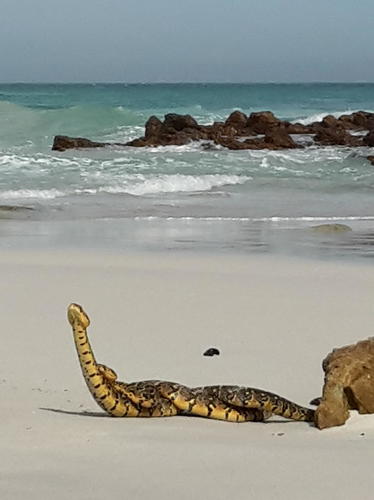
The puff adder is a highly venomous viper species found in savannahs and grasslands from Morocco and western Arabia throughout Africa except for the Sahara and rainforest regions. It is responsible for causing the most snakebite fatalities in Africa owing to various factors, such as its wide distribution, frequent occurrence in highly populated regions, and aggressive disposition. Two subspecies are currently recognized, including the nominate subspecies described here.
📌 Taxonomy
German naturalist Blasius Merrem described Bitis arietans in 1820. The specific name arietans means "striking violently" and is derived from the Latin arieto. The type locality given is "Promontorio bonae spei " (Cape of Good Hope), South Africa.
📌 Subspecies
{|class=wikitable
!Subspecies
!Taxon author
!Common name
!Geographic range
|-
|B. a. arietans
|(Merrem, 1820)
|African puff adder
|style="width:40%"|Throughout Africa from southern Morocco down to the Western Cape of South Africa, across to the south-west Arabian Peninsula
|-
|B. a. somalica
|Parker, 1949
|Somali puff adder
|Somalia, northern Kenya
|-
|}
📌 Scalation
The head has a less than triangular shape with a blunt and rounded snout. Still, the head is much wider than the neck. The rostral scale is small. The circumorbital ring consists of 10–16 scales. Across the top of the head, there are 7–11 interocular scales; three or four scales separate the suboculars and the supralabials. It has 12 to 17 supralabials and 13–17 sublabials. The first three or four sublabials contact the chin shields, of which only one pair exists. Often, two fangs are on each maxilla, and both can be functional.
Midbody, the snake has 29–41 rows of dorsal scales. These are strongly keeled except for the outermost rows. The ventral scale count is 123–147, the subcaudals number 14–38. Females have no more than 24 subcaudals. The anal scale is single.
📌 Geographic distribution and habitat
The species Bitis arietans may be the most common and widespread snake in Africa. It is not found in rainforest areas, such as along the coast of West Africa and in Central Africa (i.e., central DR Congo); it is also absent from the Mediterranean coastal region of North Africa. On the Arabian Peninsula, it is found as far north as Ta'if.
📌 Behaviour
Normally a sluggish species, the puff adder relies on camouflage for protection. Locomotion is primarily rectilinear, using the broad ventral scales in a caterpillar fashion and aided by its own weight for traction. When agitated, it can resort to a typical serpentine movement of surprising speed.
Although mainly terrestrial, it is a good swimmer and can also climb with ease; often it is found basking in low bushes. One specimen was found above the ground in a densely branched tree.
If disturbed, it hisses loudly and continuously, adopting a tightly coiled defensive posture with the forepart of its body held in a taut "S" shape. At the same time, it may attempt to back away from the threat toward cover. It may strike suddenly and fast, to the side as easily as forward, before returning quickly to the defensive position, ready to strike again. During a strike, the force of the impact is so strong, and the long fangs penetrate so deeply, that prey items are often killed by the physical trauma alone. The fangs apparently can penetrate soft leather.
It can strike to a distance of about one-third of its body length, but juveniles can launch their entire bodies forward in the process. The puff adder rarely grips its victims, but instead releases quickly to return to the striking position.
📌 Feeding
Mostly nocturnal, the puff adder rarely forages actively, preferring, instead, to ambush prey as it happens by. Its prey includes mammals (rodents [Aethomys sp., Arvicanthis sp., Mastomys sp., Otomys sp., Rattus sp., Rhabdomys pumilio, and Saccostomus campestris] and even occasionally small deer), birds, amphibians (such as Schismaderma carens), lizards, other snakes, and tortoises.
📌 Reproduction
Female puff adders produce a pheromone to attract males, which engage in neck-wrestling combat dances. A female in Malindi was followed by seven males. They give birth to large numbers of offspring; litters over 80 have been reported, while 50–60 are not unusual. Newborns are in length. Very large specimens, particularly those from East Africa, give birth to the highest numbers of offspring. A Kenyan female in a Czech zoo gave birth to 156 young, the largest litter for any species of snake.
📌 Captivity
The puff adder does well in captivity, but gluttony has been reported, more heavily in juveniles. Kauffeld (1969) mentions that specimens can be maintained for years on only one meal per week, but that when offered all they can eat, the result is often death, or at best wholesale regurgitation. It is a bad-tempered snake, and some specimens never settle down in captivity, always hissing and puffing when approached.
📌 Venom
The species Bitis arietans is responsible for more snakebite fatalities than any other African snake, due to a combination of factors, including its wide distribution, common occurrence, large size, potent venom that is produced in large amounts, long fangs, and habit of basking by footpaths and sitting quietly when approached. and is one of the most toxic of any vipers based on LD50. Mallow et al. (2003) give an LD50 range of 1.0–7.75 mg/kg SC. Venom yield is typically 150–350 mg, with a maximum of 750 mg. Serious bites cause limbs to become immovably flexed as a result of significant hemorrhage or coagulation in the affected muscles. Residual induration, however, is rare and usually these areas completely resolve.
Most fatalities are associated with poor clinical management and neglect.
==References==