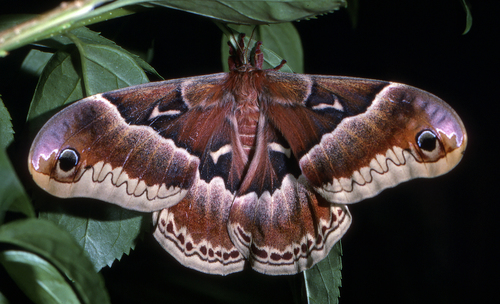
Callosamia promethea, commonly known as the promethea silkmoth, is a member of the family Saturniidae, which contains approximately 2,300 species. It is also known as the spicebush silkmoth, which refers to one of the promethea silkmoth's common host plants, spicebush. C. promethea is classified as a silk moth, which stems from its ability to produce silk, which it does in the formation of its cocoon. C. promethea lives in forests in the eastern U.S. and does not damage the trees on which it lives. The species was first described by Dru Drury in 1773.
๐ Distribution and habitat
The range of C. promethea extends the length of the east coast of the United States and west to the Great Plains. C. promethea is found in deciduous forests.
๐ Adult
Callosamia promethea does not consume any food in its adult stage.
๐ Life cycle
=== Egg ===
Female promethea silkmoths lay their eggs on the leaves of the host plants of the caterpillars. The eggs are laid at night. A female's eggs are laid in groups of 4 to 10 at a time. Eggs are white, flat and elliptical.
๐ Caterpillar
Once the caterpillars hatch, they are fairly solitary. They eat leaves from the edge inwards. When the caterpillars form cocoons, they are twice as long as they are wide.
๐ Pupa
Some caterpillars in the family Saturniidae will pupate in the ground.
๐ Adult
The wingspan of this moth is . Like most Lepidoptera, females are on average larger than males. Males are darkly pigmented, while females are more brightly colored. The males and females both have tan on the edges of their wings. The males have a set of eyespots on their forewings, but the females have spots on all their wings. In the northern part of the promethea silkmoth's range, there is one brood per year and it occurs during the early summer. In the southern part of the moth's range, there are two broods, with one occurring in the spring and the other occurring in late summer.
๐ Predators
The location of the C. promethea cocoon typically provides the pupae with sufficient protection from possible predators. The cocoons hang from thin branches and are difficult to open, so mice may have difficulty predating because the branches are too thin to hold their weight and woodpeckers could have trouble opening the pupa. Other predators of the cocoons include some flies and wasps.
๐ Protective coloration and behavior
=== Mimicry ===
Callosamia promethea utilizes Batesian mimicry, in which an edible species mimics a toxic species as a form of protection from predators. Promethea silkmoth females are rust and cream colored, but the males have very different coloration. Promethea silkmoth males mimic the pipe vine swallowtail (Battus philenor), a poisonous butterfly. The topside of the wings of promethea silkmoth males is black, as are the wings of the pipe vine swallowtails, which also have a shiny blue pattern on the top surface of their wings. The promethea silkmoth males do not have this reflective blue pattern, but their mimicry is still effective due to the fact that the blue reflective pattern is only visible on pipe vine swallowtails in a certain light, so the blue is not essential for C. promethea mimicry to be effective.
The effectiveness of this mimicry was tested experimentally. Promethea silkmoth males were painted with various patterns, then released, and the amount of each group that was recaptured showed that mimicry helped the moths survive. The control group was painted black, to match their actual coloration. One experimental group was painted black and yellow to mimic the tiger swallowtail (Papilio glaucus), which is not a poisonous butterfly and does not mimic the poisonous pipe vine swallowtail. The other experimental group was painted with orange stripes to mimic the poisonous monarch butterfly. The two groups that were painted to be mimetic to a poisonous butterfly both were recaptured more than the group painted to match an edible butterfly. This shows that mimicry, specifically the partial mimic of promethea silkmoth males to pipe vine swallowtails, is adequate protection against predation.
๐ Mating
=== Female/male interactions ===
๐ Pheromones
Female promethea silkmoths release pheromones to attract males. The females remain in place, camouflaged, as they wait for the males to sense their pheromones and come to them. Females release their pheromones at a specific time of day called the "calling time". For C. promethea this time is late afternoon and into the early evening. When males sense the pheromones of a female they travel up the gradient of the pheromones and towards the female. Males are able locate females from miles away. One C. promethea male has been found to be able to detect and find a female from 23 miles away. A distance this long is likely to be covered in multiple days.
๐ Mate choice
In terms of locating mates, males cannot find females unless they release pheromones, so the females control how frequently they mate. When females do send out their pheromones, the first male to reach a female will mate with her.
๐ Number of mates
Callosamia promethea are polyandrous, meaning the females mate with multiple males. However, not all females practice this behavior, some only mating with a single male. They are the only moth in the family Saturniidae known to be polyandrous. This is likely because C. promethea is the only moth that is both diurnal (males) and nocturnal (females). This allows for egg laying and mating to occur at different times of day, so there is no trade off between the two activities. Male moths are polygamous, as well. Polyandrous females are more fecund, due to laying more eggs. A female's eggs are mostly mature when they are laid.
๐ Conservation
Callosamia promethea is not endangered and there are no specific management practices in place to maintain or control the species.
๐ Pest status
While these moths do live on many species of trees as a caterpillar they are not reported to cause any noticeable damage to their host trees.