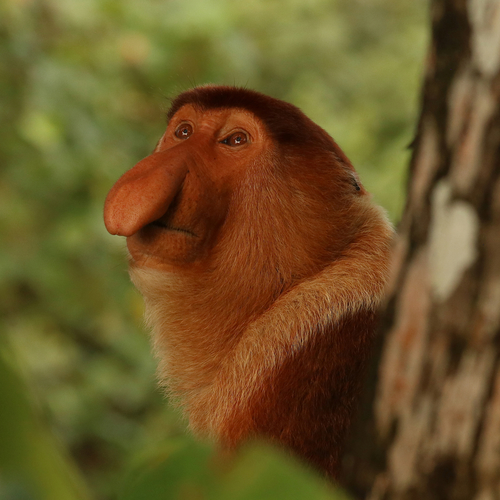
The proboscis monkey or long-nosed monkey is an arboreal Old World monkey with an unusually large nose, a reddish-brown skin color and a long tail. It is endemic to the Southeast Asian island of Borneo and is found mostly in mangrove forests and on the coastal areas of the island.
π‘οΈ Conservation Status
endangered
en
π Taxonomy
The proboscis monkey belongs to the subfamily Colobinae of the Old World monkeys. The two subspecies are:
*N. l. orientalis (Chasen, 1940), restricted to north-east Kalimantan
This animal was made known to Westerners by Baron Friedrich von Wurmb in 1781, he later sent specimens of it to Stamford Raffles in Europe.
π Nose
Further adding to the dimorphism is the large nose or proboscis of the male, which can exceed in length, and hangs lower than the mouth. Theories for the extensive length of their nose suggest it may be sexual selection by the females, who prefer louder vocalisations, with the size of the nose increasing the volume of the call. Nevertheless, the nose of the female is still fairly large for a primate. The skull of the proboscis monkey has specialized nasal cartilages that support the large nose.
Proboscis monkey (Nasalis larvatus) male head.jpg|Male
Proboscis monkey (Nasalis larvatus) female Labuk Bay.jpg|Female
Proboscis monkey (Nasalis larvatus) juvenile Labuk Bay.jpg|Juvenile
Nasalis larvatus Paris 150110.jpg|Nasal cartilages that were left intact in a specimen skull in order to show the structures that support the nose
π Distribution and habitat
The proboscis monkey is endemic to the island of Borneo and can be found in all three nations that divide the island: Brunei, Indonesia and Malaysia. It is most common in coastal areas and along rivers. This species is restricted to lowland habitats that may experience tides. It favors dipterocarp, mangrove and riverine forests.
π Behavior and ecology
===Social behavior===
, from right to left), Labuk Bay, Sabah]]
Proboscis monkeys generally live in groups composed of one adult male, some adult females and their offspring. Some individuals are solitary, mostly males. Monkey groups live in overlapping home ranges, with little territoriality, One-male groups consist of 3 to 19 individuals, Overall, members of the same bands are fairly tolerant of each other. A linear dominance hierarchy exists between females.
π Reproduction
Females become sexually mature at the age of five years. They experience sexual swelling, which involves the genitals becoming pink or reddened. Copulations tend to last for half a minute. When soliciting, both sexes will make pouted faces. In addition, males will sometimes vocalize and females will present their backsides and shake their head from side to side. The young begin to eat solid foods at six weeks and are weaned at seven months old. The nose of a young male grows slowly until reaching adulthood. The mother will allow other members of her group to hold her infant.
π Communication
Proboscis monkeys are known to make various vocalizations. When communicating the status of group, males will emit honks. They have a special honk emitted towards infants, which is also used for reassurance. Males will also produce alarm calls to signal danger. Both sexes give threat calls, but each are different. In addition, females and immature individuals will emit so-called "female calls" when angry. Honks, roars and snarls are made during low-intensity agonistic encounters. Nonvocal displays include leaping-branch shaking, bare-teeth open mouth threats and erection in males, made in the same situations.
π Feeding and activities
As a seasonal folivore and frugivore, the proboscis monkey eats primarily fruit and leaves. Groups usually sleep in adjacent trees. Monkeys tend to sleep near rivers, if they are nearby. Proboscis monkeys will start the day foraging and then rest further inland. Their daily activities consist of resting, traveling, feeding and keeping vigilant. As night approaches, the monkeys move back near the river and forage again. Predators (potential or confirmed) of the proboscis monkey include crocodilians like false gharials and saltwater crocodiles, the Sunda clouded leopard, sun bears and reticulated pythons as well as, for probably young or sickly monkeys, large eagles (such as the crested serpent eagle or black eagle), large owls, and monitor lizards. Monkeys will cross rivers at narrows or cross arboreally if possible. This may serve as predator avoidance.
π Conservation status
The proboscis monkey is assessed as endangered in the IUCN Red List of Threatened Species and listed in Appendix I of CITES. Its total population has decreased by more than 50% in the past 36β40 years to 2008 due to ongoing habitat loss because of logging and oil palm plantations, and hunting in some areas due to the species being treated as a delicacy, as well as its use in traditional Chinese medicine. The population is fragmented: the largest remaining populations are found in Kalimantan; there are far fewer in Sarawak, Brunei and Sabah. The proboscis monkey is protected by law in all regions of Borneo. In Malaysia, it is protected by a number of laws including the Wildlife Protection Act (federal law), the Wildlife Protection Ordinance 1998 (Chapter 26) and Wildlife Conservation Enactment 1997 (Sabah state law).
The proboscis monkey can be found in 16 protected areas: Danau Sentarum National Park, Gunung Palung National Park, Kendawangan Nature Reserve, Kutai National Park, Lesan Protection Forest, Muara Kaman Nature Reserve, Mandor Reserve and Tanjung Puting National Park in Indonesia; Bako National Park, Gunung Pueh Forest Reserve, Kabili-Sepilok Forest Reserve, Klias National Park, Kulamba Wildlife Reserve, Lower Kinabatangan Wildlife Sanctuary, Sungei Samunsam Wildlife Sanctuary and Ulu Segama Reserve in Malaysia.