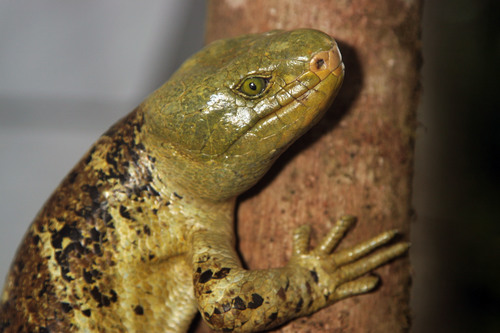
The Solomon Islands skink, also known as prehensile-tailed skink, monkey-tailed skink, giant skink, zebra skink, and monkey skink, is an arboreal species of skink endemic to the Solomon Islands archipelago. It is the largest known extant species of skink.
π Taxonomy and etymology
The Solomon Islands skink was first described by John Edward Gray in 1855 as Corucia zebrata. The generic name Corucia derives from the Latin word meaning "shimmering". This is in reference to Gray's description of "a play of colors effect from the body scales".
The closest living relatives of C. zebrata are the blue-tongued skinks of the genus Tiliqua and skinks of the genus Egernia of Australia, New Guinea, and Indonesia, all of which are also assigned to the subfamily Lygosominae.
π Distribution and habitat
The Solomon Islands skink is native to Papua New Guinea, and the Solomon Islands archipelago, a group of islands in the south-west Pacific Ocean. The common subspecies (C. z. zebrata) is found on the islands of Choiseul, New Georgia, Santa Isabel, Guadalcanal, Nggela, Malaita, Makira, Ugi and Owaraha. The northern subspecies (C. z. alfredschmidti) is known from the islands of Bougainville and Buka and the Shortland Islands. Bougainville and Buka are geographically part of the Solomons Archipelago, though politically part of Papua New Guinea. It commonly occurs in the strangler fig tree (Ficus sp.), provided the epiphytic growth of its several food plants are present. It occurs in trees in semi-cleared areas and cultivated food gardens, again provided its food plants occur there.
π Biology
The Solomon Islands skink is the world's largest species of extant skink; adults can reach a total length (including tail) of when fully grown, with the tail accounting for more than half this length.
The Solomon Islands skink has a long, slender body, strong, short legs, and a triangular shaped head with small round eyes. The skink has a strong crushing jaw but the teeth are small and used for eating plant material. Male Solomon Islands skinks tend to have a broader head and a more slender body shape than female skinks. Males have a V-shaped pattern of scales just aft of the cloacal opening, which is not present in female skinks.
The scales of Solomon Islands skinks are a dark green but are often speckled with light brown or black. The scales on the underside vary from light yellow to different shades of green. The toes on all four legs have thick, curved nails used for climbing and gripping tree limbs.
As a crepuscular animal, it is most active during the dusk and dawn hours, feeding primarily at dusk. it also is active and eats during the hours of dawn, though to a lesser extent. It has quite good eyesight and relies upon it to identify threats, as well as potential food. It relies heavily on its sense of smell and uses it to identify its territory and other members of its group, called a circulus. Like snakes, the skink "smells" by flicking its tongue to gather scents and when the tongue is retracted, it touches it to the opening of a Jacobson's organ at the roof of its mouth.
π Subspecies
The common Solomon Islands skink (C. z. zebrata) has a white sclera with its eyes while the northern Solomon Islands skink (C. z. alfredschmidti) has a black sclera. The iris of the northern Solomon Islands skink is a mix of green and yellow whereas the iris of the common Solomon Islands skink can vary from several different shades of green to orange to a dark black. According to Dr. Gunther KΓΆhler, who described the northern subspecies, this subspecies possesses "larger dorsal and ventral scales" and has "seven instead of usually five parietal scales".
The northern Solomon Islands skink is the shorter of the two subspecies with males averaging and females averaging in total length. The common Solomon Islands skinks are slightly longer with the males averaging and the females averaging in total length. The common Solomon Islands skink, at , weighs more than the northern Solomon Islands skink, which weighs closer to .
π Reproduction
The Solomon Islands skink is one of the few species of reptile that lives in a communal group known as a circulus. The newborn skink is of a large size compared to its mother; the northern Solomon Islands skinks are approximately in length and weigh , whereas the common Solomon Islands skinks are and when they are born. Females exhibit fierce protective behavior around the time of birth; this protectiveness of young is a rare occurrence in reptiles but is shorter in duration when compared to the protective behavior exhibited by a typical mammal.
π Conservation
===Threats===
Extensive logging is a serious ongoing threat to the survival of this species, as is consumption for food by native people, and export demand for the pet trade.
Since there is no regulation on the rapid deforestation occurring in the Solomon Islands, limited export to recognized institutions may be needed to aid this species in genetic diversity for its survival via ex situ breeding programs. According to herpetologists who study the Solomon Islands skink, such as Dr. David Kirkpatrick and Dr. Kevin Wright, captive breeding alone is not practical as a sole method of species survival due to the limited number of offspring and long gestation periods.
π In captivity
The Solomon Islands skink is represented in both public and private collections. The Philadelphia Zoo has bred this species of skink over multiple generations for the past 40 years. The keeping of the Solomon Islands skink in captivity is not without its challenges: as it is a large arboreal tropical animal. It requires a large arboreal enclosure, with a constant temperature between 75β80 degrees Fahrenheit (24β27 degrees Celsius), with heat being provided from above as well as below, allowing the skink to bask in the heat from above as it would during dusk, while providing a radiant heat from below to aid digestion. The dynamics of the skink's circulus means that not all groups do well when new animals are introduced. Despite successful breeding programs, its somewhat unusual nature of single births and slow growth has made these programs challenging.