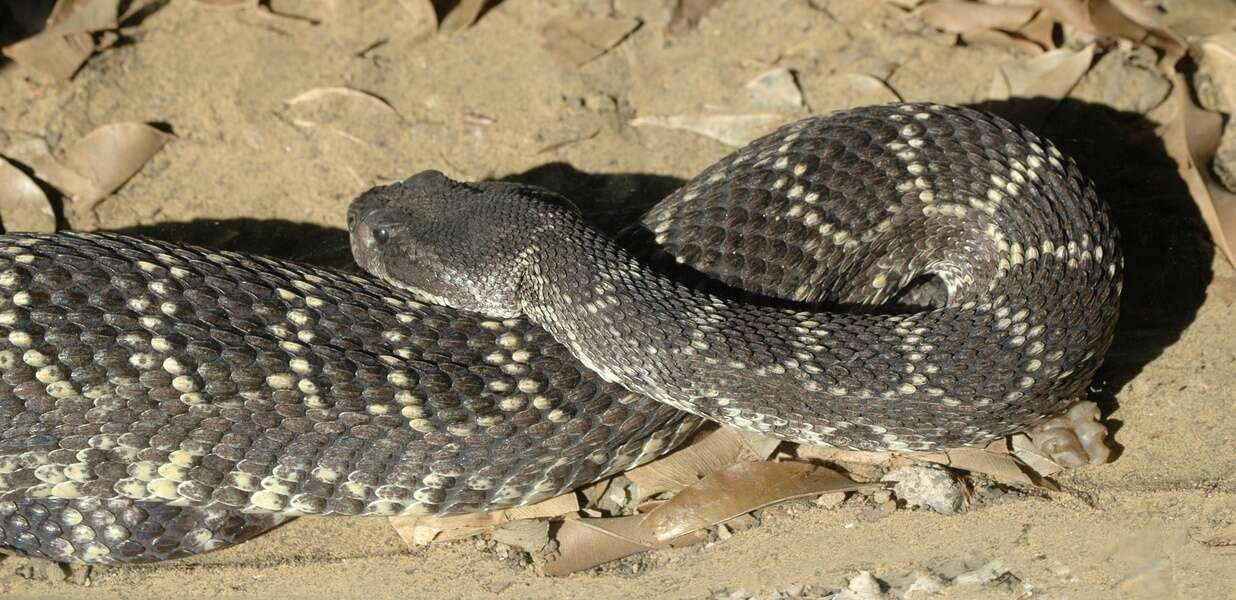
Prairie rattlesnake, Great Plains rattlesnake is a venomous pit viper species native to the western United States, southwestern Canada, and northern Mexico. Currently, two subspecies are recognized, including the prairie rattlesnake, the nominate subspecies, and the Hopi rattlesnake.
📌 Taxonomy
The taxonomic history of this species is convoluted. Previously, seven other C. viridis subspecies were also recognized, including C. v. abyssus, C. v. caliginis, C. v. cerberus, C. v. concolor, C. v. helleri, C. v. lutosus and C. v. oreganus. However, in 2001 Ashton and de Queiroz described their analysis of the variation of mitochondrial DNA across the range of this species. Their results agreed broadly with those obtained by Pook et al. (2000). Two main clades were identified, east and west of the Rocky Mountains, which they argued were actually two different species: on the one hand C. viridis, including the conventional subspecies C. v. viridis and C. v. nuntius, and on the other C. oreganus, including all the other traditional subspecies of C. viridis. The authors retained the names of the traditional subspecies, but emphasized the need for more work to be done on the systematics of C. oreganus.
📌 Distribution and habitat
Prairie rattlesnakes are found in North America over much of the Great Plains, the eastern foothills and some intermontane valleys of the Rocky Mountains, from southwestern Canada through the United States to northern Mexico. In Canada, they occur in Alberta and Saskatchewan; in the US in eastern Idaho, most of Montana, North Dakota, South Dakota, Wyoming, Nebraska, Colorado, Kansas, Oklahoma, Texas, New Mexico, northeastern Arizona, extreme western Iowa, and in Mexico in northern Coahuila and northwestern Chihuahua. Its vertical range is from near the Rio Grande to over in elevation in Wyoming. The type locality is described as "the Upper Missouri [Valley, USA]". An emendation was proposed by H.M. Smith and Taylor (1950) to "Gross, Boyd County, Nebraska." They seem to prefer dry areas with moderate vegetation coverage. Vegetation cover will vary depending on region and subspecies.
📌 Behavior
Prairie rattlesnakes are primarily terrestrial, but occasionally climb in trees or bushes. Some even rest in crevices or caves. They are typically active diurnally in cooler weather and nocturnally during hot weather. This species complex is equipped with powerful venom, using about 20-55 percent of venom in one bite, and will defend themselves if threatened or injured. As with other rattlesnake species, prairie rattlesnakes will rapidly vibrate their tails, which produces a unique rasping sound to warn intruders. Prairie rattlesnakes prefer a straight migration path while migrating even in human-dominated environments because it leads to a higher chance of survival and better body condition throughout and after migration.
The venom of the prairie rattlesnake is a complexly structured mixture of different proteins with enzymes such as proteases and peptidases found among them. Besides the hemotoxin and its tissue destructive effect, the venom also has neurotoxic properties.
📌 Reproduction
Prairie rattlesnakes are viviparous and produce 1-25 young per reproduction event. The average number of young ranges from four to 12, but can vary greatly due to availability of food and environmental conditions. Males may compete for females during the breeding season, but western rattlesnake females may not necessarily breed every year. They give birth in late summer or early fall, female rattlesnakes coming together to birth and care for their young in communal dens. Females have been observed 'babysitting' unrelated juveniles when their mothers require a break, as well as engaging in other social behaviors such as drinking rainwater off of each others' backs. Snakelets are 22–28 cm long. In addition, the young are toxic as soon as they are born. They reach sexual maturity at three years of age.
📌 Conservation status
This species is classified as Least Concern on the IUCN Red List of Threatened Species (v3.1, 2001). Species are listed as such due to their wide distribution, presumed large population, or because they are unlikely to be declining fast enough to qualify for listing in a more threatened category. The population trend was stable when assessed in 2006.
📌 Subspecies
Crotalus viridis nuntius ,
the Hopi rattlesnake, inhabits the United States from northeastern and north-central Arizona, from the New Mexico border to Cataract Creek, including the Little Colorado River basin, the southern section of the Apache Indian Reservation, the Hopi Reservation, and the Coconino Plateau from the southern rim of the Grand Canyon to US Highway 66 in the south.
Crotalus viridis viridis , the prairie rattlesnake, inhabits the North American Great Plains from the Rocky Mountains to 96° W and from southern Canada to extreme northern Mexico, including southwestern Saskatchewan, southeastern Alberta, eastern Washington, Idaho in the Lemhi Valley, Montana east of the higher Rockies, southwestern North Dakota, west, central and extreme southeastern South Dakota, western Iowa, central and western Nebraska, Wyoming except for the Rockies, Colorado, central and western Kansas, Oklahoma, extreme southeastern Utah, northeastern Arizona, New Mexico, western and southwestern Texas, northeastern Sonora, northern Chihuahua, northern Coahuila.