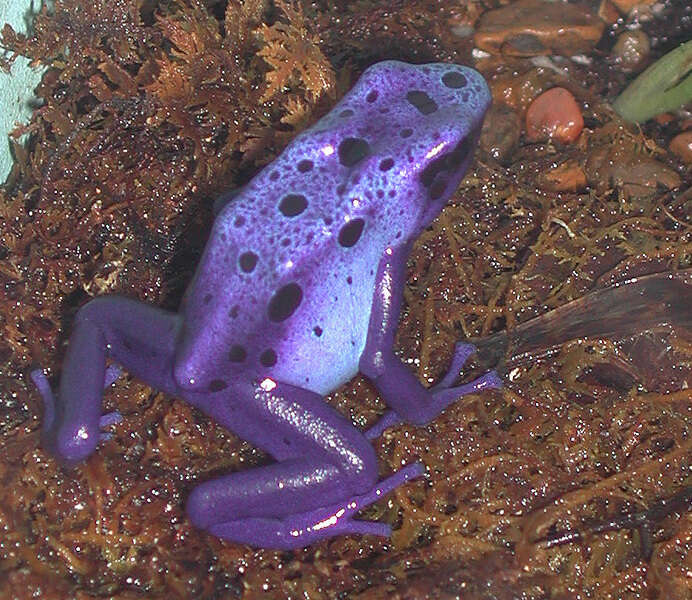
Poison dart frog is the common name of a group of frogs in the family Dendrobatidae which are native to tropical Central and South America. These species are diurnal and often have brightly colored bodies. This bright coloration is correlated with the toxicity of the species, making them aposematic. Some species of the family Dendrobatidae exhibit extremely bright coloration along with high toxicity — a feature derived from their diet of ants, mites and termites— while species which eat a much larger variety of prey have cryptic coloration with minimal to no amount of observed toxicity. Many species of this family are threatened due to human infrastructure encroaching on their habitats.
📌 Characteristics
(Dendrobates tinctorius)]]
Most species of poison dart frogs are small, sometimes less than in adult length, although a few grow up to in length. They weigh on average. Most poison dart frogs are brightly colored, displaying aposematic patterns to warn potential predators. Their bright coloration is associated with their toxicity and levels of alkaloids. For example, frogs of the genus Dendrobates have high levels of alkaloids, whereas Colostethus species are cryptically colored and are not toxic.
Adult frogs lay their eggs in moist places, including on leaves, in plants, among exposed roots, and elsewhere. Once the eggs hatch, the adult piggybacks the tadpoles, one at a time, to suitable water: either a pool, or the water gathered in the throat of bromeliads or other plants. The tadpoles remain there until they metamorphose, in some species fed by unfertilized eggs laid at regular intervals by the mother.
📌 Taxonomy
Dart frogs are the focus of major phylogenetic studies, and undergo taxonomic changes frequently. The family Dendrobatidae currently contains 16 genera, with about 200 species.
{|style="text-align:left; border:1px solid #999;"
|- style="background:#cc9; text-align:center;"
! Genus name and authority!!Common name!!Species
|- style="background:#FFFDFF;"
|Adelphobates ||||
|- style="background:#eee;"
|Andinobates ||||
|- style="background:#eee;"
|Ameerega ||||
|- style="background:#FFFDFF;"
|Colostethus ||Rocket frogs ||
|- style="background:#eee;"
|Dendrobates ||Poison dart frogs ||
|- style="background:#FFFDFF;"
|Ectopoglossus ||||
|- style="background:#FFFDFF;"
|Epipedobates ||Phantasmal poison frogs ||
|- style="background:#eee;"
|Excidobates ||||
|- style="background:#FFFDFF;"
|Leucostethus ||||
|- style="background:#FFFDFF;"
|Hyloxalus || ||
|- style="background:#eee;"
|Minyobates ||||
|- style="background:#FFFDFF;"
|Oophaga || ||
|- style="background:#eee;"
|Paruwrobates || ||
|- style="background:#eee;"
|Phyllobates ||Golden poison frogs ||
|- style="background:#FFFDFF;"
|Ranitomeya ||Thumbnail dart frogs||
|- style="background:#eee;"
|Silverstoneia ||||
|}
📌 Color morphs
Some poison dart frogs species include a number of conspecific color morphs that emerged as recently as 6,000 years ago. Therefore, species such as Dendrobates tinctorius, Oophaga pumilio, and Oophaga granulifera can include color pattern morphs that can be interbred (colors are under polygenic control, while the actual patterns are probably controlled by a single locus). Differing coloration has historically misidentified single species as separate, and there is still controversy among taxonomists over classification.
Variation in predation regimens may have influenced the evolution of polymorphism in Oophaga granulifera, while sexual selection appears to have contributed to differentiation among the Bocas del Toro populations of Oophaga pumilio.
📌 Toxicity and medicine
contains epibatidine]]
The chemical defense mechanisms of the Dendrobates family are the result of exogenous means. Essentially, this means that their ability to defend has come through the consumption of a particular diet – in this case, toxic arthropods – from which they absorb and reuse the consumed toxins. The most toxic of poison dart frog species is Phyllobates terribilis. It is believed that dart frogs do not synthesize their poisons, but sequester the chemicals from arthropod prey items, such as ants, centipedes and mites – the diet-toxicity hypothesis. Because of this, captive-bred animals do not possess significant levels of toxins as they are reared on diets that do not contain the alkaloids sequestered by wild populations. Nonetheless, the captive-bred frogs retain the ability to accumulate alkaloids when they are once again provided an alkaloidal diet. Despite the toxins used by some poison dart frogs, some predators have developed the ability to withstand them. One is the snake Erythrolamprus epinephalus, which has developed immunity to the poison.
Chemicals extracted from the skin of Epipedobates tricolor may have medicinal value. Scientists use this poison to make a painkiller. One such chemical is a painkiller 200 times as potent as morphine, called epibatidine; however, the therapeutic dose is very close to the fatal dose. A derivative, ABT-594, developed by Abbott Laboratories, was named as Tebanicline and got as far as Phase II trials in humans, but was dropped from further development due to dangerous gastrointestinal side effects. Secretions from dendrobatids are also showing promise as muscle relaxants, heart stimulants and appetite suppressants. The most poisonous of these frogs, the golden poison frog (Phyllobates terribilis), has enough toxin on average to kill ten to twenty men or about twenty thousand mice. Most other dendrobatids, while colorful and toxic enough to discourage predation, pose far less risk to humans or other large animals.]]
📌 Conspicuousness
Conspicuous coloration in these frogs is further associated with diet specialization, body mass, aerobic capacity, and chemical defense. Energetic costs of producing toxins and bright color pigments lead to potential trade-offs between toxicity and bright coloration, and prey with strong secondary defenses have less to gain from costly signaling. Therefore, prey populations that are more toxic are predicted to manifest less bright signals, opposing the classical view that increased conspicuousness always evolves with increased toxicity.
📌 Aposematism
Skin toxicity evolved alongside bright coloration, perhaps preceding it. After the switch, the frogs had greater ecological opportunities, causing dietary specialization to arise. Thus, aposematism is not merely a signaling system, but a way for organisms to gain greater access to resources and increase their reproductive success.
📌 Other factors
Dietary conservatism (long-term neophobia) in predators could facilitate the evolution of warning coloration, if predators avoid novel morphs for a long enough period of time. Another possibility is genetic drift, the so-called gradual-change hypothesis, which could strengthen weak pre-existing aposematism.
Sexual selection may have played a role in the diversification of skin color and pattern in poison frogs. With female preferences in play, male coloration could evolve rapidly. Sexual selection is influenced by many things. The parental investment may shed some light on the evolution of coloration in relation to female choice. In Oophaga pumilio, the female provides care for the offspring for several weeks whereas the males provides care for a few days, implying a strong female preference. Sexual selection increases phenotypic variation drastically. In populations of O. pumilio that participated in sexual selection, the phenotypic polymorphism was evident. The lack of sexual dimorphism in some dendrobatid populations however suggests that sexual selection is not a valid explanation.
Functional trade-offs are seen in poison frog defense mechanisms relating to toxin resistance. Poison dart frogs containing epibatidine have undergone a 3 amino acid mutation on receptors of the body, allowing the frog to be resistant to its own poison. Epibatidine-producing frogs have evolved poison resistance of body receptors independently three times. This target-site insensitivity to the potent toxin epibatidine on nicotinic acetylcholine receptors provides a toxin resistance while reducing the affinity of acetylcholine binding.
📌 Behavior
=== Aggressive behavior and territoriality ===
Both male and female Dendrobatidae are territorial and display aggressive behavior, both as tadpoles and adults. Dendrobatidae are especially aggressive in defending regions that serve as male calling sites. After a female courts with a male, they are also very likely to exhibit aggressive behavior towards any females that approach that male. Both the males and females bout their own respective sexes for each other in a fairly similar fashion.
📌 Reproduction
developmental life stages]]
Many species of poison dart frogs are dedicated parents. Many poison dart frogs in the genera Oophaga and Ranitomeya carry their newly hatched tadpoles into the canopy; the tadpoles stick to the mucus on the backs of their parents. Once in the upper reaches of the rainforest trees, the parents deposit their young in the pools of water that accumulate in epiphytic plants, such as bromeliads. The tadpoles feed on invertebrates in their nursery, and their mother will even supplement their diet by depositing eggs into the water. Other poison frogs lay their eggs on the forest floor, hidden beneath the leaf litter. Poison frogs fertilize their eggs externally; the female lays a cluster of eggs and a male fertilizes them afterward, in the same manner as most fish. Poison frogs can often be observed clutching each other, similar to the manner most frogs copulate. However, these demonstrations are actually territorial wrestling matches. Both males and females frequently engage in disputes over territory. A male will fight for the most prominent roosts from which to broadcast his mating call; females fight over desirable nests, and even invade the nests of other females to devour competitor's eggs.
The operational sex ratio in the poison dart frog family is mostly female biased. This leads to a few characteristic behaviors and traits found in organisms with an uneven sex ratio. In general, females have a choice of mate. In turn, males show brighter coloration, are territorial, and are aggressive toward other males. Females select mates based on coloration (mainly dorsal), calling perch location, and territory.
📌 Mating behavior
Observations of the Dendrobatidae family suggest that males of the species typically make their mating call in morning between the times of 6:30 am to 11:30 am. In the majority of cases, the males choose the oviposition site and lead the females there. In some Dendrobatidae species, such as strawberry poison frog, visual cues under high light intensity are also used to identify individuals from the same population. Different species use different cues to identify individuals from their same population during mating and courtship.
📌 Post-mating behavior
Typically in many species the larger portion of parental investment falls on the shoulders of the female sex, whereas the male sex has a much smaller portion. However, it has been studied that in the family of Dendrobatidae, many of the species exhibit sex role reversal in which the females are competing for a limited number of males and the males are the choosers and their parental investment is much larger than the females. This theory also says that the female will typically produce eggs at an exceedingly fast rate that the males cannot possibly take full care of them which then leads to some of the males becoming unreceptive. Dendrobatidae also exhibit the parental quality hypothesis. This is where the females mating with the males try to ensure that their male mates with as few individuals as possible so that their number of offspring is limited, and thus each individual offspring receives a larger portion of care, attention, and resources. However, this creates an interesting dynamic of balance as there is a limited number of males available, and with many females competing for a limited number of males for courtship this makes it difficult to limit the number of individuals a male mates with. Whereas in many species, the competition is flipped in that the competition is prominent among the males, among the Dendrobatidae it is the opposite as the females seem to have a great deal of competition among themselves for males. Females will even take the drastic measures and resort to the destroying of other female's eggs in order to make sure that the male they mated with is receptive and that it scares the male from mating with other females.
📌 Behavior as tadpoles
The poison dart frog is known for its aggressive and predatory behavior. As tadpoles, the individuals of the genus Dendrobates exhibit some unique cannibalistic tendencies, along with many other forms of predatory behavior. Dendrobates tadpoles that either consumed three or more conspecific tadpoles and/or relatively large larvae of the mosquito Trichoprosopon digitatum common in their environment led them to having a much higher growth rate and typically lived much longer lives. Reasons for this behavior could be that predation and aggression was selected for and favored for a few reasons. One reason is to eliminate predators, and the second reason is that it serves as a source of food in habitats that were low in resources. This predation could have evolved over time and led to cannibalism as another form of predatory behavior that had benefitted individuals survival fitness. However, one observation has been noted in the general characteristic of Dendrobates tadpoles including D. arboreus, D. granuliferus, D. lehmanni, D. occultator, D. pumilio, D. speciosus, and many other Dendrobates species is that they have reduced mouth parts as young tadpoles which limits their consumption typically to unfertilized eggs only. Thus, it can be assumed that the cannibalistic tendencies of Dendrobates is limited to their lifetime as a tadpole and does not cross over into their adult life.
📌 Captive care
All species of poison dart frogs are Neotropical in origin. Wild-caught specimens can maintain toxicity for some time (which they obtain through a form of bioaccumulation), so appropriate care should be taken when handling them. While scientific study on the lifespan of poison dart frogs is scant, retagging frequencies indicate it can range from one to three years in the wild. However, these frogs typically live for much longer in captivity, having been reported to live as long as 25 years. These claims also seem to be questionable, since many of the larger species take a year or more to mature, and Phyllobates species can take more than two years.
In captivity, most species thrive where the humidity is kept constant at 80 to 100% and where the temperature is around to during the day and no lower than to at night. Some species tolerate lower temperatures better than others.
📌 Conservation status
Many species of poison dart frogs have recently experienced habitat loss, chytrid diseases, and collection for the pet trade. Some are listed as threatened or endangered as a result. Zoos have tried to counteract this disease by treating captive frogs with an antifungal agent that is used to cure athlete's foot in humans.
📌 Threats
=== Parasites ===
Poison dart frogs suffer from parasites ranging from helminths to protozoans.
📌 Diseases
Poison dart frogs suffer from chytridiomycosis, which is a deadly disease that is caused by the fungus Batrachochytrium dendrobatidis (Bd). This infection has been found in frogs from Colostethus and Dendrobates.
📌 Media
* [http://calphotos.berkeley.edu/cgi/img_query?where-family=Dendrobatidae&where-lifeform=specimen_tag&rel-lifeform=ne&rel-family=eq Dendrobatidae] at CalPhotos
* [http://www.terrarium.tv/videos-dendrobatesazureus.html Terrarium.tv]
Category:Dendrobatoidea
Category:Aposematic species
Category:Taxa named by Edward Drinker Cope
Category:Fauna of the Neotropical realm