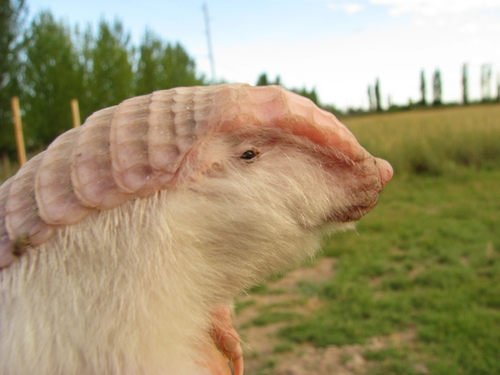
The pink fairy armadillo is the smallest species of armadillo, first described by Richard Harlan in 1825. The pink fairy armadillo is 90–115 mm (3.5–4.5 in) long, and typically weighs about 120 g (4.2 oz). This solitary, desert-adapted animal is endemic to the deserts and scrub lands of central Argentina. The pink fairy armadillo is closely related to the only other fairy armadillo (Chlamyphorinae), the greater fairy armadillo.
📌 Evolutionary origins
Currently, fairy armadillos have the least molecular data available among all families of armadillos. The subfamily Chlamyphorinae includes only two extant species: Chlamyphorus truncatus, the pink fairy armadillo, and Calyptophractus retusus, the greater fairy armadillo. These two species are morphologically similar: both have notably reduced eyes and reinforced forearms that support enlarged digging claws. They are also one of the few mammals that lack visible external ears. Both species are specialized to a subterranean lifestyle which was developed in their ancestral lineage sometime between 32 and 17 Mya. Research conducted in 2009 supported the idea that the three previously identified subfamilies Dasypodinae, Euphractinae, and Tolypeutinae of armadillos, which separated shortly after the Eocene-Oligocene transition, were monophyletic. Chlamyphorinae, the subfamily, including the pink fairy armadillo, was found to display phylogenetic affinities with the clade Tolypeutinae. This was a significant step in defining the previously completely unknown phylogenetic position of this armadillo subfamily within Cingulata.
📌 Range and habitat
Pink fairy armadillos are nocturnal burrowing mammals endemic to the xeric environment in central Argentina. In order for them to survive and maintain stability, they must occupy undisturbed places that contain sufficient amounts of compact sand and hiding places. This also refers to possible captivity conditions for this animal due to its desert-adapted characteristics.
📌 Thermoregulation and external shell
Its fine hair is beneficial for thermoregulation in an environment with highly variable temperatures.
The pink fairy armadillo can curl up to protect the vulnerable soft underside, covered with dense white hair. The armoured shell consists of 24 bands that allow the animal to curl up in a ball, and the armour is flattened in the posterior portion of the animal so that it can compress dirt behind it as it is digging. This compression strategy is thought to help prevent tunnel collapses. Lastly, the shell itself is also thought to help with thermoregulation. Since the underlying blood vessels are so close to the surface, the animal can control the amount of functional surface area exposed to the environment to retain or lose heat. Like most armadillos, they rely mostly on a sense of smell to find each other and their prey.
📌 Burrowing lifestyle
The armadillo has two massive sets of claws on its front and hind limbs, which help it to dig burrows in compacted soil very quickly. The pink fairy armadillo is nicknamed the "sand-swimmer" because it is said that it can "burrow through the ground as fast as a fish can swim in the sea."
Along with these unique traits, the pink fairy armadillo has greatly reduced eyes and relies heavily on touch and hearing to navigate. It also has a torpedo-shaped body that reduces the amount of drag it may encounter while working in tunnels and a thick, hairless tail that it uses for balance and stability while using its other limbs to dig.
📌 Etymology
The genus name comes from Ancient Greek χλαμύς (khlamús), meaning "cloak", and φόρος (phóros), "bearing". The specific epithet truncatus means "maimed" in Latin, referring to the species' truncated plates.
📌 Threats
]]
As a subterranean dweller, the armadillo is forced to leave its burrows when heavy storms roll in due to the threat of drowning and the risk of wetting its fur. If its fur is wet, the armadillo cannot properly thermoregulate and could experience hypothermia during night hours. Once above ground during a rainstorm, the armadillo is vulnerable to an array of predators. Domestic dogs have greatly preyed on these armadillos. Even their underground homes are not completely safe, as fairy armadillos are preyed upon in their burrows by domestic dogs and cats as well as wild boars.
These armadillos do not do well in captivity. The survival rate is so low that many will die in transport from where they were captured to their new area of captivity. Armadillos that are put into captivity typically do not last longer than a few hours or at most eight days. Not a single specimen has survived more than four years. In spite of the high mortality rate associated with captivity, many are sold illegally on the black market, often as pets.
Pink fairy armadillos are highly susceptible to changes in climate, habitat loss, farmland pesticide usage, and overhunting. Because they inhabit temperate and warm regions, cold temperatures could wipe out their populations due to their low metabolism rate and inability to store fat. As their habitat area is increasingly converted to farmland, the armadillos' burrows not only get ploughed over, but the land is no longer habitable for them. The use of pesticides on farmlands is highly concerning because these pesticides adhere to ants, the armadillos' primary source of food. Ingestion of enough of these pesticide-infested ants can be detrimental to their health. Overhunting is one factor that has definitely contributed to the animals' endangerment. Many people in the Americas continue to hunt armadillos for consumption, which is said to be similar to pork in texture and taste.
📌 Conservation efforts
In 2006, the armadillo was placed in the Near-Threatened category on the IUCN Red List. In 2008, it was moved to the Data Deficient category due to the lack of scientific information on its population dynamics and natural history. Field sightings were confirmed to be rare and less common than before, even though the pink fairy armadillo is already difficult to observe due to its nocturnal fossorial lifestyle.
Researchers have found that the pink fairy armadillo is highly susceptible to stress, making the attempts to apply any conservation policies, including taking it out of its natural environment, extremely difficult and largely unsuccessful. Any modifications in its environment, external temperature, or diet are known to trigger stress responses, which are considered to be a possible reason for the failure of captivity attempts.
Many of the armadillos have died during the transportation process from their wild habitat, and many more have only survived several days in captivity. Overall, there are only three reports of captive maintenance of the pink fairy armadillo that are considered successful – in 1970, 1985, and 2009, reporting individuals that lived in captivity for at least 30 months, 22 months, and 8 months, respectively.
This armadillo species is found in several protected areas, including the Lihué Calel National Park. Both national and provincial legislation is in place specifically protecting the species.