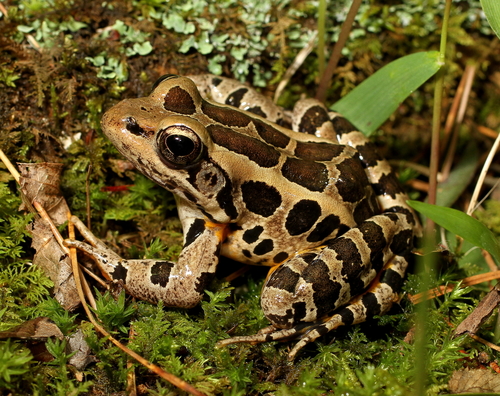
The pickerel frog is a small North American frog, characterized by the appearance of seemingly "hand-drawn" squares on its dorsal surface.
π Distinguishing features
The pickerel frog is a medium sized gray or tan frog marked with seven to twenty-one irregular rectangular dark brown spots which are oriented in two columns down its back. The average number of square markings has been found to vary based on geographic regions. The distinctive rectangular spots of the pickerel frog may blend together to form a long rectangle along the back. All leopard frogs have circular spots. In addition, pickerel frogs have prominent dorsolateral ridges that are unbroken. Another important distinguishing mark is the orange or yellow flash pattern found on the inner surface of the hind legs of pickerel frogs. The frog must be picked up to examine this, as the legs cover the coloration otherwise. The plains leopard frog (Lithobates blairi) exhibits this coloration as well, but the dorsolateral ridges are interrupted and inset medially in that species. The front toes of pickerel frogs are not webbed, a morphological characteristic for some frogs of the genus Rana and some frogs of the genus Lithobates. This allows pickerel frogs to be fit for terrestrial life.
π Sexual dimorphism
Pickerel frogs display sexual dimorphism; the females are typically larger and darker in color than the males. During the summer and breeding season males can be recognized by their swollen thumbs. Males also have internal vocal sacs located between the tympanum and the foreleg. In general, secondary sexual characteristic are not typically evident outside of the breeding season; therefore, pickerel frogs can be rather difficult to sex.
π Range
The pickerel frog ranges in the west from much they are of Wisconsin, southeast Minnesota, eastern Iowa, through Missouri and down to eastern Texas. To the east they extend through northern Louisiana, most of Mississippi, northern Alabama, Georgia, and South Carolina to the coast. Their northern range extends into Canada in the southern reaches of Ontario, Quebec, New Brunswick, and Nova Scotia. The range is spotty through the midwestern states and a field guide should be obtained for the specifics on ranges in a particular area. This frog has also been spotted in Newfoundland and Labrador, Canada.
π Breeding habitat
Pickerel frogs prefer cool, clear water. They breed in both temporary ponds and permanent ponds, but appear to favor ponds with long to permanent hydroperiods. In Rhode Island specifically, pickerel frog tadpoles and egg masses were found in permanent manmade rural ponds, farm ponds, and urban ponds surrounded by roads; all of the mentioned habitats were well-vegetated.
π Reproduction
Pickerel frogs typically emerge from hibernation around mid April with the majority of the frogs arriving at breeding ponds by early May. No fall reproduction has been reported for this species. At the ponds, pickerel frogs are usually observed in large groups in the water. Mating behavior is not much different from other ranids. The males initiate breeding by emitting their low pitched call; this call is usually so low pitched that it is often not heard during calling surveys. Males can alter their call type based on interactions with other males. Males are known to call while submerged, although this is often inaudible in the air. Frogs reproduce by external fertilization while engaging in a behavior called amplexus; sometimes amplexus will last more than a day or two, even after the female has deposited the eggs.
π Egg mass
Egg masses are typically laid in well-vegetated areas and are often difficult to locate. The masses superficially resemble those of wood frogs but at close inspection one can usually distinguish between the two. Pickerel frog egg masses are spherical and about the same size of a wood frog egg massβroughly 5β10 cm in diameterβalthough pickerel frog egg masses contain more eggs, about 2000β3000.
π Larvae
The tadpole stage lasts roughly three months. Small pickerel tadpoles are yellowish to yellowish brown in color; as they grow their color changes to an olive green, which eventually changes to gray brown on top and cream colored underneath. Larger tadpole are often mistaken as green frogs. There are a few characteristics to aid in distinguishing between pickerel and green tadpoles. The nose of the pickerel frog tadpole is more pointed, the eyes are closer together, and the nostrils are closer to the edge of the nose.
π Metamorphs
This is the stage where frogs have all four limbs and are able to walk on land, but still have their tails. They are not quite juvenile frogs. Metamorphs are roughly 2.6 cm long, but they are nearly as agile as the adult and juvenile when they emerge from the ponds. They are often mistaken for the closely related leopard frog. Larger tadpoles complete metamorphosis more efficiently because they used less energy total for the process than smaller tadpoles but energy costs are actually positively correlated with tadpole mass and duration of metamorphosis.
π Defense mechanism
In case of attack, pickerel frogs have an excellent defense mechanism: they emit skin secretions which are irritating to people and toxic to some predators; making the pickerel frog the only poisonous frog native to the United States. A peptidomic analysis of the defensive skin secretion have established the presence of canonical bradykinin and multiple bradykinin-related peptides. Due to its poison, most mammals, birds, snakes and other frogs will leave the pickerel frog alone. The skin secretions of a stressed pickerel frog are known to be toxic to other frogs, as many a novice frog catcher has found when they find only the pickerel frog still alive in their bucket. These secretions can also be moderately irritating if they come in contact with the eyes, mucous membranes, or broken skin.
The tadpole of this species is considered unpalatable to many species that would commonly predate on tadpoles. They also exhibit behaviors to avoid predation. To avoid fish, the tadpoles will move to stream margins in order to make them inaccessible to the fish. The tadpoles will also reduce activity after sensing a fish's chemical cues.
π Predators
The pickerel frog's poisonous secretions cannot stop all creatures; green frogs, bull frogs, northern water snakes, eastern ribbon snakes, and common garter snakes are their usual predators. When threatened, pickerel frogs will jump into the water and dive to the bottom to escape predators like birds and snakes.