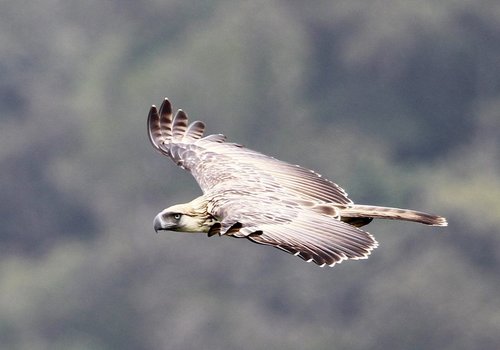
The Philippine eagle, also known as the monkey-eating eagle or great Philippine eagle, is a critically endangered species of eagle of the family Accipitridae which is endemic to forests in the Philippines. It has brown and white-colored plumage, a shaggy crest, and generally measures 86 to 102 cm in length and weighs 4.04 to 8.0 kg.
🛡️ Conservation Status
critically endangered
cr
📌 Names
The Philippine eagle has numerous native names in the Philippine languages. These include and (a Spanish loanword) in Tagalog; or in the Visayan languages; or in Maranao and Maguindanao; in Subanen; and or in the Manobo languages, Klata, Tagabawa, Mandaya, and Kalagan. Some of these names are also used for other large eagles in general, such as the white-breasted sea eagle (also called in Visayan). In modern Filipino, it is usually referred to as háribon (a portmanteau of "háring ibon", literally "bird king").
📌 Taxonomy
The first European to study the species was the English explorer and naturalist John Whitehead in 1896, who observed the bird and whose servant, Juan, collected the first specimen a few weeks later. These reports gave its generic name, from the Greek (πίθηκος, "ape" or "monkey") and (-φάγος, "eater of"). The species name commemorates Jeffery Whitehead, the father of John Whitehead. In 1995, it was declared a national emblem under President Fidel V. Ramos. This species has no recognized subspecies.
📌 Evolutionary history
A 1919 study of the bird's skeletal features led to the suggestion that the nearest relative was the harpy eagle (Harpia harpyja). The species was included in the subfamily Harpiinae until a 2005 study of DNA sequences which identified them as not members of the group, finding instead that the nearest relatives are snake eagles (Circaetinae), such as the bateleur. The species has subsequently been placed in the subfamily Circaetinae.
📌 Distribution and habitat
's habitat representation in Philippine National Museum.]]
The Philippine eagle is endemic to the Philippines and can be found on four major islands: eastern Luzon, Samar, Leyte, and Mindanao. The largest numbers of eagles reside on Mindanao, with between 82 and 233 breeding pairs. Only six pairs are found on Samar, two on Leyte, and a few on Luzon. It can be found in Northern Sierra Madre National Park on Luzon and Mount Apo, Mount Malindang, and Mount Kitanglad National Parks on Mindanao.
This eagle is found in dipterocarp and mid montane forests, particularly in steep areas. Its elevation ranges from the lowlands to mountains of over . Only an estimated of old-growth forest remain in the bird's range. However, its total estimated range is about .
📌 Ecology and behavior
Evolution in the Philippines, without other predators, made the eagles the dominant hunter in the Philippine forests. The Philippine eagle has a wide range of prey which includes birds, reptiles and mammals (mainly civets and colugos).
Each breeding pair requires a large home range to successfully raise a chick, thus the species is extremely vulnerable to deforestation. Earlier, the territory has been estimated at , but a study on Mindanao Island found the nearest distance between breeding pairs to be about on average, resulting in a circular plot of .
The species' flight is fast and agile, resembling the smaller hawks more than similar large birds of prey. Another captive Philippine eagle lived for 46 years at the Philippine Eagle Center in Davao City. However, wild birds on average are believed to live shorter lives than captive birds.
📌 Reproduction
The complete breeding cycle of the Philippine eagle lasts two years. The female matures sexually at five years of age and the male at seven. Like most eagles, the Philippine eagle is monogamous. Once paired, a couple remains together for the rest of their lives. Even nests have no predators other than humans, as even known nest predators such as palm civets and macaques (being prey species) are likely to actively avoid any area with regular eagle activity.
📌 Conservation
]]
In 1994, the IUCN and BirdLife International listed this species as critically endangered. The IUCN believed that between 180 and 500 Philippine eagles survive in the Philippines. In 2015, about 600 were estimated to be left in the wild. The Zoological Society of London listed the Philippine eagle as the top 15 EDGE species, out of all the world's recorded species, making it the Philippines' most "evolutionary distinct and globally endangered" species.
They are threatened primarily by deforestation through logging and expanding agriculture. Old-growth forest is being lost at a high rate, and most of the forest in the lowlands is owned by logging companies. Charles Lindbergh, best known for crossing the Atlantic alone and without stopping in 1927, was fascinated by this eagle. As a representative of the World Wildlife Fund, Lindbergh traveled to the Philippines several times between 1969 and 1972, where he helped persuade the government to protect the eagle. In 1969, the Monkey-eating Eagle Conservation Program was started to help preserve this species. In 1992, the first Philippine eagles were hatched in captivity through artificial insemination; however, the first naturally bred eaglet was not hatched until 1999. The first captive-bred bird to be released in the wild, Kabayan, was released in 2004 on Mindanao; however, he was accidentally electrocuted in January 2005. Another eagle, Kagsabua, was released in March 2008, but was shot and eaten by a farmer.
Ongoing research on behavior, ecology, and population dynamics is also underway. In recent years, protected lands have been established specifically for this species, such as the of Cabuaya Forest and the of Taft Forest Wildlife Sanctuary on Samar. However, a large proportion of the population is found on unprotected land.
📌 Reintroduction to Leyte
In 2024, the Philippine Eagle Foundation decided to start a project which would involve the transplantation of Philippine eagles in Leyte where this species survives but may have been extirpated as the last records were prior to Typhoon Haiyan (Yolanda) in 2013 which devastated the forests and have had no sightings since then. In June 2024, 2 rescued and non-paired eagles with tracking devices from Mindanao were released. They were released in hopes that they would form a pair but this project faced a significant setback when the male named "Uswag" was found dead at sea. Researchers believed that this eagle got blown off course and drowned at sea. As of October 2024, the female named "Carlito" was documented alive and is hunting and able to fend for itself.
📌 Philippine Eagle Diplomacy
In a June 2019 wildlife loan agreement, a pair of Philippine eagles; (as of 2019) Geothermica, a 15 year old male and Sambisig (meaning one unity) a 17 year old female, were loaned to the Jurong Bird Park Singapore. This was part of conservation efforts for the species and also commemorated 50 years friendship between the Philippines and Singapore. Before the pair were shipped, they were given 2 specially printed passports dedicated to them. The pair were scheduled to stay at Singapore for 10 years as part of the agreement. The move marked the initiation of the government's Philippine Eagle Diplomacy program. As of 2024, Geothermica had died from lung infection, his body now taxidermied at the National Museum, while Sambisig remained in Singapore at the new bird park that replaced Jurong. Despite this setback, Singapore Zoo and the Philippine Eagle Foundation maintain that this breeding program will continue and it will be likely that another possible mate for "Sambisig" will be loaned.
In August 2024, the Philippine Eagle Foundation launched the Philippine Eagle Geothermica's Gateway Project facility as tribute to 19-year-old Geothermica, who died from an Aspergillus molds' fungal infection at the Bird Paradise, Mandai Wild Reserve in September 2022. His sculpture stands in the center of the new facility while his taxidermied body is currently displayed at the National Museum of the Philippines. The PEF partnered with Mandai Wildlife Group, United Architects of the Philippines-Davao City and Kublai Millan for the project.
📌 Folklore
The Manaul, a legendary bird in ancient Bisaya folklore and the namesake for its Bisaya term, was inspired by both the Philippine eagle and the white-bellied sea eagle. The Manaul was responsible for the legendary creation of the islands, pecking giant boulders onto the sea to stop the war between the sky god Kaptan and the sea and underworld god Magwayen.
📌 National symbol of the Philippines
The Philippine eagle was officially declared the national bird of the Philippines on July 4, 1995, by President Fidel V. Ramos under Proclamation No. 615, series of 1995. Due to the eagle's size and rarity, it is also a coveted species for birdwatchers. on January 18, 2021, and on the 5,000-Piso Lapulapu commemorative non-circulating banknote. On December 11, 2021, the Bangko Sentral ng Pilipinas unveiled the design of the new 1,000-Piso polymer banknote featuring the bird as the main portrait, controversially replacing those of three World War II martyrs: Chief Justice José Abad Santos, suffragist Josefa Llanes Escoda, and General Vicente Lim.
The Philippine eagle is also used in sporting events as a mascot, most notably one in the 2005 Southeast Asian Games held in Manila known as "Gilas". The Philippine eagle is also the animal used in the Philippines men's national basketball team or Gilas Pilipinas' logo/team crest.
📌 Conservation
Historically, about 50 Philippine eagles have been kept in zoos in Europe (England, Germany, Belgium, Italy and France), the United States, and Japan. The first was a female that arrived in London Zoo in August 1909 The majority arrived in zoos between 1947 and 1965.