🛡️ Conservation Status
vulnerable
vu
📌 Taxonomy
The dwarf pufferfish was first described as Tetraodon (Monotretus) travancoricus in 1941 by S.L. Hora and K.K. Nair, The justification for moving to Carinotetraodon was based largely on osteological evidence and not on the presence of skin keels, which other members of the genus have, but which had not been confirmed in dwarf pufferfish until one year later in aquarium literature.
The following cladogram is based on molecular evidence and demonstrates the polyphyletic nature of the genus Carinotetraodon. A polyphyletic genus is one in which members share common characteristics, but do not necessarily share an immediate common ancestor, and their placement is based on these shared traits rather than confirmed, empirical evidence. "Carinotetraodon" is represented in quotation marks to signify its polyphyletic status. Freshwater species are denoted with "FW". The cladogram is incomplete due to the absence of species like C. imitator, which have not undergone mitogenome analyses.
}}
|label2=
|2=
}}
}}
}}
|label2=
|2=
|label2=
|2=
}}
}}
|label2=
|2=
|label2=
|2=
}}
}}
}}
}}
}}
|label3=
|3=
|label2=
|2=
}}
|label2=
|2=
|label2=
|2=
}}
}}
}}
}}
}}
📌 Natural defenses
All pufferfish can inflate, or "puff up", their bodies by quickly ingesting large amounts of water (or air when necessary) into their highly elastic stomachs. Inflating tires pufferfish and can put them at greater risk of predation. These spines become erect when the fish is inflated. The neurotoxin accumulates in the glands of the epidermis (surface layer of skin), ovaries, and livers of pufferfish. These traits are anti-predator adaptations. The pufferfish's ability to inflate makes it difficult to swallow or bite, and the tetrodotoxin makes it unpalatable or even deadly for other fish. Biologists believe these adaptations evolved because of the slow swimming speeds of pufferfish.
📌 Resemblance to ''Carinotetraodon imitator''
Carinotetraodon imitator is a species of related pufferfish closely resembling dwarf pufferfish. They are of similar size, shape, patterns, and colouration. Both species are found within the same region and may be sympatric, possibly inhabiting the same waters. Until 1999, C. imitator was mistaken as the same species, and the two could be found together in aquaria and were widely available in the international aquarium trade, both sold as dwarf pufferfish. Dwarf pufferfish can be distinguished from their congener (a member of the same genus), as C. imitator have smaller, faint blotches compared to dwarf pufferfish, as well as greatly reduced body spination. Male dwarf pufferfish have a darker yellow colouration and an iridescent "eye wrinkle" not found in males of C. imitator.
📌 Distribution and habitat
Although closely related to marine pufferfish, they are not found in salt water, and reports to the contrary are based on misidentification. Dwarf pufferfish are one of only 27 known species of Tetraodontidae adapted to freshwater. They are a potamodromous species, meaning they migrate within freshwater river systems, and are endemic to rivers, lakes, and estuaries They can be found in waters with a pH of 7.5–8.3 and temperatures of . the Nilambur harbours, and Kallar Stream, part of the Neyyar Wildlife Sanctuary. They have been reported as rare in Bharathapuzha and the Nilgiri Biosphere Reserve. The species was also found in inundated brickyards in Puthukkad, as well as ditches, ponds, irrigation channels, and artificial tanks or abandoned water bodies in paddy fields. Their presence in small, isolated water bodies is likely due to unintentional dispersal by waterfowl.
📌 Conservation status
Several researchers have considered the species endangered, though with no rationale provided. The dwarf pufferfish is officially classified as vulnerable on the IUCN Red List due to declining populations because of damming, indiscriminate deforestation for agriculture, pollution from wastewater, and, primarily, overfishing for the aquarium trade.
📌 Diet and behaviour
Dwarf pufferfish are euryphagous carnivores in that they consume a wide variety of animals. Dwarf pufferfish favour insect larvae but will rely on crustaceans and annelids as alternate feed when the availability of preferable prey decreases. Dwarf pufferfish are commonly associated with plants in the genus Cabomba, and the presence of these plants has been shown to reduce mortality among captive specimens.
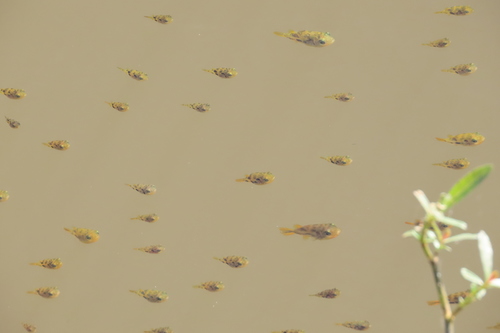
Dwarf pufferfish are a slow-swimming, dwarf pufferfish are found in large shoals, occasionally consisting of hundreds of individuals.
📌 Reproduction
In the wild, males with ripe gonads have been found during all months of the year but December and January, with the peak spawning period extending from May to August, concurring with the South-West monsoon period. Within the Pamba River, the minimum size at which half the population becomes sexually mature is approximately . Environmental and dietary conditions may influence the maturation rate of individuals. There is little information on what the larvae eat in the wild. Hatched larvae are a mean of total length, with eyes incompletely developed and the body a red-brown. The yolk sac is consumed in four days, and the larvae commence swimming after six days, at which point their eyes are completely developed.
There is no information available on the lifespans of these fish in the wild, but aquarists report specimens live for approximately five years in captivity.
📌 Association with humans
When first described in 1941, K. Nair noted that dwarf pufferfish were a favourite of children, who would catch and use the fish as playthings. are not a food fish, and are only valued as ornamental fish in aquaria. The dwarf pufferfish is also one of the few aquarium fish to regularly eat small, live snails and thus can be helpful in controlling snail populations.