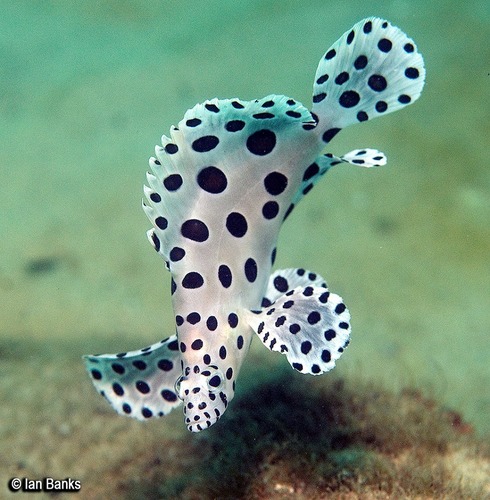
The humpback grouper, also known as the panther grouper, barramundi cod, lapu-lapung senorita, miro-miro, mérou de Grace Kelly, sarasa-hata, kalava, and many other local names, is a species of marine ray-finned fish. Specifically, it is a grouper from the subfamily Epinephelinae, which is in the family Serranidae, which also includes the anthias and sea basses. It occurs in the Western Pacific Ocean.
📌 Systematics
The humpback grouper was first formally described as Serranus altivelis in 1828 by the French zoologist Achille Valenciennes (1794–1865) with the type locality given as Java. In 1839, the English naturalist William Swainson (1789–1855) placed it in the subgenus Chromileptes, which was later created as a monotypic genus.
📌 Genetics
Genetic research has revealed the species to have missing genes relating to immunity and the MAPK signal pathway, which may affect the species' disease resistance and growth traits.
Artificial insemination of C. altivelis eggs with giant grouper (E. lanceolatus) sperm created intergeneric hybrids. The hybrids had 1.6x faster growth rate than the humpback grouper, 4.7% increased meat yield, yet was more morphologically similar to E. lanceolatus.
📌 Distribution and habitat
[[File:Cromileptes_altivelis_distribution.png|thumb|Cromileptes altivelis native distribution
The humpback fish has a preferendum temperature of 24.5 C, similar to other cool, temperate, freshwater fishes.
📌 Non-native distribution
In Florida, the grouper was first recorded to be observed in 1984, with the last recorded observation in 2012. Throughout Florida, it has been spotted in Tampa Bay, Pompano Beach, and West Beach. It was a large specimen, with a size of , and weight of . Although there are fears of the humpback grouper becoming invasive in North America, there remains no current breeding populations within the western Atlantic as of 2013. Despite this, researchers have pointed out Florida towns Jupiter and Vero Beach as likely spots for this species to establish.
The humpback grouper has a short history of being introduced in Hawaii, being first observed in 1991. It has since been extirpated, with the last observation in 2005.
There has been one recording of the humpback grouper spotted in Kenya.
📌 Biology and ecology
=== Life cycle and behaviour ===
This species is a protogynous hermaphrodite; in other words, all individuals are born female, with the ability to transform to males as they grow older. Female humpback groupers start transitioning to males as early as 3 years. By the age of 9, most humpback groupers are male. with a single spawn event lasting from 4 to 8 days.
📌 Disease
With live fish markets potentially acting as a transmitter of disease, this species has been commonly blamed for ciguatera fish poisoning cases. Ciguatera fish poisoning comes from consuming a fish with ciguatoxins, and the humpback grouper, amongst many other predatory fish, can easily accumulate ciguatoxins. Because of this, ciguatera 'hotspots' surrounding these markets have been a concern for human health.
The humpback grouper is also known to be able to carry many pathogens, including Hirudinea, Pasteurella, grouper iridoviruses, and more. Iridovirus is a leading cause of mortality in groupers kept in captivity, which causes lethargic swimming, darker body coloration, anemia, and more.
📌 Conservation
The humpback grouper has been given the Data Deficient status by the IUCN. It is a highly valued food fish, especially in Southeast Asia where it is also overexploited. It is bred in aquaculture, but there is no evidence that captive breeding has reduced the fishing pressure on wild populations. Despite this, it is suspected that the population has declined historically.
Australia has put strong conservation measures in place for this species (no take species on the Great Barrier Reef and strict possession limits elsewhere, e.g. Western Australia). Size limits apply in commercial fisheries such as the Torres Strait reef line fishery. However, it is lacking protection elsewhere.
Other potentially effective management techniques to preserve the humpback grouper would be implementing size limits, no-take areas, and increasing effort control.
📌 Aquaculture
Although the mariculture of this species has been regarded to be in a primitive stage, the humpback grouper remains to be a popular fish in US aquariums, live fish markets throughout Asia,
📌 Live fish markets
The humpback grouper is a popular fish amongst live fish markets, mainly throughout Asia, but more so in Hong Kong. Within the Hong Kong live fish markets, groupers made the majority of the sales in the 1990s.
Hatchery-produced groupers are susceptible to having poorly functioning swim bladders, causing juveniles to circle on the surface until death, with the mortality rate ranging from 20 to 30% from this condition.
📌 Rearing
When collecting eggs from this species for aquaculture, buoyant eggs are selected, and are usually 0.80–0.83 mm in diameter. From the wild, juveniles are often chosen.Newly hatched humpback groupers are sensitive, and, because of this, handling during this period is taken with care. Larvae are stocked into dark culture tanks before hatching to reduce 'shock syndrome', which is a cause of mortality due to dramatic physical changes like water disturbances, or bright light. The culture tanks are also usually stocked with microalgae (such as Nannochoropsis oculata or Tetraselmis sp.) which functions as shade, but also provides food and nutrition. Cannibalism is also a major cause of mortality during later stages, which could be reduced by handling fish into similarly sized tanks, but handling could induce shock syndrome.
In terms of feeding, there remains low interest to develop specialized food diets for the small humpback grouper market. Because of this, humpback groupers are often fed 'trash fish,' which are low-value, bycatch fish species. However, feeding juveniles with copepod nauplii has shown some promise to increase growth rates.
📌 Socioeconomic effects
Grouper aquaculture has remained popular throughout Southeast Asia because of the accessibility of materials. In Bali, 'backyard' hatcheries contributed to economic development, with an increased profit compared to more traditional local agricultural paths such as coconut plantations. In the Philippines, grouper aquaculture is profitable due to less capital investment compared to the common milkfish aquaculture.
Despite this, production is likely to remain low. Because of the slow growing humpback groupers, farmers are likely to mainly focus on faster growth fish.