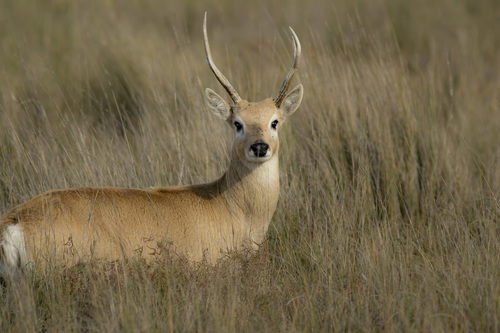
The Pampas deer is a species of deer that live in the grasslands of South America at low elevations. They are known as veado-campeiro in Portuguese and as venado or gama in Spanish. It is the only species in the genus Ozotoceros.
🛡️ Conservation Status
near threatened
nt
📌 Taxonomy and evolution
Fossil records indicate that New World deer traveled to South America from North America as part of the Great American Interchange around 2.5 million years ago, following the formation of the Isthmus of Panama. They rapidly evolved into different species, with only a few surviving today. Due to the large continental glaciers and the high soil acidity in areas where there were no glaciers, a huge part of the fossil record has been destroyed, so there is no indication of what these early New World deer looked like. Fossil records begin with clear differentiation and are close to what they look like now. The Pampas deer evolved as a plains animal; their direct ancestor first appeared during the Pleistocene epoch.
The deer may have evolved without culling predators, as, when alarmed, they do not flee immediately but rather stamp their feet (like many deer), have a particular trot and whistle, and deposit odor.
* O. b. bezoarticus - eastern and central Brazil, south of the Amazon river into Uruguay
* O. b. arerunguaensis - northwestern Uruguay
* O. b. celer - Southern Argentina, to La Pampa and Buenos Aires Province.
* O. b. leucogaster - southwestern Brazil, southeastern Bolivia, Paraguay, and northern Argentina
* O. b. uruguayensis - eastern Uruguay
Pampas deer are among the most genetically polymorphic mammals. Their current high nucleotide diversity shows that they had very large numbers in the recent past.
📌 Physical characteristics
Pampas deer have tan fur, lighter on their undersides and insides of legs. Their coats do not change with the seasons. They have white spots above their lips and white patches on their throats. Their tails are short and bushy, 10 cm to 15 cm long, and when they run, they lift their tail to reveal a white patch, just like white-tailed deer. Males have a strong smell secreted from glands in their back hooves that can be detected up to 1.5 km away.
📌 Biology and behavior
In Argentina, the mating season is December to February. In Uruguay, the mating season is February to April. Courtship behavior is submissive, such as low stretching, crouching, and turning away. The male initiates courtship with a low stretch. He makes a soft buzzing sound. He nuzzles the female and may flick his tongue at her, and averts his eyes. He stays near her, and may follow her for a long time, smelling her urine. Sometimes the female responds to courtship by lying on the ground.
Pampas deer do not defend territory or mates, but do have displays of dominance. They show dominance by keeping their heads up and trying to keep their side forward, and use slow, deliberate movements. When bucks are challenging each other, they rub their horns into vegetation and scrape them on the ground. They may urinate into the scrape they've made, and sometimes defecate. They rub the scent glands on their heads and faces into plants and objects. They usually do not fight, but just spar with each other, and they do commonly bite. Sparring is initiated by the smaller buck touching noses with the larger buck.
Groups are not separated by sex, and bucks will drift between groups. There are usually only 2–6 deer in a group, but there can be many more in good feeding areas. They do not have monogamous pairs, nor are there harems.
When they feel they may be in danger, they hide low in the foliage and hold, and then bound off about 100–200 meters, often looking back at the disturbance. Because they bound in long flat jumps and have not been observed to run, they are not thought to be endurance runners. If they are alone, they may just quietly slip away. Females with a fawn will fake a limp to distract a predator, or if they are unsure of a situation, such as if a human appears.
They will often stand on their hind legs to reach food or see over something. They are sedentary, with no seasonal or even daily movements. They usually feed regularly during the day, but sometimes have nocturnal activity.
The Pampas deer are very curious and like to explore. Although this is endearing to observers, their lack of fleeing at the sight of humans makes them easier for poachers to kill.
📌 Reproduction and calves
Fawns can be seen at any time of year, but there is a peak in September and November. Females separate themselves from the group to give birth, and keep the fawn hidden away. After giving birth, the female goes into heat and usually mates within the next 48 hours. The fawns are small and spotted, and lose their spots at about two months old. Usually only one fawn weighing about 2.2 kg is born after a gestation period lasting over seven months. At six weeks, they can eat solid food and begin to follow their mother. They stay with their mothers for at least a year, and also reach sexual maturity at about a year.
📌 Conservation
, Uruguay (2015)]]
The Pampas deer of southern Argentina, once very abundant, are now considered a threatened species by the IUCN. The IUCN separates the subspecies O. b. celer in southern Argentina as endangered. The diseases that particularly plague O. b. celer are gut parasites and foot and mouth diseases. Their overall decline is also due (in part) from hunting and poaching, but also from agricultural habitat loss (thus exposing deer to diseases from domesticated and feral livestock), competition from more recently-introduced wildlife, and general over-exploitation. There is less than 1% of their natural habitat left that was present in 1900.
📌 Relations with humans and culture
Over the centuries, especially since European colonization, Pampas deer have been harvested in their millions. In the 1860s, documents for the Port of Buenos Aires indicate that some two million Pampas deer pelts were sent to Europe during the decade, alone. Many years later, as infrastructure was being built throughout the pampas, roads and automobiles made hunting even easier. The deer were also killed for food, medicinal purposes, and purely for sport. As of 2003, there are fewer than 2,000 Pampas deer in Argentina and Uruguay. Both countries have declared the species to be a "natural monument" and yet the hunting continues, albeit somewhat less frequently.
The decline of the Pampas deer has been likened to that of the once-plentiful bison of North America, as the deer were once far greater in number, and held a similar place in the survival and spirituality of the native peoples of the region, including the Guaraní. The deer were revered; not only were they hunted, their carcasses blessed, and spirits thanked for their sacrifice, but the entire animal would be utilized for food, building materials, weapons, clothing, medicine, and more. Historically, the native peoples of northern Argentina, Paraguay and Uruguay participated in the sale of Pampas deer pelts for export, and yet the animals persevered until European powers ultimately took over. The settlers brought with them mass agricultural expansion and uncontrolled, unregulated hunting of wildlife, as well as new, lethal pathogens with the arrival of domesticated livestock. Escaped farm animals formed feral populations, thus competing with the Pampas deer and other local species for resources, in addition to exposing them to potential new diseases.
Some landowners have set aside areas of their properties as undisturbed or native habitat for the deer, as well as keeping cattle instead of sheep or goats; sheep and goats compete more directly with the deer as they also browse on shrubbery and tall vegetation, far more than the grazing cattle. The landowners that choose cattle are doing it as a service, however, as sheep are far more lucrative to raise than cattle. Conservationists encourage this trend, sharing research that more edible vegetation is available on ranches with cattle and deer during times of drought than on ranches with cattle and sheep.