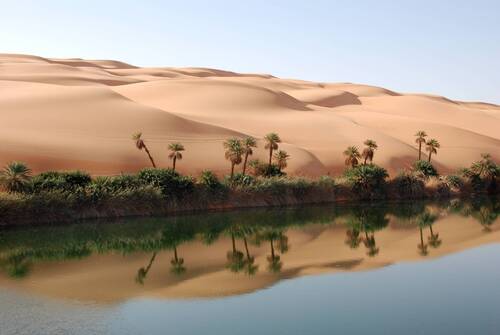
The Arecaceae are a family of perennial, flowering plants in the monocot order Arecales. Their growth form can be climbers, shrubs, tree-like and stemless plants, all commonly known as palms. Those having a tree-like form are colloquially called palm trees. Currently, 181 genera with around 2,600 species are known, most of which are restricted to tropical and subtropical climates. Most palms are distinguished by their large, compound, evergreen leaves, known as fronds, arranged at the top of an unbranched stem, except for the Hyphaene genus, which has branched palms. However, palms exhibit an enormous diversity in physical characteristics and inhabit nearly every type of habitat within their range, from rainforests to deserts.
📌 Etymology
The word Arecaceae is derived from the word areca with the suffix "-aceae". Areca is derived from Portuguese, via Malayalam അടയ്ക്ക (aṭaykka), which is from Dravidian *aṭ-ay-kkāy ("areca nut"). The suffix -aceae is the feminine plural of the Latin -āceus ("resembling").
Palm originates from Latin palma semantically overlapping with sense of "hand front" (due to similar splayed shape) ultimately from Proto-Indo-European *pl̥h₂meh₂, a direct descendant once existed in Old English.
📌 Morphology
Whether as shrubs, tree-like, or vines, palms have two methods of growth: solitary or clustered. The common representation is that of a solitary shoot ending in a crown of leaves. This monopodial character may be exhibited by prostrate, trunkless, and trunk-forming members. Some common palms restricted to solitary growth include Washingtonia and Roystonea. Palms may instead grow in sparse though dense clusters. The trunk develops an axillary bud at a leaf node, usually near the base, from which a new shoot emerges. The new shoot, in turn, produces an axillary bud and a clustering habit results. Exclusively sympodial genera include many of the rattans, Guihaia, and Rhapis. Several palm genera have both solitary and clustering members. Palms which are usually solitary may grow in clusters and vice versa.
Palms have large, evergreen leaves that are either palmately ('fan-leaved') or pinnately ('feather-leaved') compound and spirally (-alternately) arranged at the top of the stem, with the sole exception of the king raphia (Raphia vinifera variety nigerica) which has opposite pairs of fronds. The leaves have a tubular sheath at the base that usually splits open on one side at maturity. The inflorescence is a spadix or spike surrounded by one or more bracts or spathes that become woody at maturity. The flowers are generally small and white, radially symmetric, and can be either uni- or bisexual. The sepals and petals usually number three each and may be distinct or joined at the base. The stamens generally number six, with filaments that may be separate, attached to each other, or attached to the pistil at the base. The fruit is usually a single-seeded drupe (sometimes berry-like) but some genera (e.g., Salacca) may contain two or more seeds in each fruit.
.]]
Like all monocots, palms do not have the ability to increase the width of a stem (secondary growth) via the same kind of vascular cambium found in non-monocot woody plants. This explains the cylindrical shape of the trunk (almost constant diameter) that is often seen in palms, unlike in ring-forming trees. However, many palms, like some other monocots, do have secondary growth, although because it does not arise from a single vascular cambium producing xylem inwards and phloem outwards, it is often called "anomalous secondary growth".
The Arecaceae are notable among monocots for their height, and for the size of their seeds, leaves, and inflorescences. Ceroxylon quindiuense, Colombia's national "tree", is the tallest monocot in the world, reaching up to tall. The coco de mer (Lodoicea maldivica) has the largest seeds of any plant, in diameter and weighing each (coconuts are the second largest). Raffia palms (Raphia spp.) have the largest leaves of any plant, up to long and wide. The Corypha species have the largest inflorescence of any plant, up to tall and containing millions of small flowers. Calamus stems can reach in length.
📌 Range and habitat
in Palm Canyon, just south of Palm Springs, California, is growing alongside a stream running through the desert.]]
Most palms are native to tropical and subtropical climates. Palms thrive in moist and hot climates but can be found in a variety of different habitats. Their diversity is highest in wet, lowland forests. South America, the Caribbean, and areas of the South Pacific and southern Asia are regions of concentration. Colombia may have the highest number of palm species in one country. There are some palms that are also native to desert areas such as the Arabian Peninsula and parts of northwestern Mexico. Only about 130 palm species naturally grow entirely beyond the tropics, mostly in humid lowland subtropical climates, in highlands in southern Asia, and along the rim lands of the Mediterranean Sea. The northernmost native palm is Chamaerops humilis, which reaches 44°N latitude along the coast of Liguria, Italy. In the southern hemisphere, the southernmost palm is the Rhopalostylis sapida (nīkau), which reaches 44°S on the Chatham Islands where an oceanic climate prevails. Cultivation of palms is possible north of subtropical climates, and some higher latitude locales such as the British Isles and the Pacific Northwest feature a few palms in protected locations and microclimates. In the United States, there are at least 12 native palm species, mostly occurring in the states of the Deep South and Florida.
Palms inhabit a variety of ecosystems. More than two-thirds of palm species live in humid moist forests, where some species grow tall enough to form part of the canopy and shorter ones form part of the understory. Some species form pure stands in areas with poor drainage or regular flooding, including Raphia hookeri which is common in coastal freshwater swamps in West Africa. Other palms live in tropical mountain habitats above , such as those in the genus Ceroxylon native to the Andes. Palms may also live in grasslands and scrublands, usually associated with a water source, and in desert oases such as the date palm. A few palms are adapted to extremely basic lime soils, while others are similarly adapted to extreme potassium deficiency and toxicity of heavy metals in serpentine soils.
📌 Taxonomy
specimens. The characteristic crownshaft and apex shoot, or 'spear', are visible.]]
Palms are a monophyletic group of plants, meaning the group consists of a common ancestor and all its descendants. A few general traits of each subfamily are listed below.
* Subfamily are the largest subfamily with 14 tribes and containing over 100 genera. All tribes have pinnate or bipinnate leaves and flowers arranged in groups of three, with a central pistillate and two staminate flowers.
* Subfamily includes the climbing palms, such as rattans. The leaves are usually pinnate; derived characters (synapomorphies) include spines on various organs, organs specialized for climbing, an extension of the main stem of the leaf-bearing reflexed spines, and overlapping scales covering the fruit and ovary.
* Subfamily has small to medium-sized flowers, spirally arranged, with a gynoecium of three joined carpels.
* Subfamily are the second-largest subfamily with 8 tribes. Most palms in this subfamily have palmately lobed leaves and solitary flowers with three, or sometimes four carpels. The fruit normally develops from only one carpel.
* Subfamily contains only one species, Nypa fruticans, which has large, pinnate leaves. The fruit is unusual in that it floats, and the stem is underground and dichotomously branched, also unusual in palms.
The is the sixth subfamily of Arecaceae in N.W. Uhl and J. Dransfield's 1987 classification. Members of this group have distinct monopodial flower clusters. Other distinct features include a gynoecium with five to 10 joined carpels, and flowers with more than three parts per whorl. Fruits are multiple-seeded and have multiple parts. From the modern phylogenomic data, the Phytelephantoideae are tribe in the Ceroxyloideae subfamily. However, hybridization has been observed among Orbignya and Phoenix species, and using chloroplast DNA in cladistic studies may produce inaccurate results due to maternal inheritance of the chloroplast DNA. Chemical and molecular data from non-organelle DNA, for example, could be more effective for studying palm phylogeny.
Recently, nuclear genomes and transcriptomes have been used to reconstruct the phylogeny of palms. This has revealed, for example, that a whole-genome duplication event occurred early in the evolution of the Arecaceae lineage, that was not experienced by its sister clade, the Dasypogonaceae.
For a phylogenetic tree of the family, see the list of Arecaceae genera.
📌 Selected genera
, South Africa]]
, Pakistan]]
|alt=Pair of young Beccariophoenix alfredii]]
]]
* Archontophoenix—Bangalow palm
* Areca—Betel palm
* Astrocaryum
* Attalea
* Bactris—Pupunha
* Beccariophoenix—Beccariophoenix alfredii
* Bismarckia—Bismarck palm
* Borassus—Palmyra palm, sugar palm, toddy palm
* Butia
* Calamus—Rattan palm
* Ceroxylon
* Cocos—Coconut
* Coccothrinax
* Copernicia—Carnauba wax palm
* Corypha—Gebang palm, Buri palm or Talipot palm
* Elaeis—Oil palm
* Euterpe—Cabbage heart palm, açaí palm
* Hyophorbe—Bottle palm
* Hyphaene—Doum palm
* Jubaea—Chilean wine palm, Coquito palm
* Latania—Latan palm
* Licuala
* Livistona—Cabbage palm
* Mauritia—Moriche palm
* Metroxylon—Sago palm
* Nypa—Nipa palm
* Parajubaea—Bolivian coconut palms
* Phoenix—Date palm
* Pritchardia
* Raphia—Raffia palm
* Rhapidophyllum
* Rhapis
* Roystonea—Royal palm
* Sabal—Palmettos
* Salacca—Salak
* Syagrus—Queen palm
* Thrinax
* Trachycarpus—Windmill palm, Kumaon palm
* Trithrinax
* Veitchia—Manila palm, Joannis palm
* Washingtonia—Fan palm
📌 Evolution
The Arecaceae were the first modern family of monocots to appear in the fossil record around 80 million years ago (Mya), during the late Cretaceous period. The first modern species, such as Nypa fruticans and Acrocomia aculeata, appeared 69 Mya, as evidenced by fossil Nypa pollen. Palms appear to have undergone an early period of adaptive radiation. By 60 Mya, many of the modern, specialized genera of palms appeared and became widespread and common, much more widespread than their range today. Because palms separated from the monocots earlier than other families, they developed more intrafamilial specialization and diversity. By tracing back these diverse characteristics of palms to the basic structures of monocots, palms may be valuable in studying monocot evolution. Several species of palms have been identified from flowers preserved in amber, including Palaeoraphe dominicana and Roystonea palaea. Fossil evidence of them can also be found in samples of petrified palmwood.
The relationship between the subfamilies is shown in the following cladogram:
}}
}}
}}
}}
📌 Uses
]]
fruit at Guntur, India]]
Evidence for cultivation of the date palm by Mesopotamians and other Middle Eastern peoples exists from more than 5,000 years ago, in the form of date wood, pits for storing dates, and other remains of the date palm in Mesopotamian sites. The date palm had a significant effect on the history of the Middle East and North Africa. In the text "Date Palm Products" (1993), W.H. Barreveld wrote:
sharing the top spot with the Poaceae and Fabaceae.
* Several species are harvested for heart of palm, a vegetable eaten in salads.
* Sap of the nipa palm, Nypa fruticans, is used to make vinegar.
* Palm sap is sometimes fermented to produce palm wine or toddy, an alcoholic beverage common in parts of Africa, India, and the Philippines. The sap may be drunk fresh, but fermentation is rapid, reaching up to 4% alcohol content within an hour, and turning vinegary in a day.
* Palmyra and date palm sap is harvested in Bengal, India, to process into gur and jaggery.
* Coconut is the partially edible seed of the fruit of the coconut palm (Cocos nucifera).
* Coir is a coarse, water-resistant fiber extracted from the outer shell of coconuts, used in doormats, brushes, mattresses, and ropes.
* Some indigenous groups living in palm-rich areas use palms to make many of their necessary items and food. Sago, for example, a starch made from the pith of the trunk of the sago palm Metroxylon sagu, is a major staple food for lowland peoples of New Guinea and the Moluccas.
* Palm wine is made from Jubaea also called Chilean wine palm, or coquito palm.
* Recently, the fruit of the açaí palm Euterpe has been used for its reputed health benefits.
* Saw palmetto (Serenoa repens) is being investigated as a drug for treating enlarged prostates.
* Palm leaves are also valuable to some peoples as a material for thatching, basketry, clothing, and in religious ceremonies (see "Symbolism" below).
* Singaporean politician Tan Cheng Bock uses a palm tree-like symbol similar to a Ravenala to represent him in the 2011 Singaporean presidential election. The symbol of a party he founded, Progress Singapore Party, was also based on a palm tree.
* On Ash Wednesday, Catholics receive a cross on their forehead made of palm ashes as a reminder of the Catholic belief that everyone and everything eventually returns to where it came from, commonly expressed by the saying "ashes to ashes and dust to dust."
* In 2024 the Fujairah Research Centre reported the use of date palm leaves to help restore coral reefs as it merged ancient Emerati techniques with modern science.
Image:Dates on date palm.jpg|Fruit of the date palm Phoenix dactylifera
Image:Santa Monica Palm Trees.jpg|Washingtonia robusta palms line Ocean Avenue in Santa Monica, California.
Image:Rodeo Palms -- Manvel, Texas.jpg|Rodeo Palms, a subdivision in Manvel, Texas
File:Palm tree CANA.JPG|Sabal palm in the Canaveral National Seashore
File:Coconut Palm flowers.jpg|Coconut flowers
File:Palm tree top, Georgia, US.jpg|Close-up of the top, Atlantic Ocean, Georgia, U.S.
File:Thumbnail 0EABDEB1-4CA9-4B26-9C05-035B8F9C1221.jpg|Palm Tree Orlando Florida
📌 Endangered species
, a critically endangered species endemic to the Hawaiian Islands]]
Like many other plants, palms have been threatened by human intervention and exploitation. The greatest risk to palms is destruction of habitat, especially in the tropical forests, due to urbanization, wood-chipping, mining, and conversion to farmland. Palms rarely reproduce after such great changes in the habitat, and those with small habitat ranges are most vulnerable to them. The harvesting of heart of palm, a delicacy in salads, also poses a threat because it is derived from the palm's apical meristem, a vital part of the palm that cannot be regrown (except in domesticated varieties, e.g. of peach palm). The use of rattan palms in furniture has caused a major population decrease in these species that has negatively affected local and international markets, as well as biodiversity in the area. The sale of seeds to nurseries and collectors is another threat, as the seeds of popular palms are sometimes harvested directly from the wild. In 2006, at least 100 palm species were considered endangered, and nine species have been reported as recently extinct.
The rarest palm known is Hyophorbe amaricaulis. The only living individual remains at the Botanic Gardens of Curepipe in Mauritius.
📌 Arthropod pests
Some pests are specialists to particular taxa. Pests that attack a variety of species of palms include:
* Raoiella indica, the red palm mite
* Caryobruchus gleditsiae, the palm seed beetle or palm seed weevil
* Rhynchophorus ferrugineus, the red palm weevil, recently introduced to Europe
* Rhynchophorus palmarum, the South American palm weevil
📌 Symbolism
's fold-out paleontological chart in his 1840 Elementary Geology, showing the Palms as the crown of the plant tree of life, alongside Man as the crown of the animal tree of life.]]
The palm branch was a symbol of triumph and victory in classical antiquity. The Romans rewarded champions of the games and celebrated military successes with palm branches. Early Christians used the palm branch to symbolize the victory of the faithful over enemies of the soul, as in the Palm Sunday festival celebrating the triumphal entry of Jesus Christ into Jerusalem. In Judaism, the palm represents peace and plenty, and is one of the Four Species of Sukkot; the palm may also symbolize the Tree of Life in Kabbalah.
The canopies of the Rathayatra carts which carry the deities of Krishna and his family members in the cart festival of Jagganath Puri in India are marked with the emblem of a palm tree. Specifically it is the symbol of Krishna's brother, Baladeva.
In 1840, the American geologist Edward Hitchcock (1793–1864) published the first tree-like paleontology chart in his Elementary Geology, with two separate trees of life for the plants and the animals. These are crowned (graphically) with the Palms and with Man.
Today, the palm, especially the coconut palm, remains a symbol of the tropical island paradise.
Palms appear on the flags and seals of several places where they are native, including those of Haiti, Guam, Saudi Arabia, Florida, and South Carolina.
📌 Other plants
Some species commonly called palms, though they are not true palms, include:
* Ailanthus altissima (Ghetto palm), a tree in the flowering plant family Simaroubaceae.
* Alocasia odora x gageana 'Calidora' (Persian palm), a flowering plant in the family Araceae.
* Aloe thraskii (Palm aloe), a flowering plant in the family Asphodelaceae.
* Amorphophallus konjac (Snake palm), a flowering plant in the family Araceae.
* Beaucarnea recurvata (Ponytail palm), a flowering plant in the family Asparagaceae.
* Begonia luxurians (Palm leaf begonia), a flowering plant in the family Begoniaceae.
* Biophytum umbraculum (South Pacific palm), a flowering plant in the family Oxalidaceae.
* Blechnum appendiculatum (Palm fern), a fern in the family Aspleniaceae.
* Brassica oleracea 'Lacinato kale' (Black Tuscan palm), a flowering plant in the family Brassicaceae.
* Brighamia insignis (Vulcan palm), a flowering plant in the family Campanulaceae.
* Carludovica palmata (Panama hat palm)
* Dasylirion longissimum (Grass palm), a flowering plant in the family Asparagaceae and other plants in the genus Dasylirion.
* Daucus decipiens (Parsnip palm) a flowering plant in the family Apiaceae.
* Dioon spinulosum (Gum palm), a cycad in the family Zamiaceae.
* Dracaena marginata (Dragon palm) a flowering plant in the family Asparagaceae.
* Eisenia arborea (Southern sea palm), a species of brown alga in the family Lessoniaceae.
* Encephalartos transvenosus (Modjadji’s palm) a cycad in the family Zamiaceae.
* Fatsia japonica (Figleaf palm), a flowering plant in the family Araliaceae.
* Heracleum persicum (Tromsø palm), a flowering plant in the family Apiaceae.
* Hypnodendron comosum (Palm tree moss or palm moss), a moss in the family Hypnodendraceae.
* Musa species (Banana palm), a flowering plant in the family Musaceae.
* Pachypodium lamerei (Madagascar palm), a flowering plant in the family Apocynaceae.
* Pandanus spiralis (Screw palm), a flowering plant in the family Pandanaceae and perhaps other Pandanus spp.
* Ravenala (Traveller's palm),
* Yucca filamentosa (Needle palm) and Yucca filifera (St. Peter's palm), flowering plants in the family Asparagaceae.
* Zamia furfuracea (Cardboard palm), a cycad in the family Zamiaceae.
* Zamioculcas zamiifolia (Emerald palm or aroid palm), a flowering plant in the family Araceae.