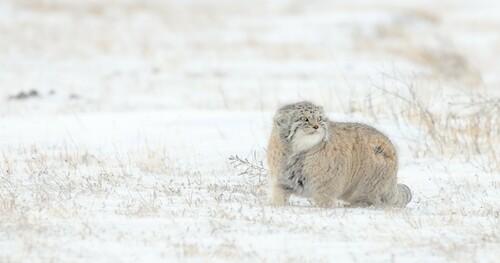
Pallas's cat, also called manul, is a small wild cat with long and dense light grey fur, and rounded ears set low on the sides of the head. Its head-and-body length ranges from 46 to 65 cm with a 21 to 31 cm long bushy tail. It is well camouflaged and adapted to the cold continental climate in its native range, which receives little rainfall and experiences a wide range of temperatures.
📌 Etymology
"Manul" is Pallas's cat's name in the Mongolian language, and it is called "manol" in the Kyrgyz language.
📌 Taxonomy
Felis manul was the scientific name used by Peter Simon Pallas in 1776, who first described a Pallas's cat that he had encountered near the Dzhida River southeast of Lake Baikal.
*Otocolobus manul ferrugineus proposed by Sergey Ognev in 1928 was an erythristic specimen from the Kopet Dag mountains.
Otocolobus was proposed by Johann Friedrich von Brandt in 1842 as a generic name. Reginald Innes Pocock recognized the taxonomic rank of Otocolobus in 1907, described several Pallas's cat skulls in detail and considered Pallas's cat an aberrant form of Felis.
In 1951, John Ellerman and Terence Morrison-Scott considered
*the nominate subspecies Felis manul manul to be distributed from Russian Turkestan to Transbaikalia;
*F. m. nigripecta to be distributed in Tibet and Kashmir;
*O. m. manul syn. O. m. ferrugineus in the western and northern part of Central Asia from Iran to Mongolia;
*O. m. nigripectus in the Himalayas from Kashmir to Bhutan.
📌 Phylogeny
Phylogenetic analysis of the nuclear DNA in tissue samples from all Felidae species revealed that the evolutionary radiation of the Felidae began in Asia during the late Miocene around . Analysis of mitochondrial DNA of all Felidae species indicates a radiation at around .
Pallas's cat is estimated to have genetically diverged from a common ancestor with the genus Prionailurus between based on analysis of nuclear DNA. Based on analysis of mitochondrial DNA, it diverged from a common ancestor with Felis.
|2=Flat-headed cat (P. planiceps) }}
|2=Rusty-spotted cat (P. rubiginosus) }}
|2=Pallas's cat |label2=Otocolobus}}
|2=other Felinae lineages }}
|2=Pantherinae }} }}
|header2=mitochondrial DNA:
|cladogram2=
|2=Pallas's cat }}
|2=
|2=Flat-headed cat }}
|2=Rusty-spotted cat }} }} }}
|2=other Felinae lineages }}
|2=Pantherinae }} }} }}
📌 Characteristics
Pallas's cat's fur is light grey with pale yellowish-ochre or pale yellowish-reddish hues. The forehead and top of the head are light grey with small black spots. It has two black zigzag lines on the cheeks running from the corner of the eyes to the jaw joints.
Pallas's cat is about the size of a domestic cat (Felis catus).
Its body is stout, and its skull is rounded with a short nasal bone, an enlarged cranial part and rounded zygomatic arches. Its orbits are large and directed forward. Its legs are short with short and sharp retractile claws.
The skull of males is long and wide at the base. Females have a long and wide skull.
The mitochondrial genome of Pallas's cat consists of 16,672 base pairs containing 13 protein-coding, 22 transfer RNA and two ribosomal RNA genes and one non-coding RNA control region.
📌 Distribution and habitat
Pallas's cat's range extends from the Caucasus eastward to Central Asia, Mongolia and adjacent parts of Dzungaria and the Tibetan Plateau. It inhabits montane shrublands and grasslands, rocky outcrops, scree slopes and ravines in areas, where the continuous snow cover is below . The typical vegetation in this part consists of small shrubs, sagebrush (Artemisia), Festuca and Stipa grasses. The continental climate in this region exhibits a range of between the highest and lowest air temperatures, dropping to in winter. Records in Azerbaijan are limited to one Pallas's cat skin found in Karabakh and a sighting of an individual in Julfa District, both in the late 20th century.
On the Iranian Plateau, two Pallas's cats were encountered near the Aras River in northwestern Iran before the 1970s. Farther east in the Alborz Mountains, an individual was recorded among rocks at an elevation of in 2016. In the Aladagh and Kopet Dag Mountains, Pallas's cat was recorded inside and in the vicinity of protected areas. In the south of the Zagros Mountains, an individual was caught in a corral used by transhumant pastoralists in Abadeh County in 2012. The surrounding area consists of rocky steppe habitat dominated by mountain almond (Prunus scoparia), Astragalus and Artemisia.
In the Hindu Kush, a Pallas's cat was observed sunbathing at the fringe of a rocky high-elevation plain near Dasht-e Nawar in Afghanistan's Koh-i-Baba range in April 2007. Pallas's cat was also photographed multiple times in Bamyan Province between 2015 and 2017.
In the Transcaspian Region, its presence was first reported in the Kopet Dag mountains and in the vicinity of the Tedzhen and Murghab Rivers in the late 19th century. In Turkmenistan's Sünt-Hasardag Nature Reserve, a camera trap recorded an individual in 2019. Pallas's cat is allegedly also present in Köpetdag Nature Reserve.
Historical records of Pallas's cat are known in the Surxondaryo Region and Gissar Range along the border of Tajikistan and Uzbekistan. In Kazakhstan, it inhabits the highlands and steppes of central and east Kazakhstan Region, the periphery of the Betpak-Dala Desert, the northern Balkhash District and the Tarbagatai Mountains. It is also present in Chagan-Uzun and Argut river basins, Mongun-Taiga, Uvs Lake Basin, Sayano-Shushenski Nature Reserve, Tunkinsky National Park, Lake Gusinoye basin and in the interfluves of the Selenga, Chikoy and Khilok rivers. In the eastern Sayan Mountains, its presence was documented for the first time in 1997. In Transbaikal, it inhabits montane steppes at elevations of , where annual rainfall ranges from . In 2013, an individual was observed on the Vitim Plateau.
Pallas's cat inhabits the semi-desert steppe of Ikh Nartiin Chuluu Nature Reserve in Mongolia. In Khustain Nuruu National Park and Gobi Gurvansaikhan National Park, it prefers rocky and rugged habitats that provides cover and camouflage.
On the Tibetan plateau, two Pallas's cats were observed in undulating alpine meadow amidst plateau pika (Ochotona curzoniae) colonies at in western China's Qumarlêb County in 2001. One of them swam across an irrigation channel. In Gêrzê County, an individual was sighted in desert steppe habitat at an elevation of in 2005. In 2011, Pallas's cat was photographed in an alpine meadow in the core area of Sanjiangyuan National Nature Reserve. In Ruoergai, it was observed at several places in habitat that was frequented by pastoralists and their livestock herds.
The presence of Pallas's cat in the Indian Himalayas was first reported in Ladakh's upper Indus Valley in 1991. In Changthang Wildlife Sanctuary, Pallas's cats were sighted close by riverbanks at elevations of in 2013 and 2015. In Gangotri National Park, a Pallas's cat was photographed in rocky alpine scrub at in 2019. In Sikkim, an individual was observed on a rocky slope at an elevation of in the vicinity of Tso Lhamo Lake in 2007. In Arunachal Pradesh, a Pallas's cat was recorded in September 2024 in the rugged high-elevation rangelands of Tawang and West Kameng districts.
In December 2012, Pallas's cat was recorded for the first time in the Nepal Himalayas. It was photographed in the upper Marshyangdi river valley in alpine pastures at elevations of and in Annapurna Conservation Area. In Shey-Phoksundo National Park, Pallas's cat scat was detected at in 2016, the globally highest record to date.
In January 2012, it was recorded for the first time in Bhutan, namely in rolling hills dominated by glacial outwash and alpine steppe vegetation in Wangchuck Centennial National Park. In autumn 2012, it was also photographed at an elevation of in Jigme Dorji National Park. In 2019, scat samples of two individuals were found in Sagarmatha National Park, providing the first genetic evidence of the cat's presence in the eastern Himalayas.
📌 Behaviour and ecology
Pallas's cat is solitary.
Pallas's cat uses caves, rock crevices and marmot burrows as shelter. The home ranges of 16 females varied from . The home ranges of nine males varied from and overlapped those of one to four females and partly also those of other males. The sizes of their home ranges decreased in winter. Pallas's cats recorded in four study areas in the western Mongolian Altai mountains were also active during the day, but with a lower frequency at sites where livestock was present.
📌 Hunting and diet
Pallas's cat is a highly specialised predator of small mammals, which it catches by stalking or ambushing near exits of burrows. It also pulls out rodents with its paws from shallow burrows. In the Altai Mountains, remains of long-tailed ground squirrel (Urocitellus undulatus), flat-skulled shrew (Sorex roboratus), Pallas's pika (Ochotona pallasi) and bird feathers were found near breeding burrows of Pallas's cats. In Transbaikal, it preys on Daurian pika (Ochotona dauurica), steppe pika (O. pusilla), Daurian ground squirrel (Spermophilus dauricus) and young of red-billed chough (Pyrrhocorax pyrrhocorax). Brandt's vole (Lasiopodomys brandtii) dominated in the diet of Pallas's cats in Mongolia's Sükhbaatar Province after the irruptive growth of this vole population during 2017 to 2020.
Scat found in Shey-Phoksundo National Park contained remains of pika species and of woolly hare (Lepus oiostolus).
📌 Reproduction and life cycle
]]
The female is sexually mature at the age of about one year. She is in estrus for 26 to 42 hours. Gestation lasts 66 to 75 days.
In the wild, the female gives birth to a litter of two to six kittens between the end of April and late May. The newborn kittens' fur is fuzzy, and their eyes are closed until the age of about two weeks.
Two-month-old kittens weigh , and their fur gradually grows longer. They start hunting at the age of about five months and reach adult size by the age of six to seven months.
📌 Threats
In China, Mongolia and Russia, Pallas's cat was once hunted for its fur in large numbers of more than 10,000 skins annually. In China and the former Soviet Union, hunting of Pallas's cat decreased in the 1970s when it became legally protected. Mongolia exported 9,185 skins in 1987, but international trade has ceased since 1988. However, domestic trade of its skins and body parts for medicinal purposes continues in the country, and it may be hunted throughout the year.
Cases of herding dogs killing Pallas's cats were reported in Iran, Kazakhstan and the Altai Republic.
Pallas's cat may be negatively affected by habitat fragmentation due to mining and infrastructure projects.
📌 Conservation
Pallas's cat is classified as Least Concern on the IUCN Red List since 2020 because of its wide-spread range and assumed large global population. It is listed in CITES Appendix II. Hunting it is prohibited in all range countries except Mongolia. Since 2009, it is legally protected in Afghanistan, where all hunting and trade with its body parts is banned. In Turkmenistan, it is proposed to be listed as Critically Endangered due to the scarcity of contemporary records.
📌 In captivity
Between 1951 and 1979, the Beijing Zoo kept 16 Pallas's cats, but they lived for less than three years. In 1984, Pallas's cat was designated as a priority species for captive breeding of the American Association of Zoos and Aquariums's Species Survival Plan. Almost half of the kittens born in member zoos died within the first 30 days, reaching the highest mortality rate in captivity of any small wild cat.
Zoos in the former Soviet Union received most of the wild-caught Pallas's cats from the Transbaikal region and a few from Mongolia. Moscow Zoo initiated a studbook for Pallas's cat in 1997. Since 2004, Pallas's cat international studbook has been managed by the Royal Zoological Society of Scotland, which also coordinates the captive breeding program for Pallas's cat within the European Endangered Species Programme. As of 2018, 177 Pallas's cats were kept in 60 zoos in Europe, Russia, North America and Japan.
In 2011, a female Pallas's cat was artificially inseminated for the first time with semen from the male at the Cincinnati Zoo. After 69 days, she gave birth to four kittens, of which one was stillborn.
📌 In popular culture
Pallas's cat is featured in a Russian Internet meme known as "Pet the cat" introduced in 2008; the meme is a picture of a Pallas's cat that invites the reader to pet it in the image's caption. In 2012, Pallas's cat became the mascot of Moscow Zoo.