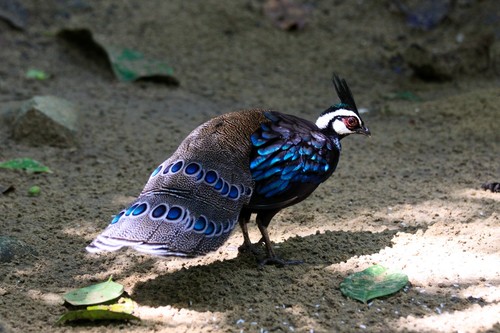
The Palawan peacock-pheasant is a medium-sized bird in the family Phasianidae endemic to the island of Palawan in the Philippines. The spectacular male has a black body with blue marks on the wings, a grayish, finely speckled back and tail with blue peacock "eyes," white marks on the face, and a red eye-ring. Females are mostly brown but with a white face. It is known as tandikan in the some local Palawano, Tagbanwa, and Batak languages of Palawan. It is featured prominently in the culture of the indigenous people of Palawan. The bird is also depicted in the official seal of the city of Puerto Princesa and is in the Philippine one hundred-peso note This species is threatened by habitat loss, the illegal wildlife trade and hunting and is listed as a Vulnerable species by the International Union for Conservation of Nature.
🛡️ Conservation Status
vulnerable
vu
📌 Distribution and habitat
Endemic to the Philippines, the Palawan peacock-pheasant is found in the humid forests of Palawan Island in the southern part of the Philippine archipelago. They are confined to the lowlands and foothills, at elevations normally below above sea level.
📌 Taxonomy
The Palawan peacock-pheasant, with its unique male plumage and distant range, represents a basal (Early? Pliocene, c.5-4 mya) offshoot of the genus Polyplectron (Kimball et al. 2001). The species is widely accepted to be monotypic, but while some males have white supercillia, giving a "double-barred" or masked appearance, others lack this trait, exhibiting dark faces, taller, denser crests and prominent white cheek spots. The birds with white supercillia are sometimes classified as a distinct subspecies, nehrkornae. The white-cheeked form may inhabit deep forest habitat with low ambient light in rolling terrain whilst the masked form appears to inhabit taller, more open forest on flatter terrain with higher ambient light. This masked form exhibits an abbreviated, more tightly compacted and highly iridescent crest. Females of the two respective forms exhibit analogous differentiation. The female of the masked form is more prominently patterned and densely crested with paler contour plumage.
It was long known as Polyplectron emphanum, but the name Polyplectron napoleonis was given one year before and takes priority over the newer name (Dickinson 2001). The species name “emphanum” comes from the Greek “emphaino” and means “showy, conspicuous, remarkable” referring to the splendid look of this bird.
📌 Behavior and ecology
Peacock-pheasants are highly invertivorous, taking isopods, earwigs, insect larvae, mollusks, centipedes and termites as well as small frogs, drupes, seeds and berries.
They are strictly monogamous, renesting yearly. The female usually lays up to two eggs. Both parents rearing chicks for up to two years. Males act as sentinels of nest sites and are highly pugnacious during the reproductive cycle.
Their call is a short high screech, each around 0.5 to 1 second long, and repeated every 5 seconds.
📌 Conservation status
Due to ongoing habitat loss, small population size and limited range as well as hunting and capture for trade, the Palawan peacock-pheasant is classified as Vulnerable in the IUCN Red List of Threatened Species. It is listed on Appendix I of CITES.
depicting a male Palawan peacock-pheasant]]
IUCN has assessed this bird as vulnerable with its population being estimated at 20,000 to 49,999 mature individuals. Forest loss, due to legal and illegal logging, mining and conversion into farmland and urban development, is its main threat. It is also hunted both for the pet trade and for its meat.
The whole of Palawan was designated as a Biosphere Reserve; however, protection and enforcement of laws has been difficult and these threats still continue. It occurs in just one protected area in Puerto Princesa Subterranean River National Park.
This species serves as a Flagship species and is the symbol of the city of Puerto Princesa.
Conservation actions proposed include surveys of remaining lowland forest to understand its true distribution and population status and to propose key sites as protected areas; better control hunting and traping; to assess its ecological requirements, particularly its sensitivity to habitat modification; to support the extension of Puerto Princesa Subterranean River National Park; and to formally protect the forests of Iwahig Prison and Penal Farm. Its also recommended that captive breeding programs.
📌 Works cited
*Dickinson, E. C. (2001): The correct scientific name of the Palawan Peacock-Pheasant is Polyplectron napoleonis (Lesson, 1831). Bull. B. O. C. 121(4): 266–272.
*Kimball, Rebecca T.; Braun, Edward L.; Ligon, J. David; Lucchini, Vittorio & Randi, Ettore (2001): A molecular phylogeny of the peacock-pheasants (Galliformes: Polyplectron spp.) indicates loss and reduction of ornamental traits and display behaviour. Biol. J. Linn. Soc. 73(2): 187–198. [http://www.ingentaconnect.com/content/els/00244066/2001/00000073/00000002/art90536 HTML abstract]
*Lesson, René-Primevère (1831): Traite d'Ornithologie 7:487; 8: 650.
*Temminck, Coenraad Jacob (1832): Nouveau Recueil de Planches coloriées d'Oiseaux 88 plate 540.