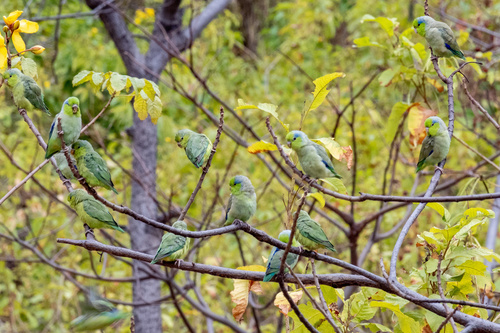
The Pacific parrotlet, also known as Lesson's parrotlet, or the celestial parrotlet, is a species of small parrot in the family Psittacidae.
🛡️ Conservation Status
Appendix II
appendix ii
📌 Distribution and habitat
Wild Pacific parrotlets are native to western Ecuador and northwestern Peru. Most common in dry habitats such as the desert and deciduous forest, but have spread into humid areas in response to deforestation. Pacific parrotlets have also been reported in the middle Marañón valley. Pacific parrotlets are found living in flocks from 40 to 50, on the borders of W lowlands and foothills, woodlands, shrubby clearings, gardens, parks, and crops (Restall & Freile, 2019, p. 208). Pacific parrotlets typically live in subtropical or tropical dry forest, subtropical or tropical moist lowland forest, subtropical or tropical dry shrubland, and heavily degraded former forest. Pacific parrotlets are non-migratory, meaning they stay in the same area year-round.
📌 Conservation
The Pacific parrotlet is currently listed as Least Concern by the IUCN Red List. The number of mature individuals in the wild is not known, but population size seems to be stable.
📌 Social
Pacific parrotlets are found living in flocks from 40 to 50 (Restall & Freile, 2019, p. 208). In captivity they are best kept individually with ample human attention, given their propensity for aggression, but can also be kept as a pair in a very large cage under extreme supervision, as they are very social birds that can benefit from same species companionship, but have violent tendencies under stressful conditions. The cage must be big enough that the weaker bird in the pair can fly away from confrontation when conflict arises. Parrotlets are very easy to emotionally distress and their reactions are dangerous to their health, so keeping them isolated from other parrot species outside of the cage is an absolute must.
When initially introducing two individual birds to become a pair, this must be done gradually over a longer period of time. At first the birds should live in separate cages in the same room, after a while; careful and supervised time together out of the cage, and lastly when a friendship has formed; moving into the large cage for the pair. Preferably none of the birds should have lived in the large cage prior, since this can spark territorial aggression.
📌 Reproduction
Pacific parrotlets are very protective of their eggs and chicks. Each clutch has 4–6 white eggs, which are incubated for an average of 18 days. In the wild they nest in tree cavities or on fence posts. They have also been observed to nest in abandoned nests of necklaced spinetails and pale-legged horneros.
📌 Aviculture
This species is not very common in pet stores and is valued by breeders. Its normal price range is $250 all the way up to US$1200. Since 1930 the U.S. has had an established breeding population in captivity, before CITES laws preventing importing wildlife from foreign countries. In the wild, the average lifespan for Pacific parrotlets is 10.4 years. Captive Pacific parrotlets can exceed this age with good care, proper breeding, and regular veterinary examinations, although individuals may have shorter or longer life spans due to poor breeding practices.
Pacific parrotlets, like many larger parrot species, can learn to "speak", or mimic, though their "voices" are not as clear as larger birds. Their vocabulary is relatively limited compared to larger parrots, although they have been known to learn a few words and phrases.
The species is well known among parrotlet breeders and owners as being feisty and curious despite their small size.
File:Female Blue and Male Green Pacific Parrotlets.jpg|Female blue and male green/wild-type
File:Forpus coelestis -yellow mutation -pet-8d.jpg|Male yellow mutation
File:Forpus coelestis (normal and American white) -AFA show bird-8a.jpg|Male wild-type and female American white/dilute blue
File:Forpus coelestis -Wilhelma Zoo-8a.jpg|Two male wild-types
File:Forpus coelestis -pet on finger -male-8d.jpg|Female wild-type
File:Parrotlet (Fluffy Nuggy) on finger.jpg|A turquoise parrotlet on a finger for size reference.