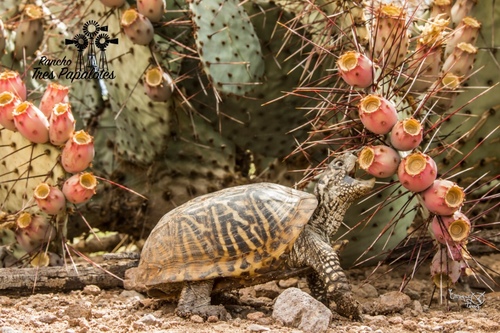
The ornate box turtle is one of only two terrestrial species of turtles native to the Great Plains of the United States. It is one of the two different subspecies of Terrapene ornata. It is the state reptile of Kansas and Nebraska. It is currently listed as threatened in Illinois and is of concern and protected in six Midwestern states.
🛡️ Conservation Status
near threatened
nt
📌 Distribution and habitat
The geographic distribution of the ornate box turtle includes a large part of the Midwest, from Wisconsin to the Gulf of Mexico and from Louisiana to Colorado.
Water is important for this turtle to regulate body temperature in hot weather and to replace body water after hibernation, but they do not spend large amounts of time in flowing or standing water. In the hottest part of the day, the turtle is less active because movement increases body temperature and makes it harder for the turtle to keep cool, and when the temperature is lower(dawn and dusk), the turtle is more active. In Nebraska, winter burrows were dug after October and turtles stayed in them until April and all of these turtles were in individual burrows. Ornate box turtles were two times more likely to be found in the same sub-habitat type as the original and even more likely to be in a sub-habitat next to the original habitat than areas two sub-habitats away.
📌 Lifespan
The lifespan of the ornate box turtle has been reported to be from 32 to 37 years, with studies showing that males occur about half as frequently as females. The shell does increase in size as turtles get older, even though its weight makes it heavy to carry around.
📌 Threats to the ornate box turtle
=== Intrinsic threats – natural occurrences and factors relating to the turtle itself===
Because of its late reproductive age, low reproductive rate, high young mortality, and long lifespan, the ornate box turtle is subject to pressure from intrinsic factors that limit the population growth. which means the gene pool would be too small and cause inbreeding and mortality. The bottleneck effect is a double-edged sword for species that live a long time because the loss of genetic diversity would not be as obvious or as severe, but once it occurred, it would be harder to recover. The other thing about the ornate box turtle's life history that is a problem for its survival is its home range philopatry, which means that it returns to the same area every time and so disruptions in the area make it more vulnerable.
📌 Extrinsic threats – human effects on the ornate box turtle
The ornate box turtle is a terrestrial turtle and terrestrial turtles are sensitive to human causes such as habitat destruction, introduced species, harvest or collection, pollution, and climate change.
Agriculture – agriculture in the Great Plains has been the worst problem for the ornate box turtle recently because it has taken away many acres of land, destroyed habitat, caused more traffic, and created small, isolated areas of prairie. In addition, the small pieces of prairie mean more edge habitats, which causes more predators to live there and that increases predation of the box turtle that is already suffering from less total habitat area. Other agricultural factors that are a problem for the ornate box turtle are fences, water troughs, cattle (trampling), mowing, and other machinery.
Development – houses and other building construction causes loss of habitat similar to agriculture, but also increased removal for pets, predation by dogs, and greater predation to crows and raccoons that increase around human living areas. Where housing developments are built, there are also more roads. The box turtle feeds on carrion when it is available and on roads road-kill is a large source of carrion and a large cause of death of ornate box turtles.
Over-exploitation – very many ornate box turtles have been collected for sale in pet stores, and individuals have always collected some turtles. The commercial trade has had a large effect on the Great Plains populations and if it continues, the result will be a serious decline in turtles.
📌 Conservation efforts
According to the International Union for Conservation of Nature (IUCN), the ornate box turtle is "near threatened." In some states, such as Nebraska, Kansas, and Colorado, the turtle is "secure"; but in South Dakota, it is listed as "imperiled"; and in Wyoming, it is listed as "critically imperiled." and isolated habitat areas have isolated groups of turtles that lose genetic diversity and experience bottlenecks that decrease their survival.