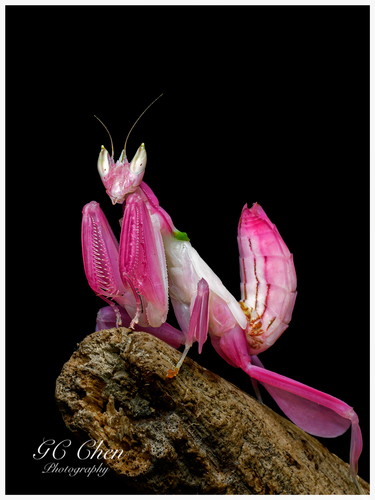
Hymenopus coronatus is a mantis from the tropical forests of Southeast Asia. It is known by various common names, including walking flower mantis, orchid-blossom mantis and (pink) orchid mantis. It is one of several species known as flower mantis, a reference to their unique physical form and behaviour, which often involves moving with a "swaying" motion, as if being "blown" in the breeze. Several species have evolved to mimic orchid flowers as a hunting and camouflaging strategy, "hiding" themselves in plain view and preying upon pollinating insects that visit the blooms. They are known to grab their prey with blinding speed.
📌 Distribution
Hymenopus coronatus is found in tropical regions of Southeast Asia, including Cambodia, Indonesia, Laos, Malaysia, Myanmar, Singapore, Thailand, Vietnam. It may also extend into the far eastern regions of India and Bangladesh. This accords with the most northerly historic record from Sivasagar, in Northeast India (stated as "Sibságar, Assam") by Wood-Mason, 1878.
📌 Behaviour
a Phalaenopsis orchid]]
Hugh Cott referenced an early-20th-century account by Nelson Annandale of Hymenopus coronatus, in which he details how the mantis hunts on the flowers of the "Straits rhododendron" (Melastoma polyanthum). The nymph has what Cott calls "special alluring coloration", where the animal itself acts as a "decoy". The insect is pink-and-white (like many orchid blooms), possessing flattened limbs which feature "that semi-opalescent, semi-crystalline appearance that is caused in flower-petals by a purely structural arrangement of liquid globules or empty cells". The mantis climbs up and down the twigs of the plant until it finds a cluster of flowers. It holds on to these with the claws of its two rearmost pairs of legs. It then sways from side to side, mimicking the wind; soon, various small flies and insects will land on and around the flowers, attracted by nectar as well as the small, black spot on the end of the mantis's abdomen, which resembles a fly. When a larger Dipteran fly—as big as a house fly—was observed landing nearby, the mantis at once seized and ate it.
Mimicry has been widely discussed since the 1861 description by Henry Walter Bates. While the orchid mantis is successful at catching its prey through its color mimicry alone, recent research shows that orchid mantises attract an greater number of natural pollinators when compared to actual flowers,
The female of the species is, reported by Costa (quoting Shelford's 1903 account), to show parental care by guarding her eggs. Costa asks rhetorically, "Why has so little [research] been done on parental care in mantids, such an unexpected and intriguing aspect of their behavior?"
The camouflage of the orchid mantis probably deceives potential predators, as well as serving as an aggressive mimicry of the orchid to help catch insect prey.
📌 In human culture
===History===
[[File:Hymenopus bicornis in active pupa stage by James Wood-Mason 1889.jpg|thumb|Drawing of nymph of "Hymenopus bicornis in active pupa[l] stage" by James Wood-Mason, who sent it to Alfred Russel Wallace, who in turn lent it to Edward Bagnall Poulton for his 1890 book The Colours of Animals]]
Alfred Russel Wallace in his 1889 book Darwinism, calls the mantis rare:
The drawing was published in Edward Bagnall Poulton's book The Colours of Animals. Poulton calls it an "Indian Mantis" which "feeds upon other insects, which it attracts by its flower-like shape and pink colour. The apparent petals are the flattened legs of the insect."
📌 Breeding
The orchid mantis is favoured by insect breeders, but is extremely rare, so is also extremely expensive.
📌 Additional images
Hymenopus coronatus head.jpg|Mounted adult male
Orchid Mantis 314.jpg|Mounted female
Hymenopus coronatus2.jpg|Display of adult females
Hymenopus coronatus MHNT Exuvie.jpg|Last instar exuviae
Hymenopodidae - Hymenopus coronatus.JPG|Late instar female
Gardenology.org-IMG 7230 qsbg11mar.jpg|Late instar female on flowers from Chiang Mai Province, Thailand
Bloembidsprinkhaan (4373508235) (2).jpg|Adult male