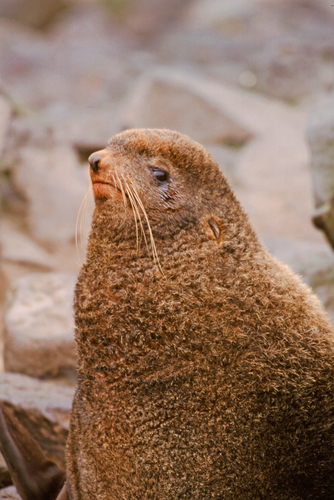
The northern fur seal is an eared seal found along the north Pacific Ocean, the Bering Sea, and the Sea of Okhotsk. It is the largest member of the fur seal subfamily (Arctocephalinae) and the only living species in the genus Callorhinus. A single fossil species, Callorhinus gilmorei, is known from the Pliocene of Japan and western North America.
π‘οΈ Conservation Status
vulnerable
vu
π Distribution and habitat
The northern fur seal is found in the north Pacific – its southernmost reach is a line that runs roughly from the southern tip of Japan to the southern tip of the Baja California Peninsula, the Sea of Okhotsk, and the Bering Sea. An estimated 1.1 million northern fur seals occur across the range, of which roughly half breed on the Pribilof Islands in the east Bering Sea. Another 200β250 thousand breed on the Commander Islands in the west Bering Sea, some 100,000 breed on Tyuleniy Island off the coast of Sakhalin in the southwest Sea of Okhotsk, and another 60β70 thousand in the central Kuril Islands in Russia. Smaller rookeries (around 5,000 animals) are found on Bogoslof Island in the Aleutian Chain, San Miguel Island in the Channel Island group and South Farallon Island off the coast of California. Recent evidence from stable isotope analysis of Holocene fur seal bone collagen (Ξ΄13C and Ξ΄15N) indicates that before the maritime fur trade, it was more common for these animals to breed at local rookeries in British Columbia, California, and likely along much of the northwest coast of North America.
During the winter, northern fur seals display a net movement southward, with animals from Russian rookeries regularly entering Japanese and Korean waters in the Sea of Japan and Alaskan animals moving along the central and eastern Pacific to British Columbia, Canada and as far south as Baja California.
The northern fur seal's range overlaps almost exactly with that of Steller sea lions; occasional cohabitation occurs at reproductive rookeries, notably in the Kurils, the Commander Islands, and Tyulen'i Islands. The only other fur seal found in the Northern Hemisphere is the Guadalupe fur seal which overlaps slightly with the northern fur seal's range in California.
π Ecology
Fur seals are opportunistic feeders, primarily feeding on pelagic fish and squid depending on local availability. Identified fish prey include anchovy, hake, herring, saury, lantern fish, rockfish, capelin, salmon, pollock, and mackerel. Their feeding behavior is primarily solitary.
Northern fur seals are preyed upon primarily by sharks and killer whales.
π Reproductive behavior
]]
Seals enter breeding rookeries in May. Generally, older males (10 years and older) return first and compete for prime breeding spots on the rookeries. They remain on the rookery, fasting throughout the duration of the breeding season. Deaths of females as a consequence of these conflicts have been recorded, though the males themselves are rarely seriously injured. Young males unable to acquire and maintain a territory of a harem typically aggregate in neighboring "haulouts", occasionally making incursions into the reproductive sections of the rookery in an attempt to displace an older male.
After remaining with their pups for the first eight to ten days of their lives, females begin foraging trips lasting up to a week. These trips last for about four months before weaning, which happens abruptly, typically in October. Most of the animals on a rookery enter the water and disperse towards the end of November, typically migrating southward. Breeding site fidelity is generally high for fur seal females, though young males might disperse to other existing rookeries, or occasionally find new haulouts.
Peak mating occurs somewhat later than peak birthing from late June to late July. As with many other otariids, the fertilized egg undergoes delayed implantation: after the blastocyst stage occurs, development halts and implantation occurs four months after fertilization. In total, gestation lasts around a year, such that the pups born in a given summer are the product of the previous year's breeding cycle.
π Status
Recently, concern about the status of fur seal populations has increased, particularly in the Pribilof Islands, where pup production has decreased about 50% since the 1970s, with a continuing drop of about 6β7% per year. This has caused them to be listed as "vulnerable" on the IUCN Red List, and more specifically, the Pribilof Islands / eastern Pacific stock is listed as "depleted" under the U.S. Marine Mammal Protection Act, though to date the species is not yet listed under the U.S. Endangered Species Act). Increasing concern about the species' status, particularly in the eastern part of its range, has led to an intensified research program into their behavioral and foraging ecology. Possible causes for recent declines and lack of recovery are increased predation by killer whales, competition with fisheries, and climate change effects, but to date, no scientific consensus has been reached.
π Fur trade
, 1890s]]
Northern fur seals have been a staple food of native northeast Asian and Alaska Native peoples for thousands of years. The arrival of Europeans to Kamchatka and Alaska in the 17th and 18th centuries, first from Russia and later from North America, was followed by a highly extractive commercial fur trade. The commercial fur trade was accelerated in 1786, when Gavriil Pribylov discovered St. George Island, a key rookery of the seals. An estimated 2.5 million seals were killed from 1786 to 1867. This trade led to a decline in fur seal numbers. Restrictions were first placed on fur seal harvest on the Pribilof Islands by the Russians in 1834. Shortly after the United States purchased Alaska from Russia in 1867, the U.S. Treasury was authorized to lease sealing privileges on the Pribilofs, which were granted somewhat liberally to the Alaska Commercial Company. From 1870 to 1909, pelagic sealing proceeded to take a significant toll on the fur seal population, such that the Pribilof population, historically numbering on the order of millions of individuals, reached a low of 216,000 animals in 1912.
Significant harvest was more or less arrested with the signing of the North Pacific Fur Seal Convention of 1911 by Great Britain (on behalf of Canada), Japan, Russia, and the United States. The Convention of 1911 remained in force until the onset of hostilities among the signatories during World War II, and is also notable as the first international treaty to address the conservation of wildlife. A successive convention was signed in 1957 and amended by a protocol in 1963. "The international convention was put into effect domestically by the Fur Seal Act of 1966 (Public Law 89-702)", said an Interior Department review of the history. Currently, a subsistence hunt by the residents of St. Paul Island and an insignificant harvest in Russia are allowed.