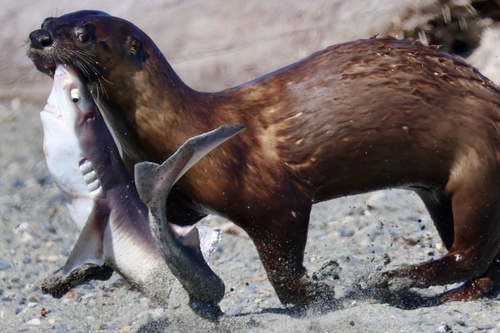
The North American river otter, also known as the northern river otter and river otter, is a semiaquatic mammal that is endemic to the North American continent throughout most of Canada, along the coasts of the United States and its inland waterways. An adult North American river otter can weigh between 5 and 14 kilograms (11โ31ย lb). The river otter is protected and insulated by a thick, water-repellent coat of fur.
๐ Taxonomy and evolution
The North American river otter was first described by German naturalist Johann Christian Daniel von Schreber in 1777. The mammal was identified as a species of otter and has a variety of common names, including North American river otter, northern river otter, common otter and, simply, river otter. The North American river otter was first classified in the genus Lutra. Lutra was the early European name (from Latin), and the specific epithet canadensis
In a new classification, the species is called Lontra canadensis, where the genus Lontra includes all the New World river otters.
Molecular biological techniques have been used to determine when the river otter and the giant otter (Pteronura brasiliensis) of South America diverged. These analyses suggest they diverged in the Miocene epoch 23.03 to 5.33 million years ago (Mya), which is "much earlier" than indicated in the fossil record. Fossils of a giant otter dating back 3.5 Mya (during the Pliocene) have been found in the US Midwest; however, fossils of the modern river otter did not appear in North America until about 1.9 Mya. The New World river otters originated from the Old World river otters following a migration across the Bering Land Bridge, which existed off and on between 1.8 million and 10,000 years ago. The otters migrated to North America and southwards again across the Panamanian Land Bridge, which formed 3 Mya.
๐ Subspecies
Listed alphabetically:
*L. c. canadensis (Schreber, 1777) โ (eastern Canada, U.S., Newfoundland)
*L. c. kodiacensis (Goldman, 1935) โ (Kodiak Island, Alaska)
*L. c. lataxina (Cuvier, 1823) โ (U.S.)
*L. c. mira (Goldman, 1935) โ (Alaska, British Columbia)
*L. c. pacifica (J. A. Allen, 1898) โ (Alaska, Canada, northern U.S., south to central California, northern Nevada, and northeastern Utah)
*L. c. periclyzomae (Elliot, 1905) โ (Queen Charlotte Islands, British Columbia)
*L. c. sonora (Rhoads, 1898) โ (U.S., Mexico)
๐ Form and function
allow it to detect prey in murky water]]
North American river otters characteristically approach within a few meters (a few feet) of a boat or a person on shore due to their near-sightedness, a consequence of vision adapted for underwater sight. North American river otters have a transparent inner eyelid (called a nictitating membrane) to protect their eyes while swimming.
Otters, like most mustelids, have 36 specialized teeth, including sharp canines and carnassials that inflict lethal bites to prey. Also, North American river otters have large molars used for crushing hard objects, such as the shells of molluscs. Additional premolars may be present. The dental formula is .
๐ Distribution and habitat
The North American river otter is found throughout North America, inhabiting inland waterways and coastal areas in Canada, the Pacific Northwest, the Atlantic states, and the Gulf of Mexico. They also inhabit the forested regions of the Pacific coast in North America. The species is also present throughout Alaska, including the Aleutian Islands, and the north slope of the Brooks Range.
However, urbanization and pollution has resulted in a reduction in the otters' range in the United States. and especially in the Midwestern United States. Since their reintroduction to Kentucky in the early 1990s, the otters have recovered to the point that a trapping season was implemented in 2006, and the species is now found in all of the state's major waterways. In 2010, the Colorado Department of Wildlife reported the river otter, reintroduced to the state in the 1980s, was "thriving" and recommended its protection status be reconsidered. In late 2012, a river otter nicknamed Sutro Sam took up residence around the former site of the Sutro Baths in San Francisco, the first river otter sighting in that city since the 1950s. North American river otters occupy all Canadian provinces and territories, except, until recently, Prince Edward Island. In Minnesota, otter populations have rebounded due to reintroduction efforts in the 1980s, improvements in water quality, habitat restoration, and harvest regulation. While river otters are most common in northern Minnesota, otters can be seen in urban areas like the Twin Cities.
Historical records indicate North American river otters were once populous throughout most major drainages in the continental United States and Canada prior to European settlement. North America's largest North American river otter populations were found in areas with an abundance and diversity of aquatic habitats, such as coastal marshes, the Great Lakes region, and glaciated areas of New England. In addition, riverine habitats in interior regions supported smaller otter populations. However, river otters were scarce or absent in areas of Southern California such as the chaparral and oak woodlands and Mojave Desert seasonal waterway regions, or in the xeric shrubland regions in New Mexico, Texas, Nevada, and Colorado. In Mexico, North American river otters lived in the Rio Grande and Colorado River Deltas.
]]
Although commonly called a "river otter", the North American river otter is found in a wide variety of aquatic habitats, both freshwater and coastal marine, including lakes, rivers, inland wetlands, coastal shorelines, marshes, and estuaries. It can tolerate a great range of temperature and elevations. Aquatic life ties North American river otters almost exclusively to permanent watersheds. Their main requirements are a steady food supply and easy access to a body of water. However, it is sensitive to pollution, and will disappear from tainted areas.
Like other otters, the North American river otter lives in a holt, or den, constructed in the burrows of other animals, or in natural hollows, such as under a log or in river banks. An entrance, which may be under water or above ground, leads to a nest chamber lined with leaves, grass, moss, bark, and hair.
๐ Behavior
North American river otters only settle in areas that consist of vegetation, rock piles, and sufficient coverage.
๐ Playing
North American river otters are renowned for their sense of play. Otter play mostly consists of wrestling with conspecifics. Chasing is also a common game. North American river otters rely upon play to learn survival skills such as fighting and hunting.
๐ Hunting
A highly active predator, the North American river otter has adapted to hunting in water, and eats aquatic and semiaquatic animals. The vulnerability and seasonal availability of prey animals mainly governs its food habits and prey choices. This availability is influenced by the following factors: detectability and mobility of the prey, habitat availability for the various prey species, environmental factors, such as water depth and temperature, and seasonal changes in prey supply and distribution in correspondence with otter foraging habitat. or gut contents removed from trapped otters. Fish are the primary component of the North American river otter's diet throughout the year. Every study done on the food habits of the North American river otter has identified varying fish species as being the primary component of its diet. For instance, an Alberta, Canada study involved the collection and analysis of 1,191 samples of North American river otter scat (feces) collected during each season. Fish remnants were found in 91.9% of the samples. Moreover, a western Oregon study revealed fish remains were present in 80% of the 103 digestive tracts examined. However, North American river otters, as foragers, will immediately take advantage of other prey when readily obtainable. Other prey consumed by North American river otters includes fruits, aquatic plants, reptiles, amphibians, birds (most especially moulting ducks which render the birds flightless and thus makes them easier to capture), aquatic insects, small mammals, and mollusks.
North American river otters are not scavengers; they avoid consuming carrion (dead animals). North American river otters do not generally handle prey of a large size relative to themselves but there are occasions where they have been observed ambushing and killing adult common snapping turtles while the large turtles (which are roughly equal in average body weight to a North American river otter) are hibernating. Remains of the much larger North American beaver have been found in North American river otter scat in some regions, although most otter dietary studies in areas where otters and beaver live near each other do not show them to be regular predators of beavers (despite the claims of fur-trappers that otters frequently hunt beavers) and perhaps only young beaver kits may be attacked.
๐ Ecological impacts on prey species
When left unchecked, though, otters can be significant predators under certain circumstances (e.g. in hatcheries or other fish culture facilities). Likewise, the potential predatory impact of otters may be considerable whenever fish are physically confined (most commonly in smaller ponds offering sparse cover or other escape options). To protect fish in these cases, the otters may need to be removed or relocated. Even in larger bodies of water, river otters may take disproportional advantage of any seasonal concentrations of fish when and where only very limited areas of suitable spawning, low-flow, or over-wintering habitat may exist. Even fast-swimming fish like trout slow down in extremely cold water, leaving them vulnerable. As such, careful consideration of any threatened, endangered, or fish species of special interest is warranted prior to reintroduction of otters to a watershed.
๐ Social behavior
marina]]
in Aurora, Illinois.]]
A North American river otter can have a territory as large as . However, their usual territory is about . This can change during mating seasons, but that topic is up for debate.
Although North American river otters are known to be social animals, they can also survive by themselves. Their bodies allow them to avoid predators quite effectively since they can dive, burrow, twist, and turn their bodies for evasive techniques, enabling them to survive independently. North American river otters famously love to play together, which creates strong social bonds, improves hunting skills, and marks territory. North American river otters are not aggressively territorial, but frequently scent-mark certain spots to make their presence known.
๐ Reproduction and life cycle
Delayed implantation distinguishes the species from the Eurasian otter, which does not do this.
In early spring, expectant mothers begin to look for a den where they can give birth. The female otters do not dig their own dens; instead, they rely on other animals, such as beavers, to provide suitable environments to raise their offspring. When the mothers have established their domains, they give birth to several kits.
๐ Ecology
===Diet===
(Catostomus commersonii) at the Seedskadee National Wildlife Refuge (Wyoming)]]
The diet of the North American River otters is extensive and mostly consists of fish, frogs, crayfish, turtles, insects and some small mammals. They are known to hunt in pairs or alone and can hunt on both land and in the water. The North American river otter (Lontra canadensis) is a predator adapted to hunting in water, feeding on aquatic and semi-aquatic animals. The vulnerability and seasonal availability of prey animals primarily determines the food habits and prey preference of the river otter.
๐ Fish
North American river otters consume an extensive assortment of fish species ranging in size from that impart sufficient caloric intake for a minute amount of energy expenditure. Likewise, the common carp (Cyprinus carpio) is a preferred fish species for the North American river otter in other regions of Colorado.
Adult North American river otters are capable of consuming of fish per day. A study conducted on captive otters revealed they preferred larger fish, ranging from , more than smaller fish, ranging from , and they had difficulty catching fish species less than or larger than . Otters are known to take larger fish on land to eat, whereas smaller fish are consumed in the water.
๐ Crustaceans
North American river otters may prefer to feed on crustaceans, especially crayfish (Cambarus, Pacifasticus, and others) and crabs more than fish where they are locally and seasonally plentiful. A study conducted on North American river otters in a southwestern Arkansas swamp identified a correlation between crayfish consumption, fish consumption, and water levels.
During the winter and spring, when the water levels were higher, North American river otters had a greater tendency to prey upon crayfish (73% of scats had crayfish remains) rather than fish. However, when water levels are lower, crayfish will seek out shelter while fish become more highly concentrated and susceptible to predation. Therefore, fish are more vulnerable to being preyed upon by otters because the crayfish have become more difficult to obtain.
๐ Reptiles and amphibians
Amphibians, where regionally accessible, have been found in the North American river otter's diet during the spring and summer months, as indicated in many of the food habit studies. The most common amphibians and reptiles recognized were frogs (Rana and Hyla). Specific species of reptiles and amphibians prey include: boreal chorus frogs (Pseudacris maculata); Canadian toads (Bufo hemiophrys); wood frogs (Rana sylvatica); American bullfrogs (Rana catesbeiana); green frogs (Rana clamitans); northwestern salamanders (Ambystoma gracile); California giant salamander (Dicamptodon ensatus); rough-skinned newt (Taricha granulosa); and garter snakes (Thamnophis).
Amphibians and reptiles are more obtainable by the North American river otter during the spring and summer as a result of breeding activity, appropriate temperatures, and water supply for the prey.
๐ Birds
, in California]]
Waterfowl, rails, and some colonial nesting birds are preyed upon by North American river otters in various areas. Susceptibility of these species is greatest during the summer (when waterfowl broods are vulnerable) and autumn. The North American river otters have also been known to catch and consume moulting American wigeon (Mareca americana) and green-winged teal (Anas crecca). Other species of birds found within their diets include: northern pintail (Anas carolinensis); mallard (Anas platyrhynchos); canvasback (Aythya valisineria); ruddy duck (Oxyura jamaicensis); and the American coot (Fulica americana).
Although they consume birds, North American river otters do not feed on bird eggs.
๐ Insects
Aquatic invertebrates have been recognized as an integral part of the North American river otter's diet. Otters consume more aquatic insects in the summer as the populations increase and specific life stages heighten their susceptibility. Most aquatic invertebrates preyed upon by the otters are from the orders Odonata (dragonfly nymphs), Plecoptera (stonefly nymphs), and Coleoptera (adult beetles). Invertebrates discovered within scats or digestive tracts could most likely be a secondary food item, first being consumed by the fish that are subsequently preyed upon by the North American river otters.
๐ Mammals
Mammals are rarely consumed by North American river otters, and are not a major dietary component.
Records of North American otters preying upon North American beavers (Castor canadensis) vary; it has been reported in the southern boreal forest of Manitoba. Trappers in Alberta, Canada commonly assert North American river otters are major predators of North American beavers.
๐ Predators
Aquatic predators of the North American river otter include the American alligator (Alligator mississippiensis), American crocodile (Crocodylus acutus), and killer whale (Orcinus orca), none of which commonly coexist with the North American river otter and thus rarely pose a threat. Terrestrial predators include the bobcat (Lynx rufus), cougar (Puma concolor), coyote (Canis latrans), domestic dog (Canis familiaris), wolf (Canis lupus), American black bear (Ursus americanus), bald eagle (Haliaeetus leucocephalus), and red fox (Vulpes vulpes), grizzly bears (Ursus arctos horribilis) and polar bears (Ursus maritimus)
๐ Threats
Threats to North American river otter populations in North America vary regionally. North American river otter inhabitation is affected by type, distribution, and density of aquatic habitats and characteristics of human activities. Preceding the settlement of North America by Europeans, North American river otters were prevalent among aquatic habitats throughout most of the continent. Trapping, loss or degradation of aquatic habitats through filling of wetlands, and development of coal, oil, gas, tanning, timber, and other industries, resulted in local extinctions or population declines in North American river otter populations in many areas. In 1980, an examination conducted on U.S. river otter populations determined they were locally extinct in 11 states, and lost significant population in 9 other states. The most severe population declines occurred in interior regions where fewer aquatic habitats supported fewer otter populations. Although the distribution became reduced in some regions of southern Canada, the only province-wide extinction occurred on Prince Edward Island.
During the 1970s, improvements in natural resource management techniques emerged, along with increased concerns about North American river otter population declines in North America. Consequently, many wildlife management agencies developed strategies to restore or enhance otter populations, including the use of reintroduction projects. Since 1976, over 4,000 otters have been reintroduced in 21 U.S. states. All Canadian provinces except Prince Edward Island and 29 U.S. states have viable populations that sustain annual harvests. While current harvest strategies do not pose a threat to maintaining otter populations, harvest may limit expansion of otter populations in some areas.
Oil spills present a localized threat to otter populations, especially in coastal areas. Water pollution and other diminution of aquatic and wetland habitats may limit distribution and pose long-term threats if the enforcement of water quality standards is not upheld. Acid drainage from coal mines is a persistent water quality issue in some areas, as it eliminates otter prey. This dilemma prevents, and consequently inhibits, recolonization or growth of North American river otter populations. Recently, long-term genetic consequences of reintroduction projects on remnant North American river otter populations has been discussed. Similarly, many perceived threats to North American river otters, such as pollution and habitat alterations, have not been rigorously evaluated. Little effort has gone into assessing the threat of disease to wild North American river otter populations, so it is poorly understood and documented.
๐ Conservation
Lontra canadensis is listed in Appendix II of the Convention on International Trade in Endangered Species of Wild Fauna and Flora (CITES). They have been virtually eliminated through many parts of their range, especially around heavily populated areas in the midwestern and eastern United States. Appendix II lists species that are not necessarily threatened with extinction currently, but may become so unless trade is closely controlled.
The North American river otter is considered a species of least concern according to the IUCN Red List, as it is not currently declining at a rate sufficient for a threat category. By the early 1900s, North American river otter populations had declined throughout large portions of their historic range in North America. However, improvements in water quality (through enactment of clean water regulations) and furbearer management techniques have permitted river otters to regain portions of their range in many areas. Reintroduction projects have been particularly valuable in restoring populations in many areas of the United States. However, North American river otters remain rare or absent in the southwestern United States. Water quality and development inhibit recovery of populations in some areas. The species is widely distributed throughout its range. In many places, the populations have re-established themselves because of conservation initiatives. Reintroduction of river otters may present a problem in that it may contaminate the genetic structure of the native population.