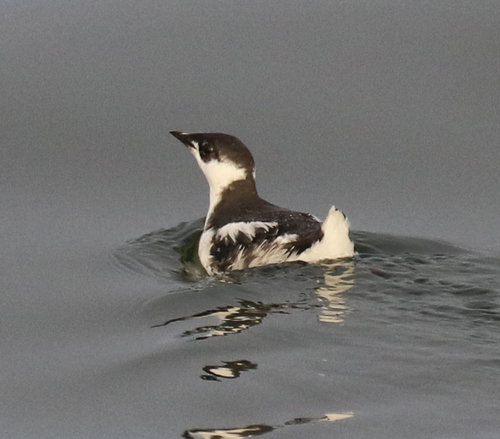
Auks or alcids are birds of the family Alcidae in the order Charadriiformes. The alcid family includes the murres, guillemots, auklets, puffins, and murrelets. The family contains 25 extant or recently extinct species that are classified into 11 genera. Auks are found throughout the Northern Hemisphere.
🛡️ Conservation Status
endangered
en
📌 Names
The English names of several species differ between Europe and North America. The two species known as 'murres' in North America are called 'guillemots' in Europe, and the species called 'little auk' in Europe is known as 'dovekie' in North America.
The word 'auk' is derived from Icelandic álka and Norwegian alka or alke, from Old Norse ālka, from Proto-Germanic *alkǭ (sea-bird, auk).
The family name Alcidae comes from the genus name Alca, which was given by Carl Linnaeus in 1758 for the razorbill (Alca torda), from the Norwegian word alke.
📌 Feeding and ecology
The feeding behaviour of auks is often compared to that of penguins; both groups are wing-propelled, pursuit divers. In the region where auks live, their only seabird competition are cormorants (which are dive-powered by their strong feet). In areas where the two groups feed on the same prey, the auks tend to feed further offshore. Strong-swimming murres hunt faster, schooling fish, whereas auklets take slower-moving krill. Time depth recorders on auks have shown that they can dive as deep as in the case of Uria guillemots, for the Cepphus guillemots and for the auklets.
📌 Breeding and colonies
Auks are pelagic birds, spending the majority of their adult lives on the open sea and going ashore only for breeding, although some species, such as the common guillemot, spend a great part of the year defending their nesting spot from others.
Auks are monogamous, and tend to form lifelong pairs. They typically lay a single egg, and they use the nesting site year after year.
Some species, such as the Uria guillemots (murres), nest in large colonies on cliff edges; others, such as the Cepphus guillemots, breed in small groups on rocky coasts; and the puffins, auklets, and some murrelets nest in burrows. All species except the Brachyramphus murrelets are colonial.
📌 Evolution and distribution
]]
Historically, the auks were believed to be one of the earliest distinct charadriiform lineages due to their characteristic morphology, but genetic analyses have demonstrated that these peculiarities are the product of strong natural selection, instead; as opposed to, for example, plovers (a much older charadriiform lineage), auks radically changed from a wading shorebird to a diving seabird lifestyle. Thus today, the auks are no longer separated in their own suborder (Alcae), but are considered part of the Lari suborder, which otherwise contains gulls and similar birds. Judging from genetic data, their closest living relatives appear to be the skuas, with these two lineages separating about 30 million years ago (Mya).
s are auks found in the Atlantic Ocean.]]
The family contains 25 extant or recently extinct species that are classified into 11 genera. The extant auks (subfamily Alcinae) are broken up into two main groups - the usually high-billed puffins (tribe Fraterculini) and auklets (tribe Aethiini), as opposed to the more slender-billed murres and true auks (tribe Alcini), and the murrelets and guillemots (tribes Brachyramphini and Cepphini). The tribal arrangement was originally based on analyses of morphology and ecology. mtDNA cytochrome b sequences, and allozyme studies confirm these findings except that the Synthliboramphus murrelets should be split into a distinct tribe, as they appear more closely related to the Alcini; in any case, assumption of a closer relationship between the former and the true guillemots was only weakly supported by earlier studies.
Of the genera, only a few species are placed in each. This is probably a product of the rather small geographic range of the family (the most limited of any seabird family), and the periods of glacial advance and retreat that have kept the populations on the move in a narrow band of subarctic ocean.
(Fratercula cirrhata)]]
Today, as in the past, the auks are restricted to cooler northern waters. Their ability to spread further south is restricted as their prey hunting method, pursuit diving, becomes less efficient in warmer waters. The speed at which small fish (which along with krill are the auk's principal prey) can swim doubles as the temperature increases from , with no corresponding increase in speed for the bird. The southernmost auks, in California and Mexico, can survive there because of cold upwellings. The current paucity of auks in the Atlantic (six species), compared to the Pacific (19–20 species) is considered to be because of extinctions to the Atlantic auks; the fossil record shows many more species were in the Atlantic during the Pliocene. Auks also tend to be restricted to continental-shelf waters and breed on few oceanic islands.
Hydotherikornis oregonus (Described by Miller in 1931), the oldest purported alcid from the Eocene of California, is actually a petrel (as reviewed by Chandler in 1990) and is reassigned to the tubenoses (Procellariiformes). A 2003 paper, "The Earliest North American Record of Auk (Aves: Alcidae) From the Late Eocene of Central Georgia", reports a Late Eocene, wing-propelled, diving auk from the Priabonain stage of the Late Eocene. These sediments have been dated through Chandronian NALMA {North American Land Mammal Age}, at an estimate of 34.5 to 35.5 million years on the Eocene time scale for fossil-bearing sediments of the Clinchfield Formation, Gordon, Wilkinson County, Georgia. Furthermore, the sediments containing this unabraded portion of a left humerus (43.7 mm long) are tropical or subtropical as evidenced by a wealth of warm-water shark teeth, palaeophied snake vertebrae, and turtles.
📌 Systematics
}} }}
|2= }} }} }} }}
|2=
|2=
}}
}}
|2= }}
|2= }}
|2=
|2=Little auk
|3=
|2= }} }} }} }} }} }} }} }}
* Basal and incertae sedis
** Miocepphus (fossil: Middle Miocene of CE USA)
*** Miocepphus mcclungi Wetmore, 1940
*** Miocepphus bohaskai Wijnker and Olson, 2009
*** Miocepphus blowi Wijnker and Olson, 2009
*** Miocepphus mergulellus Wijnker and Olson, 2009
* Subfamily Alcinae
** Tribe Alcini – typical auks and murres) is quite distinct from the brachyramphine murrelets.]]
*** Uria
**** Common murre or common guillemot, Uria aalge
**** Thick-billed murre or, Brünnich's guillemot, Uria lomvia
*** Alle
**** Little auk or dovekie, Alle alle
*** Pinguinus
**** Great auk, Pinguinus impennis (extinct, c.1852)
**** Pinguinus alfrednewtoni Olson, 1977 (fossil: Pliocene)
*** Alca
**** Razorbill, Alca torda
** Tribe Synthliboramphini – synthliboramphine murrelets (Cepphus grylle), a true guillemot, in summer (front) and winter plumage]]
*** Synthliboramphus
**** Scripps's murrelet, Synthliboramphus scrippsi – formerly in S. hypoleucus ("Xantus's murrelet")
**** Guadalupe murrelet, Synthliboramphus hypoleucus – sometimes separated in Endomychura
**** Craveri's murrelet, Synthliboramphus craveri – sometimes separated in Endomychura
**** Ancient murrelet, Synthliboramphus antiquus
**** Japanese murrelet, Synthliboramphus wumizusume
** Tribe Cepphini – true guillemots (Brachyramphus marmoratus), a brachyramphine murrelet, in breeding plumage]]
*** Cepphus
**** Black guillemot or tystie, Cepphus grylle
**** Pigeon guillemot, Cepphus columba
***** Kurile guillemot, Cepphus columba snowi
**** Spectacled guillemot, Cepphus carbo
** Tribe Brachyramphini – brachyramphine murrelets
*** Brachyramphus
**** Marbled murrelet, Brachyramphus marmoratus
**** Long-billed murrelet, Brachyramphus perdix
**** Kittlitz's murrelet, Brachyramphus brevirostris
* Subfamily Fraterculinae
** Tribe Aethiini – auklets
*** Ptychoramphus
**** Cassin's auklet, Ptychoramphus aleuticus
*** Aethia
**** Parakeet auklet, Aethia psittacula
**** Crested auklet, Aethia cristatella
**** Whiskered auklet, Aethia pygmaea
**** Least auklet, Aethia pusilla
** Tribe Fraterculini – puffins
*** Cerorhinca
**** Rhinoceros auklet, Cerorhinca monocerata
*** Fratercula
**** Atlantic puffin, Fratercula arctica
**** Horned puffin, Fratercula corniculata
**** Tufted puffin, Fratercula cirrhata
Biodiversity of auks seems to have been markedly higher during the Pliocene. See the genus accounts for prehistoric species.