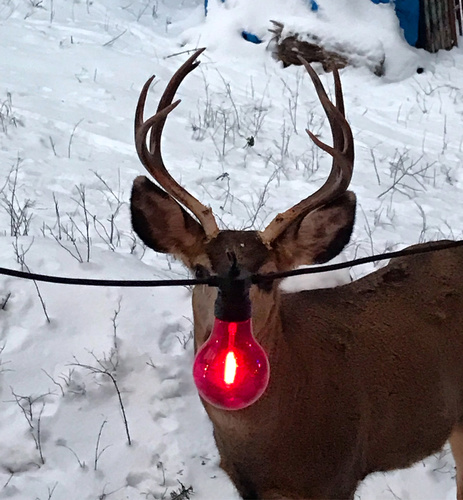
The mule deer is a deer indigenous to western North America; it is named for its ears, which are large like those of the mule. Two subspecies of mule deer are grouped into the black-tailed deer.
๐ Taxonomy
Mule deer can be divided into two main groups: the mule deer (sensu stricto) and the black-tailed deer. The first group includes all subspecies, except O. h. columbianus and O. h. sitkensis, which are in the black-tailed deer group. Mule deer apparently evolved from the black-tailed deer. Despite this, the mtDNA of the white-tailed deer and mule deer is similar, but differs from that of the black-tailed deer. This may be the result of introgression, although hybrids between the mule deer and white-tailed deer are rare in the wild (apparently more common locally in West Texas), and the hybrid survival rate is low even in captivity. Many claims of observations of wild hybrids are not legitimate, as identification based on external features is complicated.
๐ Subspecies
Some authorities have recognized O. h. crooki as a senior synonym of O. h. eremicus, but the type specimen of the former is a hybrid between the mule deer and white-tailed deer, so the name O. h. crooki is invalid. Additionally, the validity of O. h. inyoensis has been questioned, and the two insular O. h. cerrosensis and O. h. sheldoni may be synonyms of O. h. eremicus or O. h. peninsulae. Inland, the California mule deer is known from around San Bernardino to as far north as Lassen; many deer inhabit the areas in and around Sequoia National Park, Yosemite, Plumas National Forest, and of course, the Sierra Nevada, its range partly overlapping with that of the Inyo subspecies (O. h. inyoensis). It is also known to range across the border into west-central Nevada, between Reno and Carson City.
**O. h. cerrosensis โ Cedros or Cerros Island mule deer, after Cedros Island, off of the southwestern Pacific coast of Baja California state, the subspecies' sole habitat.
**O. h. eremicus โ Desert or burro mule deer. Primarily found in the Lower Colorado River Valley, Southern California's Inland Empire, the areas around Las Vegas and extreme southern Nevada, much of Arizona and parts of southern New Mexico. In Mexico, it is primarily known from Sonora, having been known from as far south as Hermosillo; it has also been observed (somewhat out-of-range) in Coahuila, Chihuahua and Durango.
**O. h. fuliginatus โ Southern mule deer. Mainly found in Southern California (Los Angeles, Orange and San Diego Counties) and along the U.S.-Mexico borderlands, into the northern half of the Baja California Peninsula, where it has been sighted as far south as El Rosario. Notably high population densities occur to the west of Anza-Borrego Desert State Park (in the San Diego County portion of the Cleveland National Forest) and in and around the region of Julian, California.
**O. h. hemionus โ Rocky Mountain mule deer. Primarily found in western and central North America, as far south as Colorado and as far north as Yukon and the Northwest Territories, including inland British Columbia.
**O. h. inyoensis โ Inyo mule deer (named after Inyo County, California). This deer is primarily found within the Sierra Nevada and Yosemite, within inland Central California, and has been sighted as far south as Death Valley and as far north as the Stanislaus National Forest.
**O. h. peninsulae โ Baja or Peninsular mule deer; found across the majority of the state of Baja California Sur, Mexico.
**O. h. sheldoni โ Tiburรณn Island mule deer, also called the venado bura de Tiburรณn in Spanish. This deer is only found on Tiburรณn Island, Mexico, in the Gulf of California.
* Black-tailed deer group:
**O. h. columbianus โ Columbian black-tailed deer; found primarily in coastal temperate rainforest habitats of the Pacific Northwest and Northern California (north of approx. the San Francisco Bay Area to Vancouver, British Columbia)
**O. h. sitkensis โ Sitka black-tailed deer (named after Sitka, Alaska); found in similar temperate rainforests as the Columbian subspeciesโthough with a more northerly rangeโfrom the central coast of British Columbia (including Haida Gwaii) throughout Southeast Alaska (along the Gulf of Alaska), with smaller populations further north to Anchorage, the Kenai Peninsula, and Kodiak Island. Found typically in dense, lush habitats, such as the Great Bear Rainforest and Tongass National Forest.
๐ Seasonal behaviors
In addition to movements related to available shelter and food, the breeding cycle is important in understanding deer behavior. The rut or mating season usually begins in the fall as does go into estrus for a period of a few days, and males become more aggressive, competing for mates. Does may mate with more than one buck and go back into estrus within a month if they did not become pregnant. The gestation period is about 190โ200 days, with fawns born in the spring. The survival rate of the fawns during labor is about 50%. Fawns stay with their mothers during the summer and are weaned in the fall after about 60โ75 days. Mule deer females usually give birth to two fawns, although if it is their first time having a fawn, they often have just one.
The size of mule deer groups follows a marked seasonal pattern. Groups are smallest during fawning season (June and July in Saskatchewan and Alberta) and largest in early gestation (winter; February and March in Saskatchewan and Alberta).
Besides humans, the three leading predators of mule deer are coyotes, wolves, and cougars. Bobcats, Canada lynx, wolverines, American black bears, and grizzly bears may prey upon adult deer but most often attack only fawns or infirm specimens, or they may eat a deer after it has died naturally. Bears and small carnivores are typically opportunistic feeders and pose little threat to a strong, healthy mule deer.
๐ Diet and foraging behaviors
]]
In 99 studies of mule deer diets, some 788 species of plants were eaten by mule deer, and their diets vary greatly depending on the season, geographic region, year, and elevation. The studies gave these data for Rocky Mountain mule deer diets:
{| class="wikitable"
|-
!
! Shrubs and trees
! Forbs
! Grasses and grass-like plants
|-
| Winter
| 74%
| 15%
| 11% (varies 0โ53%)
|-
| Spring
| 49%
| 25%
| 26% (varies 4โ64%)
|-
| Summer
| 49%
| 46% (varies 3โ77%)
| 3% (varies 0โ22%)
|-
| Fall
| 60%
| 30% (varies 2โ78%)
| 9% (varies 0โ24%)
|-
|}
The diets of mule deer are very similar to those of white-tailed deer in areas where they coexist.
Mule deer readily adapt to agricultural products and landscape plantings. In the Sierra Nevada range, mule deer depend on the lichen Bryoria fremontii as a winter food source.
The most common plant species consumed by mule deer are the following:
* Among trees and shrubs: Artemisia tridentata (big sagebrush), Cercocarpus ledifolius (curlleaf mountain mahogany), Cercocarpus montanus (true mountain mahogany), Cowania mexicana (Mexican cliffrose), Populus tremuloides (quaking aspen), Purshia tridentata (antelope bitterbrush), Quercus gambelii (Gambel oak), and Rhus trilobata (skunkbush sumac). Where available, mule deer also eat a variety of wild mushrooms, which are most abundant in late summer and fall in the southern Rocky Mountains; mushrooms provide moisture, protein, phosphorus, and potassium.
Mule deer are variably gregarious, with a large proportion of solitary individuals (35 to 64%) and small groups (groups with โค5 deer, 50 to 78%). Reported mean group size measurements are three to five and typical group size (i.e., crowding) is about seven.
File:Mule Deer foraging at Okanagan Mountain Provincial Park.webm|Mule deer foraging on a late winter morning at Okanagan Mountain Provincial Park
File:Mule Deer in Zion Canyon.jpeg|Male Rocky Mountain mule deer (O. h. hemionus) in Zion National Park
File:muledeerleavenworth.jpg|Male O. h. hemionus near Leavenworth, Washington
File:Odocoileus hemionus 5432.JPG|Female Columbian black-tailed deer (O. h. columbianus) in Olympic National Park
File:Female mule deer in Garden of the Gods, Colorado Springs, Colorado, USA.jpg|Female mule deer in Garden of the Gods, Colorado Springs, Colorado, US
๐ Nutrition
Mule deer are ruminants, meaning they employ a nutrient acquisition strategy of fermenting plant material before digesting it. Deer consuming high-fiber, low-starch diets require less food than those consuming high-starch, low-fiber diets. Rumination time also increases when deer consume high-fiber, low-starch diets, which allows for increased nutrient acquisition due to greater length of fermentation. Because some of the subspecies of mule deer are migratory, they encounter variable habitats and forage quality throughout the year. Forages consumed in the summer are higher in digestible components (i.e. proteins, starches, sugars, and hemicellulose) than those consumed in the winter. The average gross energy content of the consumed forage material is 4.5kcal/g.
Due to fluctuations in forage quality and availability, mule deer fat storage varies throughout the year, with the most fat stored in October, which is depleted throughout the winter to the lowest levels of fat storage in March. Changes in hormone levels are indications of physiological adjustments to the changes in the habitat. Total body fat is a measure of the individual's energy reserves, while thyroid hormone concentrations are a metric to determine the deer's ability to use the fat reserves. Triiodothyronine (T3) hormone is directly involved with basal metabolic rate and thermoregulation.
๐ Migration
]]
Mule deer migrate from low elevation winter ranges to high elevation summer ranges. Although not all individuals in populations migrate, some will travel long distances between summer and winter ranges. Researchers discovered the longest mule deer migration in Wyoming spanning 150 miles from winter to summer range.
Mule deer migrate in fall to avoid harsh winter conditions like deep snow that covers up food resources, and in spring follow the emergence of new growth northwards. There is evidence to suggest that mule deer migrate based on cognitive memory, meaning they use the same path year after year even if the availability of resources has changed. This contradicts the idea that animals will go to the areas with the best available resources, which makes migratory paths crucial for survival.
๐ Risks
There are many risks that mule deer face during migration including climate change and human disturbance. Climate change impacts on seasonal growth patterns constitute a risk for migrating mule deer by invalidating historic or learned migration paths.
Human activities such as natural resource extraction, highways, fencing, and urban development all have an impact on mule deer populations and migrations through habitat degradation and fragmentation. As traffic volumes increase, the more mule deer tend to avoid those areas and abandon their typical migration routes. It has also been found that fencing can alter deer behavior, acting as a barrier, and potentially changing mule deer migration patterns. In addition, urban development has replaced mule deer habitat with subdivisions, and human activity has increased. As a result of this, researchers have seen a decline in mule deer populations. This is especially prominent in Colorado where the human population has grown by over 2.2 million since 1980.
๐ Management
==== Protecting migration corridors ====
Protecting migration corridors is essential to maintain healthy mule deer populations. One thing everyone can do is help slow the increase in climate change by using greener energy sources and reducing the amount of waste in our households. In addition, managers and researchers can assess the risks listed above and take the proper steps to mitigate any adverse impacts those risk have on mule deer populations. Not only will populations benefit from these efforts but so will many other wildlife species.
๐ Highways
One way to help protect deer from getting hit on roadways is to install high fence wildlife fencing with escape routes. This helps keep deer off the road, preventing vehicle collisions and allowing animals that are trapped between the road and the fence a way to escape to safety.
๐ Natural resource extraction
Approaches to mitigating the impact of drilling and mining operations include regulating the time of year when active drilling and heavy traffic to sites are taking place, and using well-informed planning to protect critical deer habitat and using barriers to mitigate the activity, noise, light at the extraction sites.
๐ Urban development
The increase in urbanization has impacted mule deer migrations and there is evidence to show it also disrupts gene flow among mule deer populations. One clear option is to not build houses in critical mule deer habitat; however, building near mule deer habitat has resulted in some deer becoming accustomed to humans and the resources, such as food and water. Rather than migrate through urban areas some deer tend to stay close to those urban developments, potentially for resources and to avoid the obstacles in urban areas. Suggested measures by property owners to protect mule deer genetic diversity and migration paths include planting deer-resistant plants, placing scare devices such as noise-makers, and desisting from feeding deer.
๐ Disease
Wildlife officials in Utah announced that a NovemberโDecember 2021 field study had detected the first case of SARS-CoV-2 in mule deer. Several deer possessed apparent SARS-CoV-2 antibodies, however a female deer in Morgan County had an active Delta variant infection. White-tailed deer, which are able to hybridize with mule deer and which have shown high rates of SARS-CoV-2 infection, have migrated into Morgan County and other traditional mule deer habitats since at least the early 2000s.
๐ Chronic wasting disease
Chronic wasting disease (CWD) is a disease rapidly spreading throughout populations of the Cervus family. It first appeared in captive deer in Colorado in 1967 but has made a large impact on wild mule deer populations since then, spreading throughout all of North America.