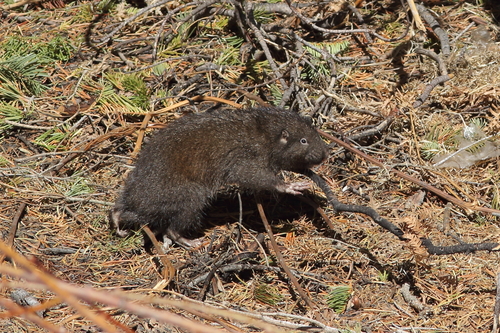
The mountain beaver is a North American rodent. It is the only living member of its genus, Aplodontia, and family, Aplodontiidae. It should not be confused with true North American and Eurasian beavers, to which it is not closely related; the mountain beaver is instead more closely related to squirrels. There are seven subspecies of mountain beaver, six of which are found in California and three of which are endemic to the state.
๐ Spelling and etymology
The name Aplodontia ("simple tooth") is in reference to the single large basin comprising the bulk of each cheek tooth. The specific epithet, rufa, means red or reddish.
Most references use the spelling "Aplodontidae" for the family name. This has been deemed incorrect due to the technical rules of converting a genus name into a family name. The proper conversion of Aplodontia to a family name is to drop the -a only and add -. Thus, Aplodontiidae is technically correct. This spelling is gaining acceptance in modern texts and is the standard spelling currently recognized by the Integrated Taxonomic Information System.
Alternate spellings of the genus name have also been reported, with as many as 30 variants historically. These include "Haplodontia", "Haplodon", "Aploodontia", "Apluodontia", and "Aplodontie", among others.
๐ Taxonomy and phylogeny
]]
Originating in the late Oligocene, the mountain beaver has retained a number of primitive characteristics that make it a living fossil. In particular, it is the only surviving species to retain the Eocene-era protrogomorph chewing mechanism (zygomasseteric system).
In the protrogomorphous condition, the medial masseter muscle does not pass through the infraorbital foramen as it does in guinea pigs and mice. Likewise, the lateral masseter muscle attaches to the base of the zygomatic arch and does not extend to the region in front of the eye as is seen in squirrels and mice. Although modern blesmols also share the mountain beaver's primitive, protrogomorphous chewing mechanism, this trait appears to have newly re-evolved in that family.
In addition to its skull and jaw, the mountain beaver's kidneys are notably primitive. Their poor renal function is considered one of the key limits on the species' geographic distribution.
The mountain beaver was once thought to be related to the earliest protrogomorphous rodents, such as the ischyromyids (Paramys). Both molecular and morphological phylogeneticists have recently suggested a more distant relationship to these animals.
Molecular studies have revealed the Sciuridae (squirrels) clade as the mountain beaver's closest living relative. According to the fossil record, the Aplodontiidae clade split from the squirrels in the Middle or Late Eocene as indicated by the extinct genera Spurimus and Prosciurus.
๐ Subspecies
At present, seven subspecies of Aplodontia rufa are recognized:
*A. r. californica (Peters, 1864): distributed throughout the Sierra Nevada in Northern California and extreme western Nevada
*A. r. humboldtiana Taylor, 1916: restricted to the far northwestern coast of California
*A. r. nigra Taylor, 1914: restricted to a small region in southern Mendocino County, California
*A. r. pacifica Merriam, 1899: distributed across coastal Oregon
*A. r. phaea Merriam, 1899: found mostly in Point Reyes, northwest of San Francisco, California
*A. r. rainieri Merriam, 1899: found across the Cascade Range from southern British Columbia to southern Washington
*A. r. rufa (Rafinesque, 1817): found along coastal Washington, all the way down through Oregon to Northern California
๐ Habitat and distribution
Mountain beavers are found in the Cascade Mountains of British Columbia and southward including the rest of the Cascade Range in the United States, the Olympic Mountains and Coast Ranges of Washington and Oregon, plus the Klamath Mountains, and the Sierra Nevada, Point Arena and Pt. Reyes of California and extreme western Nevada. They range from sea level to the tree line. They can be found in both deciduous and coniferous forests, but throughout most of the range they appear to prefer the former.
๐ Behavior
Mountain beavers are capable of climbing trees, but rarely travel far from burrows. Their thumbs are slightly opposable and the animals will sit on their hindquarters and manipulate food with their forelimbs and incisors.
Mountain beavers are asocial and generally do not live in shared burrows. Burrows usually consist of a network of tunnels built in deep soil. The entrances to these burrows often contain clumps of wilted vegetation which the animal likely uses as a kind of food cache as well as a source of nesting material. Mountain beavers seldom travel more than a few meters from their burrow entrances, taking advantage of the protection such burrows offer from predators, such as cougars and owls (though skunks and weasels that also occupy mountain beaver burrows and tunnels may take nestlings as food). nor do they hibernate.
๐ Ecology
Known predators include bobcats, coyotes, weasels, cougars, golden eagles, and owls.
Among the parasites of the mountain beaver is the largest flea known, Hystrichopsylla schefferi. Females of this flea can be long.
Mountain beavers are considered pests in areas of the Pacific Northwest because of the extensive damage they cause to forest trees due to basal-grinding (removal of bark), branch cutting, or clipping small saplings and seedlings. This damage often poses a problem for forest management and reforestation when smaller seedlings are buried or uprooted during mountain beaver feeding and can result in tree deformities, growth suppression, and mortality. Damage control measures taken to protect forest trees by controlling the mountain beaver population include trapping, placing toxic baits, and placing physical barriers (e.g., plastic mesh tubes) around the base of an individual tree.
๐ Breeding
The breeding season is between January and March, with two or three young born February to April. The ovulation period lasts a few weeks and gestation lasts for a month. The young are born hairless, pink, and blind. They are weaned at 6 to 8 weeks and leave the burrow soon after.
๐ Status and conservation
The IUCN lists the mountain beaver as a species of least concern. However, one subspecies, the Point Arena mountain beaver (A. r. nigra) of California, is considered endangered by the U.S. Fish and Wildlife Service, and Critically Imperiled by NatureServe. Originally listed in 1991, the Point Arena mountain beaver is distinguished by its black colouration and by characteristic body proportions, including a smaller overall size. The principal threat to this subspecies is habitat loss and fragmentation; its remaining range comprises a disjunct region of in western Mendocino County.