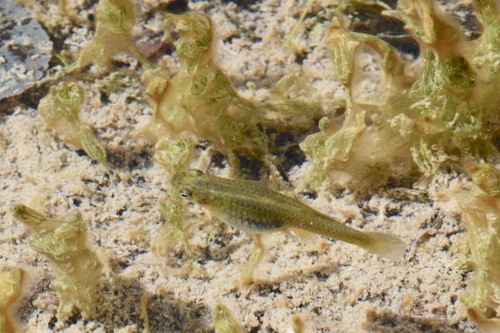
The western mosquitofish is a North American freshwater poeciliid fish, also known commonly, if ambiguously, as simply mosquitofish or by its generic name, Gambusia, or by the common name gambezi. Its sister species, the eastern mosquitofish is also referred to by these names.
📌 Naming and taxonomy
The mosquitofish is a member of the family Poeciliidae of order Cyprinodontiformes. The genus name Gambusia is derived from the Cuban Spanish term gambusino, meaning "useless". The common name, mosquitofish, is derived from their use for biological control of mosquitoes, which itself was based on early observations that, in certain circumstances, they can reduce mosquito abundances. Classification of the western mosquitofish has been difficult due to their similarity to the eastern mosquitofish, and according to ITIS (Integrated Taxonomic Information System), G. holbrooki (eastern mosquitofish) may be an invalid taxonomic name, and could be considered a subspecies of G. affinis.
📌 Global invasion history and environmental impact
honouring the mosquito fish for eradicating malaria in the region]]
Mosquitofish were intentionally introduced in many areas with large mosquito populations to decrease the population of mosquitoes by eating the mosquito larvae. Mosquitofish in Australia are considered noxious pests where they pose a threat to native fish and frog populations and little evidence indicates they have controlled mosquito populations or mosquito-borne diseases. They have been dubbed by scientists as "one of the most problematic animals on the planet".
However, from the 1920s to the 1950s, mosquitofish were considered by some to be a significant factor in eradicating malaria in South America, southern Russia, and Ukraine. Mosquitofish bred by Joice Loch were distributed through Greece, Serbia and the Middle east. On the coast of the Black Sea in Russia, the mosquitofish is commemorated for eradicating malaria by a monument in Sochi.
Mosquitofish are still employed for biological control of mosquitoes in some places. In 2008, in some parts of California and in Clark County, Nevada, mosquitofish were bred in aquariums so people could stock stagnant pools of water with the mosquitofish to reduce the number of West Nile virus cases.
📌 Reproduction
Reproduction of the mosquitofish starts with the male arranging the rays of the gonopodium (modified anal fin) into a slight tube. The male mosquitofish uses this tubular fin to secrete milt into the female's genital aperture in the process of internal fertilization. The female's genital aperture is located just behind the anal fin and is an opening for the milt to fertilize the ova within the ovary. Mosquitofish are within the infraclass Teleostei and as all teleosts, mosquitofish lack a uterus, so production of oocytes and gestation occur within the ovary of a female mosquitofish. Inside the female, sperm from multiple males can be stored to later fertilize ova. Based on laboratory experiments, female mosquitofish become vitellogenic when springtime temperatures reach , and then the oocytes mature when the average temperature reaches about . Then late in the summer when the photoperiod is less than 12.5 hours long, the next clutch of oocytes develops. In one reproductive season, a female may fertilize, with stored milt, two to six broods of embryos, with the size of the brood decreasing as the season progresses. Reproduction rates are highly dependent on temperature and ration level. As temperature increases from 20 to 30 °C, mean age at first reproduction decreases from 191 to 56 days, and brood size and mass of offspring increase significantly. Interbrood interval estimates at 25 and 30 °C are 23 and 19 days, respectively.
📌 Embryology
Mosquitofish have a 16- to 28-day gestation period. They are lecithotrophic, which means during gestation, nutrients are provided to the embryos by a yolk sac. If the gestation period is shorter, each newborn will at birth still have a yolk sac connected through a slit located on the ventral side of the body wall. Brood size of females depends on the size of the given female; larger females are more capable of a larger brood quantity than smaller females. Many females have a brood quantity of up to or more than 60 young. Mosquitofish are viviparous, which means after the gestation of a brood, the female will have live birth. In most cases, the newborn brood will have an equal male to female sex ratio.
📌 Growth
After birth, newborn mosquitofish are about in length. As juveniles, they grow at a rate of about per day, but growth is highly temperature-dependent. Growth rates of juvenile mosquitofish reach their peak when the water temperature is within a range of , depending on resource availability. As temperatures rise above or dip below this range, growth rates decrease. Consistent temperatures at or above are typically lethal, while growth stops when temperatures are at or below . For male mosquitofish, sexual maturity is reached in about 43 to 62 days, but maturation age is also dependent on temperature and resources. Female mosquitofish reach sexual maturity in about 21 to 28 days if born early within the reproductive season. The lifespan of a mosquitofish averages less than a year and the maximum is about 1.5 years. However, mosquitofish kept as pets can live much longer, with owners reporting lifespans of over three years. Male mosquitofish lifespans are considerably shorter than females.