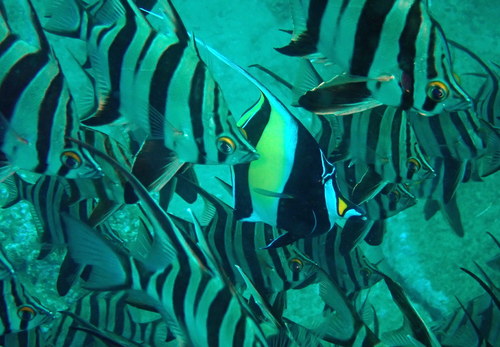
The Moorish idol is a species of marine ray-finned fish belonging to the family Zanclidae. It is the only member of the monospecific genus Zanclus and the only extant species within the Zanclidae. This species is found on reefs in the Indo-Pacific region.
📌 Taxonomy
The Moorish idol was first formally described as Chaetodon cornutus in 1758 by Carl Linnaeus in the 10th edition of the Systema Naturae with "Indian Seas" given as its type locality. In 1831 Georges Cuvier classified it in the new monospecific genus Zanclus. In 1876 Pieter Bleeker proposed the monotypic family Zanclidae. The Zanclidae is classified within the suborder Acanthuroidei of the order Acanthuriformes. Some authors classify the Moorish idols in the surgeonfish family Acanthuridae but the absence of spines on the caudal peduncle is a clear difference between this species and the surgeonfishes.
The Moorish idol is the only extant member of its family, the Zanclidae, making it a relict. A number of extinct relatives are known.
📌 Etymology
The Moorish idol's unusual common name was apparently given to it because, in some areas of southeast Asia, fishermen have respect for these fishes, releasing them when caught and honouring them with a bow after their release. In this case, "Moor" is erroneously used as it usually refers to Amazigh people from Morocco where this fish does not occur in the wild, although this term may be related to the practice of referring to muslims in Sri Lanka and India as "Moors" during the colonial period.
The genus name Zanclus is derived from the Ancient Greek word zanklon, meaning "sickle", and is an allusion to the long curved dorsal fin. The specific name, cornutus, means "horned", and refers to the small bony protuberances over the eyes.
📌 Distribution
The Moorish idol has a wide range in the Indian and Pacific Oceans. They are found from the eastern coast of Africa between Somalia and South Africa east to Hawaii and Easter Island. They are also found in the eastern Pacific from the southern Gulf of California to Peru, including many islands such as the Galapagos and Cocos Island.
📌 Biology
{{Multiple image
| image1 = Moorish Idol, Hin Daeng, Koh Lanta, Thailand imported from iNaturalist photo 340437545.jpg
| direction = horizontal
| caption1 = Juvenile stage
| image2 = Zanclus cornutus preflexion larvae.png
| caption2 = Preflexion larvae. A is a 2.8 mm (notochord length) specimen. B is a 3.2 mm (notochord length) specimen.
| total_width = 300
| image3 = Zanclus cornutus postflexion larvae.png
| caption3 = Postflexion larvae measuring 9.5 mm (standard length). They are normally found in small groups of 2 or 3 individuals but they can also be solitary or gather in large schools.
📌 Reproduction
These fish are pelagic spawners. The males and females release sperm and eggs into the water, and the eggs drift away on the current following fertilization. The preflexion larval stage of the Moorish idol has no fin spines, soft rays, or internal support structures for the fins. However, in a 3.2 mm specimen there is the start of the dorsal and anal fins. The larger preflexion specimens have mostly cartilaginous supraoccipital crests with 23 to 26 curved dorsal spines. Also, pigmentation increases with size in the preflexion larvae. The postflexion larval stage refers to the stage that includes the formation of the caudal fin and fin rays. This is the stage right before juvenile and settlement into their habitat. In the postflexion stage, the Moorish idol larvae have fully developed fins, their body form is compressed and deep-bodied. The larvae have a small terminal mouth and kite shaped body. They have seven dorsal spines at the start of their dorsal fin that are covered in small spines. Their third dorsal spine is very long (about 1.2x their standard length). They also have one pelvic fin spine and three anal fin spines covered in small spines.
📌 Spawning aggregations in Palau
]]
Unlike in most other areas of the world, Moorish idols in Palau aggregate in schools of hundreds of fish to spawn. The reason for it is unknown. This annual winter "blue water spawning" event lasts from December to March, but peaks in January and February. Moorish idols aggregate in the morning, forming tight synchronous schools that move up and down the reef until mid-day. At mid-day, aggregations ascend upwards from the reef and swim towards the open ocean, often at the ocean surface. Spawning eventually follows.
A great diversity of large predatory fish species take this opportunity to hunt the aggregations while they are still on the reef, often forming multi-species hunting packs. This notably includes packs of hundreds of grey reef sharks, which will also follow the Moorish idols when a school moves away from the safety of the reef to spawn. Once the Moorish idols enter the open water, the grey reef sharks attack in a tight cluster and enter a feeding frenzy, eventually eating most of the school. Only a few Moorish idols in a school may survive the sharks. As a result of the extremely high mortality rate, these spawning events have been described as seeming "suicidal".
📌 Conservation status
Since their last assessment in 2015, the Moorish idol is listed as a species of least concern by the IUCN. They were found to be widely distributed and locally abundant with no major threats to the species.
📌 In the aquarium
(top) and pennant coralfish (bottom)]]
Moorish idols are notoriously difficult to maintain in captivity. They require large tanks, often exceeding , are voracious eaters, and can become destructive.
Some aquarists prefer to keep substitute species that look very similar to the Moorish idol. These substitutes are all butterflyfishes of the genus Heniochus and include the pennant coralfish, H. acuminatus; threeband pennantfish, H. chrysostomus and the false Moorish idol, H. diphreutes.
In captivity, Moorish idols typically are very picky eaters. They will either eat no food and perish, or eat everything all at once. They are reportedly able to live for up to several years in captivity.
📌 In popular culture
* In the 2003 Disney/Pixar animated movie Finding Nemo, a Moorish idol fish named Gill, voiced by Willem Dafoe, is one of Nemo's tank mates and the leader of the Tank Gang. Gill was depicted having a very strong desire for freedom outside of the aquarium and was constantly scheming to achieve this, possibly alluding to the difficulty of keeping real-life Moorish idols in captivity. Gill and the other members of the Tank Gang appeared in the 2016 sequel, Finding Dory, in a post credits scene.
* Moorish idols have long been among the most recognizable of coral reef fauna. Their image has graced all types of products, such as: shower curtains, blankets, towels and wallpaper made with an ocean or underwater theme.