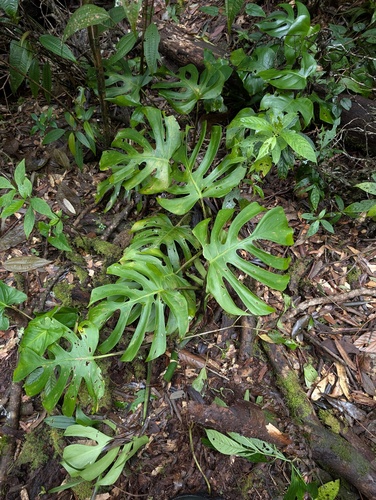
Monstera is a genus of 59 species of flowering plants in the arum family, Araceae, native to tropical regions of central and south America.
== Etymology ==
The genus is named from the Latin word for "monstrous" or "abnormal", and refers to the unusual leaves with natural holes, or fenestrations (slits) and perforations (holes), that most members of the genus have.
== Description ==
=== Growth pattern ===
They are evergreen vines, growing to heights of 20 metres (66 ft) in trees, climbing by means of aerial roots which act as hooks over branches; these roots will also grow into the soil to help support the plant. Since plants in the genus root both into the soil and over trees, it is considered a hemiepiphyte with roots in soil but climbing on trees. Aerial roots hanging directly to the ground have, according to Madison, measured up to 30 m (98 ft) long.
=== Leaves ===
The leaves are alternate, leathery, dark green, very large, from 25ā90 centimetres (9.8ā35.4 in) long (up to 300 centimetres (120 in) long in M. gigas) and 15ā75 centimetres (5.9ā29.5 in) broad, often with holes in the leaf blade. The fenestrated leaves allow for the leaves to spread over greater area to increase sunlight exposure, and to allow light to reach other leaves below, by using less energy to produce and maintain the leaves.
=== Inflorescence ===
The flowers are borne on a specialized inflorescence called a spadix, 5ā95 centimetres (2.0ā37.4 in) long; the fruit is a cluster of berries, with significant variation in color, edible in some species.
== Cultivation and care ==
Monsteras are widely cultivated as ornamental houseplants around the world for their large, decorative foliage and tolerance of indoor conditions. They thrive in bright, indirect light similar to the dappled sunlight of their native tropical forests. Direct sunlight can scorch the leaves, while low light may slow growth and reduce leaf splitting.
These plants prefer well-draining, aerated soil rich in organic matter, often containing components such as peat, perlite, or orchid bark. Watering should be moderateāallowing the top layer of soil to dry slightly between waterings helps prevent root rot. High humidity and warm temperatures between 18ā29 °C (65ā85 °F) encourage vigorous growth.
Regular pruning helps maintain shape, promotes larger leaves, and encourages new growth. Monsteras can be easily propagated from stem cuttings that include a node, which can root in water or soil under bright, indirect light. Fertilizing during the growing season with a balanced houseplant fertilizer supports healthy foliage and consistent growth.
Indoors, Monsteras are often trained to climb moss poles or trellises, mimicking their natural growth habit in tropical forests. With suitable care, they can live for many years and become a prominent feature in interior spaces.
== Species ==
As of November 2022 Plants of the World Online recognizes 70 accepted taxa (of 64 species and 6 infraspecific names):
Previously included:
Monstera alticola Croat
Monstera bocatorana Croat & Grayum
Monstera coloradensis Croat
Monstera fortunense Croat
Monstera gigantea (Roxb.) Schott - Epipremnum giganteum (Roxb.) Schott
Monstera jefense Croat
Monstera pirrense Croat
Commonly misidentified as Monstera:
Rhaphidophora tetrasperma
Thaumatophyllum bipinnatifidum
== References ==
== External links ==
Aroid Society
š Etymology
The genus is named from the Latin word for "monstrous" or "abnormal", and refers to the unusual leaves with natural holes, or fenestrations (slits) and perforations (holes), that most members of the genus have.
š Leaves
The leaves are alternate, leathery, dark green, very large, from long (up to long in M. gigas) and broad, often with holes in the leaf blade. The fenestrated leaves allow for the leaves to spread over greater area to increase sunlight exposure, and to allow light to reach other leaves below, by using less energy to produce and maintain the leaves.
š Inflorescence
The flowers are borne on a specialized inflorescence called a spadix, long; the fruit is a cluster of berries, with significant variation in color, edible in some species.
š Cultivation and care
Monsteras are widely cultivated as ornamental houseplants around the world for their large, decorative foliage and tolerance of indoor conditions. They thrive in bright, indirect light similar to the dappled sunlight of their native tropical forests. Direct sunlight can scorch the leaves, while low light may slow growth and reduce leaf splitting.
These plants prefer well-draining, aerated soil rich in organic matter, often containing components such as peat, perlite, or orchid bark. Watering should be moderateāallowing the top layer of soil to dry slightly between waterings helps prevent root rot. High humidity and warm temperatures between 18ā29 °C (65ā85 °F) encourage vigorous growth.
Regular pruning helps maintain shape, promotes larger leaves, and encourages new growth. Monsteras can be easily propagated from stem cuttings that include a node, which can root in water or soil under bright, indirect light. Fertilizing during the growing season with a balanced houseplant fertilizer supports healthy foliage and consistent growth.
Indoors, Monsteras are often trained to climb moss poles or trellises, mimicking their natural growth habit in tropical forests. With suitable care, they can live for many years and become a prominent feature in interior spaces.
š Species
Plants of the World Online recognizes 70 accepted taxa (of 64 species and 6 infraspecific names):
* Monstera acacoyaguensis
* Monstera acuminata ā Shingle plant
* Monstera adansonii
** Monstera adansonii subsp. adansonii
** Monstera adansonii subsp. blanchetii
** Monstera adansonii subsp. klotzschiana
** Monstera adansonii subsp. laniata
* Monstera alcirana
* Monstera alfaroi
* Monstera amargalensis
* Monstera anomala
* Monstera aureopinnata
* Monstera barrieri
* Monstera bocatorensis
* Monstera boliviana
* Monstera buseyi
* Monstera cenepensis
* Monstera costaricensis
* Monstera croatii
* Monstera deliciosa ā Ceriman, Swiss-cheese plant
* Monstera dissecta
* Monstera donosoensis
* Monstera dubia
* Monstera egregia
* Monstera epipremnoides
* Monstera filamentosa
* Monstera florescanoana
* Monstera gambensis
* Monstera gentryi
* Monstera gigas
* Monstera glaucescens
* Monstera gracilis
* Monstera guzmanjacobiae
* Monstera integrifolia
* Monstera juliusii
* Monstera kessleri
* Monstera kikiae
* Monstera lechleriana
* Monstera lentii
* Monstera limitaris
* Monstera luteynii
* Monstera maderaverde
* Monstera membranacea
* Monstera minima
* Monstera mittermeieri
* Monstera molinae
* Monstera momoi
* Monstera monteverdensis
* Monstera obliqua
* Monstera oreophila
* Monstera pinnatipartita
* Monstera pittieri
* Monstera planadensis
* Monstera praetermissa
* Monstera punctulata
* Monstera siltepecana
* Monstera spruceana
* Monstera standleyana
* Monstera subpinnata
* Monstera tablasensis
* Monstera tacanaensis
* Monstera tarrazuensis
* Monstera tenuis
* Monstera titanum
* Monstera tuberculata
** Monstera tuberculata var. brevinoda
** Monstera tuberculata var. tuberculata
* Monstera vasquezii
* Monstera wilsoniensis
* Monstera xanthospatha
Previously included:
* Monstera alticola
* Monstera bocatorana
* Monstera coloradensis
* Monstera fortunense
* Monstera gigantea (Roxb.) Schott - Epipremnum giganteum (Roxb.) Schott
* Monstera jefense
* Monstera pirrense
Commonly misidentified as Monstera:
* Rhaphidophora tetrasperma
* Thaumatophyllum bipinnatifidum