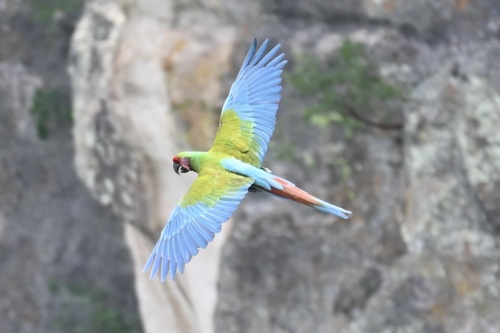
The military macaw is a medium- to large-sized macaw, named after its green and red plumage vaguely resembling a military uniform. It is native from west-central Mexico south through northern Argentina and Bolivia. While most wild populations are currently listed by the IUCN as vulnerable - and listed as endangered by Mexico - the species is still seen commonly in zoos and parks worldwide. The military macaw may be bred in captivity with relative ease, and is usually available through the pet trade. It is among the longest-lived one can own, requiring advanced knowledge, experience and confidence to keep them healthy, stimulated and thriving.
đĄïž Conservation Status
vulnerable
vu
đ Taxonomy
The military macaw was formally described in 1766 by Swedish naturalist Carl Linnaeus in the 12 edition of his Systema Naturae, where he placed it within the genus Psittacus, coining the binomial name Psittacus militaris. Linnaeus did not specify a type locality, but it was designated as 'Colombia' in 1912. The military macaw is, now, one of ten species in the genus Ara, designated in 1799 by French naturalist Bernard Germain de LacépÚde. The name Ara comes directly from the Tupi word arå ("macaw"), of the native Brazilian Tupi people. The word is also an onomatopoeia of the typically raucous vocalizations made by macaws. The specific epithet militaris is Latin meaning "military".
Three subspecies are recognised:
* A. m. mexicanus Ridgway, 1915 â Western MĂ©xico.
* A. m. militaris (Linnaeus, 1766) â Colombia, northwestern Venezuela, Ecuador, north and southeastern PerĂș and northwestern Bolivia.
* A. m. bolivianus Reichenow, 1908 â Central Bolivia and northwestern Argentina.
đ Behavior
Military macaws live in large flocks and can live about 50â60 years in the wild. They can often be heard long before they are seen. They are very noisy birds making a variety of loud cracking and shrieking sounds, including a loud kraa-aak. Military macaw activity has been observed most frequently in the morning and the evening meaning they are most likely a crepuscular species.
đ Food and feeding
Military macaws leave their roosts in flocks around dawn to forage. Their diet consists of mostly seeds but also includes fruits and leaves.
đ Breeding
]]
Pair-bonding behaviors include grooming and regurgitation and have been observed during breeding and non-breeding periods. Courtship occurs as early as March, and copulation in May to July. Breeding season is typically between March and October while incubation and hatching occur during August and September. During the breeding season, the male will feed the female 3â4 times a day.
đ Distribution and habitat
]]
, Mexico]]
Military macaws typically inhabit tropical deciduous and semi-deciduous forests. However, these macaws may seasonally fly down to lowlands, where they are likely in humid forests and thorny woodlands. They will nest in the tops of trees 8â28 m off the ground, and more often in cliff faces over above the ground.
The military macaw has escaped or been deliberately released into Florida, USA, but there is no evidence that the population is breeding and may only persist due to continuing releases or escapes.
đ Conservation
Military macaws are estimated to only have a breeding population of 2000â7000 individuals and is continuing to decrease. According to the ICUN red list, military macaws are listed as vulnerable as they face threats from habitat loss due to crops, deforestation, mining, and roads, with already extremely fragmented populations. Despite this, research shows that the trafficking of parrots from South America to North America is still common. Though they have moderate genetic diversity, they are still risk of population bottlenecks due to habitat fragmentation and inbreeding.