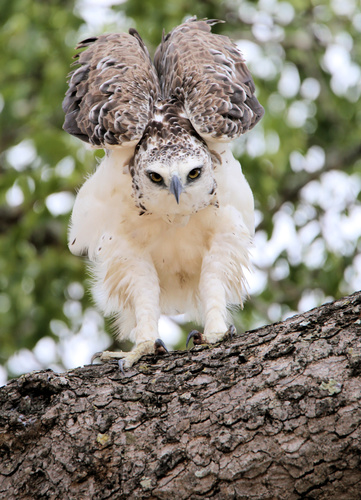
The martial eagle is a large eagle native to sub-Saharan Africa. It is the only member of the genus Polemaetus. A species of the booted eagle subfamily (Aquilinae), it has feathers over its tarsus. One of the largest and most powerful species of booted eagle, it is a fairly opportunistic predator that varies its prey selection between mammals, birds and reptiles. It is one of few eagle species known to hunt primarily from a high soar, by stooping on its quarry. This species, an inhabitant of wooded belts of otherwise open savanna, has shown a precipitous decline in the last few centuries due to a variety of factors. The martial eagle is one of the most persecuted bird species in the world. Due to its habit of taking livestock and regionally valuable game, local farmers and game wardens frequently seek to eliminate martial eagles, although the effect of eagles on this prey is almost certainly considerably exaggerated. Currently, the martial eagle is classified with the status of Endangered by the IUCN.
π‘οΈ Conservation Status
endangered
en
π Range
The martial eagle can be found in most of sub-Saharan Africa, wherever food is abundant and the environment favourable. With a total estimated distribution of about , it has a substantial distribution across Africa, giving it a somewhat broader range than other species there like the crowned eagle (Stephanoaetus coronatus) and the Verreaux's eagle (Aquila verreauxii). Although never common, greater population densities do exist in southern Africa and in some parts of east Africa. Martial eagles tend to be rare and irregular in west Africa but are known to reside in Senegal, The Gambia and northern Guinea-Bissau, southern Mali and the northern portions of Ivory Coast and Ghana. From southern Niger and eastern Nigeria the species is distributed spottily through Chad, Sudan and the Central African Republic as well as the northern, eastern, and southern portions of the Democratic Republic of the Congo. In east Africa, they range from Somaliland and Ethiopia more or less continuously south through Kenya, Uganda, Tanzania and in southern Africa from Angola, Zambia, Malawi and southern Mozambique to South Africa.
π Taxonomy
The Accipitridae family (hereafter accipitrids) is by far the most diverse family of diurnal raptors in the world, with more than 230 currently accepted species. As a member of the booted eagle subfamily, Aquilinae, the martial eagle is one of the roughly 15% of extant species in the family to have feathers covering its legs. Under current classifications, booted eagles consist of approximately 38 living species that are distributed in every continent inhabited by the accipitrids, which excludes only the continent of Antarctica. Just under half of the living species of booted eagle are found in Africa. Studies have been conducted on the mitochondrial DNA of most booted eagle species, including the martial eagle, to gain insight on how the subfamily is ordered and which species bear relation to one another. DNA testing in the 1980s indicated the martial eagle was a specialized off-shoot of the small-bodied Hieraaetus eagles, and one study went so far as to advocate that the martial eagle be included in the genus. Genetically, the martial eagle fell between two other species in monotypical genera, the African long-crested eagle (Lophaetus occipitalis) and the Asian rufous-bellied eagle (Lophotriorchis kienerii), that similarly diverged long ago from other modern species. Given the disparity of this species' unique morphology and the fact that the two aforementioned most closely related living species are only about as large as the bigger buzzards, the unique heritage of the martial eagle is evident.
There are no subspecies of martial eagle, and the species varies little in appearance and genetic diversity across its distribution.
π Sexual dimorphism
in Etosha National Park.]]
Martial eagles are highly sexually dimorphic. While females average about 10% larger in linear dimension, in body mass, the sexual dimorphism of martial eagles is more pronounced. Males reportedly can weigh from . Seven males in southern Africa averaged and five in another dataset averaged . Twelve adult males in Maasai Mara, Kenya averaged . Meanwhile, females can weigh from . In southern Africa, seven females averaging . In the Maasai Mara, 7 females averaged . Thus the dimorphism by weight is roughly 36% in favor of the female, which is unusually out-of-sync with the linear differences between the sexes. For example, the greater spotted eagle (Clanga clanga), the most sexually dimorphic booted eagle overall with a linear difference between the sexes of 20%, has around the same level of sexual dimorphism by body mass as the martial eagle which show about half as much linear dimorphism. Besides being larger, females tend to have more heavy spotting on the underside than males but this may be not a reliable field mark. In standard measurements, male martial eagles measure in wing chord size, in tail length and in tarsus length. Meanwhile, females measure in wing chord, in tail length and tarsal length. Overall, the bulk and much more massive proportions of females, which include more robust feet and longer tarsi, may at times allow experienced observers to sex lone birds in the wild.
π Colouring and field identification
.]]
The adult's plumage consists of dark brown coloration on the upperparts, head and upper chest, with an occasional slightly lighter edging to these feathers. The dark feathers can appear grayish, blackish or even plum-colored depending on lighting conditions. The body underparts are feathered white with sparse but conspicuous blackish-brown spotting. The underwing coverts are dark brown, with the remiges being pale streaked with black, overall imparting the wings of adults a dark look. The underside of the tail has similar barring as the remiges while the upperside is the same uniform brown as the back and upperwing coverts. The eyes of mature martial eagles are rich yellow, while the cere and large feet pale greenish and the talons black. Martial eagles have a short erectile crest, which is typically neither prominent nor flared (unlike that of the crowned eagle) and generally appears as an angular back to a seemingly flat head. This species often perches in a quite upright position, with its long wings completely covering the tail, causing it be described as "standing" rather than "sitting" on a branch when perched. In flight, martial eagles bear long broad wings with relatively narrow rounded tips that can appear pointed at times depending on how the eagle is holding its wings. It is capable of flexible beats with gliding on flattish wings, or slightly raised in a dihedral. This species often spends a large portion of the day on the wing, more so than probably any other African eagles, and often at a great height.
There are a few serious identification challenges for the species. The black-chested snake eagle (Circaetus pectoralis) is similar in overall colouring (despite its name it is brown on the chest and the back, being no darker than the adult martial eagle) to martial eagles but is markedly smaller, with a more prominent, rounded head with large eyes, plain, spotless abdomen, bare and whitish legs. In flight, the profile of the snake eagle is quite different, with nearly white (rather than dark brown) flight feathers and much smaller, narrower wings and a relatively larger tail. For juveniles, the main source for potential confusion is the juvenile crowned eagle, which also regularly perches in an erect position. The proportions of crowned eagles are quite distinct from martial eagles as they have much shorter wings and a distinctly longer tail. The juvenile crowned eagle has a whiter head, more scaled back, and spotted thighs and legs lacking in the martial eagle. Beyond their distinct flight profile by wing and tail proportions, crowned eagles have whiter and more obviously banded flight-feathers and tail. Other large immature eagles in Africa tend to be much darker and more heavily marked both above and below than martial eagles.
π Predatory physiology
Martial eagles have been noted as remarkable for their extremely keen eyesight (3.0β3.6 times human acuity), partly due to their eye being nearly as large as a human's eye. Due to this power, they can spot potential prey from a great distance, having been known to be able to spot prey from as far as away. Their visual acuity may rival some eagles from the genus Aquila and some of the larger falcons as the greatest of all diurnal raptors. The talons of martial eagles are impressive and can approach the size, especially in mature females, of those of the crowned eagle despite their slenderer metatarsus and toes compared to the crowned species. Accipitrids usually kill their prey with an elongated, sharp hind toe claw, which is referred to as the hallux claw and is reliably the largest talon in members of the accipitrid family. The average length of the hallux claw in unsexed martial eagles from Tsavo East National Park, Kenya was found to be . A further sample of martial eagles averaged in 6 males and in 7 females, with the median between the sexes being , these being the largest talons of all booted eagles behind only the crowned eagle. The inner claw on the front of the foot of the martial eagle is especially sizeable proportional to other extremities and unusually can approach, if not reach, the same size as the hallux claw. This inner claw was found to average , in comparison to that of the crowned eagle which measures . The tarsus is quite long in martial eagles, the fourth longest of any living eagle and the longest of any booted eagle species, seemingly an adaptation to prey capture in long grass, including potentially dangerous prey. The gape size of martial eagles is relatively large, however, being proportionally larger than in other booted eagle species behind (albeit considerably behind) the Indian spotted eagle (Clanga hastata) and the steppe eagle (Aquila nipalensis) in relative gape size, indicating a relative specialization towards swallowing large prey whole.
π Voice
The martial eagle is a weak and infrequent vocaliser. Little vocal activity has been reported even during the breeding season. The recorded contact call between pair-members consists of the birds, usually when perched, letting out a low mellow whistle, '. More or less the same vocalisation is known to have been uttered by females when male brings food and repeated mildly by large begging young. During territorial aerial display and sometimes when perched, adults may utter a loud, trilling '. The territorial call may be heard from some distance. Recent fledglings also at times make this call. A soft ' may be heard, made by pairs around their nest, perhaps being a mutual contact call. In comparison, the crowned eagle is highly vocal especially in the context of breeding.
π Behaviour
The martial eagle spends an exceptional amount of the time in the air, often soaring about hill slopes high enough that binoculars are often needed to perceive them. When not breeding, both mature eagles from a breeding pair may be found roosting on their own in some prominent tree up to several miles from their nesting haunt, probably hunting for several days in one area, until viable prey resources are exhausted, and then moving on to another area. However, martial eagles, especially adult birds, are typically devoted to less disturbed areas, both due to these typically offering more extensive prey selection and their apparent dislike for a considerable human presence. In general this species is more shy towards humans than other big eagles of Africa, but may be seen passing over populated country at times. The most frequently seen type of martial eagle away from traditional habitats are presumed nomadic subadults. One individual that was ringed as subadult was recovered 5.5 years later away from the initial banding site. Another martial eagle ringed as a nestling was found to have moved in 11 months.
π Dietary biology
The martial eagle is one of the world's most powerful avian predators. Due to both its underside spotting and ferocious efficiency as a predator it is sometimes nicknamed "the leopard of the air". The martial eagle is an apex predator, being at the top of the avian food chain in its environment. Martial eagles have been seen to charge at much larger adult ungulates and rake at their heads and flanks, at times presumably to separate the mammals from their young so they can take the latter with more ease. At other times, these eagles will set down upon a wide range of potentially dangerous prey including other aggressive predators in broad daylight, such as monitor lizards, venomous snakes, jackals and medium-sized wild cats. Over 170 prey species have been reported for the martial eagle which is a much higher number than the full prey spectrum of other larger African booted eagles, and even this may neglect some of the prey they take in the little studied populations from west and central Africa and the northern part of east Africa. Prey may vary considerably in size but for the most part, prey weighing less than are ignored by hunting martial eagles, with only about 15% of the known prey species averaging less than this. A majority of studies report the average size of prey for martial eagles being between . Average weight of prey taken has been reported at as low as . A food study largely based in data from the Great Rift Valley, Kenya, as well as from Maasai Mara, did reinforce a mean prey mass of just over for the species. However, the mean prey body mass is considerably higher in other known dietary studies. In by far the largest dietary study thus far conducted for the martial eagle species (in the Cape Province, South Africa) the estimated mean prey body mass was approximately . There is some evidence of prey partitioning (which can be potentially delineated both by prey species and body size of prey items taken) between the sexes. This is typical of raptors with pronounced size sexual dimorphism, as is the case in martial eagles. For instance, in populations where large adult monitor lizards are significant as prey, they only start to appear in prey remains at nests only after the female resumes hunting in the latter part of the breeding season. The sexual dimorphism of kills was verified in studies from the Great Rift Valley and Maasai Mara. One study stated that the mean weight of male kills was and that of females was . In Maasai Mara, the mean prey was significantly higher for both males, at about , and for females, at about .
π Mammals
The most diverse class of prey in the diet as known are mammals, with over 90 mammalian prey species reported. In Maasai Mara, the most regularly identified food, at 17.3% of 191 prey items (and particularly for male martial eagles at 23.9% of their kills), was found to be comprised by a mixture of cape and scrub hares, these in total weighing an estimated mean of . However, rodents selected as prey have ranged in size from the Southern African vlei rat (Otomys irroratus) to the South African springhare (Pedetes capensis) and the greater cane rat (Thryonomys swinderianus). There are records of predation on (the second largest African bat) straw-coloured fruit bats (Eidolon helvum) and galagos of various sizes (usually weighing a kilo or less) but otherwise mammalian prey they pursue tends to be relatively larger.
are the main prey for martial eagles in the Cape Province of South Africa.]]
Locally, large numbers are taken of any species of hyrax. The attractiveness of hyraxes as a prey resource may encourage martial eagles to vary their hunting techniques to potentially more time-consuming perch hunting so that they may capture rock hyraxes from rock formations and tree hyraxes from trees, contrary to their usual preference for capturing prey on the ground in the open after soaring high. Ranging in average mass from , hyraxes can comprise a healthy meal for a family of martial eagle and are probably among the larger items that male eagles will regularly deliver to nests. Another miscellaneous mammal known to fall prey to martial eagles is the ground pangolin (Smutsia temminckii), although it is not clear the age pangolins that are preyed on and how they are dispatched, considering that adults weigh some and have a hard keratin shell that is capable of withstanding lion (Panthera leo) jaws when in its rolled-up defensive posture.
Although far less accomplished and prolific as a predator of monkeys than the crowned eagle, the martial eagle has been known to prey on at least 14 species of monkey. The monkeys to turn up most often as martial eagle prey are grivets (Chlorocebus aethiops), vervet monkeys (Chlorocebus pygerythrus) and malbroucks (Chlorocebus cynosuros), with mean body masses of , and , respectively, because of their savanna-woods dwelling habits, tendencies to forage on the ground and their primarily diurnal activity. These monkey species have special alarm calls, distinct from those uttered in response to the presence of for example a leopard (Panthera pardus), specifically for martial eagles. Martial eagles are also known to prey on lesser spot-nosed monkeys (Cercopithecus petaurista), Lowe's mona monkeys (Cercopithecus lowei), and possibly larger Tana River mangabeys (Cercocebus galeritus) and red colobus (colobus badius). Predatory attacks on juvenile baboons (Papio sp.) by martial eagles have been reported, especially olive baboons (Papio anubis). On at least one occasion, this species has attacked humans with apparently predatory intent, making it one of the only birds of prey to do so. In 2019 a young boy was killed and two other children injured by an immature martial eagle in the Ethiopian town of Gaashaamo.
A wide range of mammalian carnivores are important prey for martial eagles. Among these many mongoose tend to be well represented in their diet. Most mongooses native to the savanna tend to be highly social burrowers. The martial eagle is a known predator of the full size range of mongoose species, from the smallest species, the common dwarf mongoose (Helogale parvula), to the largest, the adult white-tailed mongoose (Ichneumia albicauda). However, most of these types of mongoose are also relatively small, and can effectively escape quickly to the safety of their underground home, so the lighter, more nimble male martial eagle is more likely to habitually pursue them. In southern Africa, the meerkat (Suricata suricatta) comprises up to at least 9.6% of prey remains (as in the Cape Province) and the Cape grey mongoose (Galerella pulverulenta) comprising an average of 7.2% of prey remains in the Cape area. In pooled data from the Great Rift Valley and Maasai Mara, the banded mongoose (Mungos mungo), the largest of the social savanna-dwelling mongoose at , fell third behind only francolins and hares as the most regularly selected prey for martial eagles. Other similar-sized carnivores known to fall prey to martial eagles include striped polecat (Ictonyx striatus) and a few species of genet, which are about twice as heavy on average as the polecat. Even larger black-backed jackals (Canis mesomelas) are occasionally targeted as prey, especially young pups. Adult domestic dogs (Canis familiaris) of up to a modest size may occasionally be killed by martial eagles. Martial eagles are also known to opportunistically grab pups of African wild dogs (Lycaon pictus) as they emerge from their dens. Although less frequently taken, a few species of felids have been included in their prey spectrum. Adults of both domestic cats and their ancestors, the African wildcat (Felis lybica), are known to fall prey to this species. Apparent predatory attacks are even attempted on big cat cubs as they are considered potential predators of leopard (Panthera pardus) cubs and confirmed predators of lion and cheetah (Acinonyx jubatus) cubs. However, they rapidly abandon hunting attempts if the formidable mother lion or leopard is present. Successful predatory attacks on other carnivores have included small African civet (Civettictis civetta) and the juvenile aardwolf (Proteles cristata).
are one of the two main prey species for martial eagles in Tsavo East National Park, Kenya.]]
While large accipitrids worldwide are credited with attacks on young or small ungulates, perhaps no other species is as accomplished in this regard as this martial eagle. Over 30 species of ungulate have been identified as prey for this species, more species than are attributed to the perhaps more powerful crowned eagles and all the world's golden eagles. However, in all three, ungulates in a given region comprise more than 30% of the diet. A majority of the ungulate diet of martial eagles are comprised by small antelope species or the young of larger antelopes. In Maasai Mara, young ungulates appeared particularly significant in the diet of adult female martial eagles, with impala (Aepyceros melampus) fawns averaging an estimated comprising 34.2% of female kills (and 13.6% of the species' overall foods) and Thomson's gazelle (Eudorcas thomsonii) fawns at about comprising a further 15.1% of female kills (and 10.5% of the overall diet here). Furthermore, young Grant's gazelles (Nanger granti), weighing a mean of , were sometimes taken by females in Maasai Mara. Calves of the other antelope may also be included in their prey spectrum, including hartebeest (Alcelaphus buselaphus), bontebok (Damaliscus pygargus), common tsessebe (Damaliscus lunatus), springbok (Antidorcas marsupialis), Eudorcas gazelles, gerenuk (Litocranius walleri), bushbuck (Tragelaphus sylvaticus), grey rhebok (Pelea capreolus), kob (Kobus kob) and mountain reedbuck (Redunca arundinum). These species can vary in weight from (i.e. gazelles) to (i.e. tsessebe) in newborns. Additionally, piglets of warthogs (Phacochoerus africanus) (of which only the martial eagle among accipitrids is similarly mentioned as a significant predator) and bushpigs (Potamochoerus larvatus) are taken.
While martial eagles usually tend to focus on young fawns, adults of small antelopes are also attacked and taken as prey. Locally favored prey are the dik-diks, one of the smallest kinds of antelope, and every known species may be vulnerable to this eagle. In Tsavo East National Park, Kirk's dik-dik (Madoqua kirkii) were the second most numerous prey species and it was estimated that at least 86 dik-diks are taken in the park over the year by two pairs of martial eagles. At an average of , these can provide a very fulfilling meal for an eagle family. The largest prey taken by martial eagles are common duiker (Sylvicapra grimmia), potentially weighing from in weight. However, one adult female duiker dispatched via strangulation weighed an estimated , one of the largest known raptorial kill for any species on the African continent.
π Birds
are among the most favored prey species for martial eagles, known to be taken in considerable numbers everywhere from West Africa to South Africa.]]
Compared to the range and sizes of mammals included in their prey spectrum, birds taken by martial eagles may seem less impressive as a whole, but the morphology of the martial eagle, including large wing surface areas, pronounced sexual dimorphism and relatively long toes, shows that the species is at least partially specialized to hunt avian prey. Birds are universally considered by biologists more difficult to capture than mammals of the same size. In all, more than 50 bird species have been identified as the prey of martial eagles. The most significant portion of the avian diet is comprised by medium-sized terrestrial upland birds such as guineafowl, spurfowl, francolins and bustards. In total more than a dozen species of the galliform order and the bustard family each have been identified as their prey. Other guineafowl such as the vulturine (Acryllium vulturinum) and crested guineafowl (Guttera edouardi) are also readily taken elsewhere. Guineafowl and spurfowl were stated as the most numerous prey for martial eagles in Kruger National Park. In Tsavo East National Park, the red-crested korhaan (Lophotis ruficrista), perhaps the smallest bustard the eagle hunts, is the most numerous prey taken, comprising about 39% of the prey remains. Based on the high estimated weight when taken of Egyptian goose of , male geese may be targeted over females. The diversity and number of storks taken is particularly impressive. They are known to take 8 species of stork, ranging from the smallest known species, the African openbill (Anastomus lamelligerus), to the tallest species in the world, the , -tall saddle-billed stork (Ephippiorhynchus senegalensis). One naturalists observed up to a half dozen attacks in different parts of Africa on white storks (Ciconia ciconia). Short of three attacks on spotted thick-knees (Burhinus capensis), which weigh about , and smaller still crowned lapwings (Vanellus coronatus) so far as is known small waders or shorebirds are ignored as prey. Beyond occasional captures of other birds of prey (covered later), one other impressive avian prey species is the southern ground hornbill (Bucorvus leadbeateri), which at is probably the world's largest hornbill. At the other end of the scale, some martial eagles may capture a few small social species of passerine, which are exceptionally small prey (the smallest recorded prey species for the eagle overall), potentially consisting of the red-billed queleas (Quelea quelea) and the sociable weavers (Philetairus socius), as practically every meat-eating bird in Africa may be attracted to these species' colonial abundance.
π Reptiles
, can be important prey for adult female martial eagles.]]
Reptiles can be locally important in the diet, and they are known to take larger numbers of reptiles than other large African booted eagles. Only relatively large reptiles, it seems, are attacked and many of this prey is also potentially dangerous, so martial eagles have unusually long, gracile tarsi, perhaps an adaptation to dangerous large reptilian prey. A small food study in Zimbabwe found that 69% of 39 prey items were made up of monitor lizards. Large monitors such as rock monitors (Varanus albigularis), the nile monitors (Varanus niloticus) and the savannah monitors (Varanus exanthematicus) are mainly taken. These monitors are the largest lizards in Africa, weighing roughly around in standard adults, can be a formidable but fulfilling prey. So most of the hunts are ambushes on adult monitors by mature female eagles.
Other reptiles are also occasionally taken. In Kruger National Park, reptiles as a whole made up 38% of the prey remains. These consisted of monitor lizards as well as a wide range of snakes. In one case, an estimated nile crocodile (Crocodylus niloticus) was captured and flown with by a martial eagle.
π Interspecies predatory relationships
For terrestrial predators, including birds of prey, sub-Saharan Africa may be the most competitive environment in the modern world. Due to great diversity of raptors present, each species have shown adaptive specializations, which may consist of various morphological differences that allow them to capitalize on distinct prey selection, hunting methods, habitat and/or nesting habits. The larger booted eagles that dominate the avian food chain in Africa consists of martial eagles, Verreaux's eagles and crowned eagles, which due to their size and conspicuousness may lend themselves to comparisons. While prey species may overlap in these in southern Africa and some parts of east Africa, where the prey size range of all three eagles averages , these three powerful eagles differ considerably in habitat preferences, nesting habits and hunting methods. The Verreaux's eagle nests in and hunts around rocky, mountainous kopje to be in close proximity to the much favored prey, rock hyraxes, which they mainly use contour-hunting (hugging the uneven ground to surprise the prey) to capture. The crowned eagle dwells mainly in mature forests, building nests in large interior trees, and is primarily a perch-hunter, watching and listening for monkeys and other prey over a long period. While all three are known to locally favor rock hyraxes, the nesting habitat differences where they overlap are sufficient to allow these birds not to effect one another. The average prey mass of Verreaux's eagle was similar to that martial eagles, with a pair of studies showing it ranges from . The mean prey mass of crowned eagles in southern Africa also appears to be similar to that of martial eagles but in west Africa (i.e. Ivory Coast) it was considerably heavier at (which may well be the highest mean prey mass for any of the world's raptors). Elsewhere, mean prey masses for the larger booted eagles appears to be considerably smaller than in the larger African species, i.e. single studies for the Spanish imperial eagle (Aquila adalberti) and wedge-tailed eagles showed means of and , respectively, while a large number of extensive dietary studies for the golden eagle show its global mean prey mass is around .
More similar in habitat and, locally, prey selection to martial eagles are three medium-sized eagles, the African hawk-eagle (Aquila spilogaster), the tawny eagle (Aquila rapax) and the bateleur (Terathopius ecaudatus). Leopards also rarely steal kills from martial eagles but may also be robbed of small kills by martial eagles, as may cheetahs. In another case, a martial eagle stole a rock hyrax from a bearded vulture (Gypaetus barbatus). One other species worth noting is the Verreaux's eagle owl (Bubo lacteus), as it is similarly the largest African owl, weighing about , with almost identical habitat preferences and distributional range as the martial eagle. While there is considerable overlap in their diets, there are discrepancies as the eagle owl tends to hunt large numbers of hedgehogs (not known in the eagle's diet) and occasionally high quantities of mole-rats. When considered this in combination with their different times of activity and the fact that the eagle owl weighs about half as much as the martial eagle, direct competition probably does not affect either predator in any considerable way.
The martial eagle infrequently hunts other birds of prey, perhaps doing so only slightly more often than do crowned eagles and Verreaux's eagles. Nonetheless, a somewhat diverse range of raptorial birds have been identified as prey for martial eagles: the lanner falcon (Falco biarmicus), the peregrine falcon (Falco peregrinus), the spotted eagle owl (Bubo africanus) (with a surprisingly large number of 6 found at one nest in Tsavo East), the pale chanting goshawk (Melierax canorus), the hooded vulture (Necrosyrtes monachus) (in one case after a protracted aerial battle), the white-headed vulture (Trigonoceps occipitalis) and even Africa's largest bird of prey, the Cape vulture (Gyps coprotheres). As apex predators, martial eagles are themselves largely invulnerable to predation. A video exists that purportedly depicts a leopard killing a martial eagle but this eagle was misidentified as it actually features a leopard preying on an immature African fish eagle (Haliaeetus vociferus) (and, at that, one that was possibly grounded for unknown reasons). There are, however, verified (if rare) cases of caracals preying on sleeping martial eagles at night, by climbing trees and pouncing in an ambush. Additionally a case was reported where a honey badger killed an incubating adult martial eagle. It is possible that leopards may too ambush sleeping eagles, but post-fledgling martial eagles are known to be highly wary, and healthy individuals a great majority of the time will successfully evade potential dangers by day.
π Territoriality
Despite their rather aerial existence, the territorial display of adult martial eagles is considered relatively unspectacular. Their display often consists of nothing more than the adult male or both members of a pair circling and calling over their home range area or perching and calling near nestlings. Compared to other large African booted eagles, this species infrequently "sky-dances" (i.e. undulation and dramatic movements high in the sky), but some are known with presumably the male martial eagle only engaging in shallow undulations. During mutual circling, the adult female may turn and present talons. Martial eagles are not known to "cartwheel" which is when two eagles lock feet and circle down, falling almost to the ground, an action that was once thought to be part of breeding displays but is now generally considered territorial in nature. The territory of martial eagles can vary greatly in size. The average home range is estimated to be in east Africa and southern Africa, with mean distances between nests of approximately . In protected areas of west Africa, the average home range size of martial eagles is about . Somewhat surprisingly, considering their relative scarcity in west Africa overall in comparison in east and southern Africa, home ranges may be just as large in some parts of Kenya, at up to , and the largest known home ranges sizes known come from southern Africa. These are from Zimbabwe's Hwange National Park where the home ranges may be anywhere from , with average spacing between nests of . By the 1990s, approximately 100 pairs were estimated to breed in Hwange. This disparity in territory sizes are likely due to regional differences in food supply, persecution rates and habitat disturbance.
π Breeding
.]]
Martial eagles may breed in various months in the different parts of their range. They are considered a fairly early breeder compared to the average for sub-Saharan Africa birds of prey but breed much less early than bateleurs. The mating season is in November through April in Senegal, January to June in Sudan, August to July in northeast Africa and almost any month in east Africa and southern Africa, though mostly in AprilβNovember. The breeding season may thus begin in various parts of the range in a wet season or the earlier or later part of the local dry season so that no part of the brooding stage will occur during heavy rains. In the karoo of South Africa, they have also nested on electric-power pylons. Locally, with the sometimes epidemic levels of clear-cutting of old-growth trees, such pylons may provide a fairly suitable alternative that the eagles can utilize in absence of woodlands. The nest of the martial eagle is a large and conspicuous construction of sticks. In the first year of construction, the nest will average in diameter and measure about deep. After regular use over several years, the nests can regularly measure in excess of in both diameter and depth. The nest may be lightly lined with green leaves.
Martial eagles have a slow breeding rate, laying usually one egg (rarely two) every two years. Clutches of two have only been reported only in South Africa and once in Zambia, and the younger sibling probably never survives or possibly ever even hatches unless the first egg or hatchling dies. Martial eagle eggs are rounded oval and are white to pale greenish-blue, variously. Sometimes they may be handsomely marked with brown and grey blotches. The eggs of martial eagles measure on average among 57 eggs, with ranges of in egg length by in width. Their eggs are the largest of any booted eagle, slightly larger on average than those of golden or Verreaux's eagle and considerably larger than those of crowned eagles. The egg is incubated for 45 to 53 days. The female does a great majority of the incubation, as is typical, but the male may relieve her and incubate for a maximum of three hours in a day. Once the eggs hatch, the male of a pair may rarely brood the young but has never been seen to the feed the chick and, for the most part, the male just brings prey for the female to distribute between herself and the nestling. The female attendance at the nest drops considerably at seven weeks after hatching, at which point she resumes hunting. Then, the female may become main food provider but males will also make deliveries. Despite her lower attendance, she still roosts on or near the nest until the nestling stage is done. Despite the occasional capture of food, the male usually is rarely seen near the nest after the female resumes hunting. In Kenya in the 1960s, breeding success at producing a fledgling was 72% for all eggs and 48% for all possible attempts. Here, various pairs reared between 0.25 and 1 young per pair, averaging 0.55. In the Namibian Nest Record Scheme, where young were monitored for more than two months, success has also been estimated at 83%, i.e. five out of six attempts. At Kalahari Gemsbok National Park, South Africa, 38 of 53 martial eagle breeding attempts were in consecutive years and fledged an average 0.43 young per year. Almost without predators and other natural threats, the martial eagles is quite a long-lived bird with an average lifespan estimated to be 12 to 14 years. However, due to fact that they do not reproduce under normal circumstances until they are 6 to 7 years old and their sporadic, widely placed breeding attempts, makes the martial eagle an exceptionally unproductive bird with very low population replacement levels.
, South Africa]]
π Conservation issues
]]
The martial eagle is probably naturally scarce, due to its requirement for large territories and low reproductive rates. Nonetheless, the species has been experiencing a major decline in numbers in recent years, due largely to being directly killed by humans. Its conservation status was uplisted to Near Threatened in 2009 and to Vulnerable in 2013, and once again to Endangered in 2020. The local name of martial eagles in South Africa is lammervanger (or "lamb catcher"). Into the 21st century, the martial eagle continue to be strongly disliked by farmers and shot at on sight, even by those favorable towards other eagle species.
In southern Africa, many martial eagles have taken to nesting on high-tension pylons in areas that are now often absent of large trees, it is one of the few raptors to actually possibly reap more benefit than harm from the presence of these (death by collision with wires and pylons is now one of the worst killers of birds of prey, especially in Europe and southern Africa). However, collision with power lines can be a serious source of mortality, being a common modern problem for especially immature martial eagles, which are less self-assured fliers. Another hazard is caused by steep sided farm reservoirs in South Africa, in which many birds drown. Of 68 eagle drownings there, 38% were martial eagles, the highest percentage of any raptor recorded to be killed by this (again mostly immatures are claimed by this cause of mortality). In South Africa, this eagle may have lost 20% of its population in the last three generations due to such collisions. Further exacerbating the problems faced by the martial eagle, habitat destruction and reduction of prey continues to occur at a high rate outside of protected areas. Due to this large swathes of their former breeding range are now unsuitable. The preservation of this species depends on education of farmers and other local people, and the increase of protected areas where the species can nest and hunt without excessive disturbance.