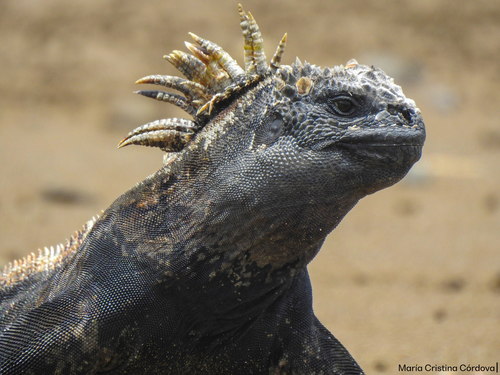
The marine iguana, also known as the sea iguana, saltwater iguana, or Galápagos marine iguana, is a species of iguana found only on the Galápagos Islands (Ecuador). Unique among modern lizards, it is a marine reptile that has the ability to forage in the sea for algae, which make up almost all of its diet. Marine iguanas are the only extant lizard that spends time in a marine environment. Large males are able to dive to find this food source, while females and smaller males feed during low tide in the intertidal zone. They mainly live in colonies on rocky shores where they bask after visiting the relatively cold water or intertidal zone, but can also be seen in marshes, mangrove swamps and beaches. Large males defend territories for a short period, but smaller males have other breeding strategies. After mating, the female digs a nest hole in the soil where she lays her eggs, leaving them to hatch on their own a few months later.
🛡️ Conservation Status
vulnerable
vu
📌 Taxonomy and evolution
===Species description and etymology===
The marine iguana was first described in 1825 as Amblyrhynchus cristatus by Thomas Bell. He recognized several of its distinctive features, but believed that the specimen he had received was from Mexico, a locality now known to be erroneous.
Its generic name, Amblyrhynchus, is a combination of two Greek words, Ambly- from Amblus (ἀμβλυ) meaning "blunt" and rhynchus (ρυγχος) meaning "snout". Its specific name is the Latin word cristatus meaning "crested," and refers to the low crest of spines along the animal's back.
Amblyrhynchus is a monotypic genus, having only one species, Amblyrhynchus cristatus.
📌 Evolution
, the result of interbreeding between a marine iguana and a Galápagos land iguana]]
Researchers theorize that Galapagos land iguanas (genus Conolophus) and marine iguanas evolved from a common ancestor since arriving on the islands from Central or South America, presumably by rafting. The land and marine iguanas of the Galápagos form a clade, the nearest relatives of which are the Ctenosaura iguanas of Mexico and Central America. It has therefore traditionally been thought that the ancestral species inhabited parts of the volcanic archipelago that are now submerged. However, a more recent study that included both mtDNA and nDNA indicates that the two split about 4.5 million years ago, which is near the age of the oldest extant Galápagos islands (Española and San Cristóbal). This is very rare and has only been documented a few times on South Plaza, a tiny island where the usually separated breeding territories and seasons of the two species overlap. The hybrids have intermediate features, stay on land and are infertile.
The different marine iguana populations fall into three main clades: western islands, northeastern islands and southeastern islands.
📌 Subspecies
Seven or eight subspecies of the marine iguana, listed alphabetically, have traditionally been recognized:
* A. c. albemarlensis Eibl-Eibesfeldt, 1962 – Isabela Island
* A. c. ater Gray, 1831 (not always recognized) – Pinzón Island
* A. c. cristatus Bell, 1825 – Fernandina Island
* A. c. hassi Eibl-Eibesfeldt, 1962 – Santa Cruz Island
* A. c. mertensi Eibl-Eibesfeldt, 1962 – San Cristóbal and Santiago Islands
* A. c. nanus Garman, 1892 – Genovesa Island
* A. c. sielmanni Eibl-Eibesfeldt, 1962 – Pinta Island
* A. c. venustissimus Eibl-Eibesfeldt, 1956 – Española Island and adjacent tiny Gardner Island
In 2017, the first comprehensive taxonomic review of the species in more than 50 years came to another result based on morphological and genetic evidence, including recognizing five new subspecies (three of these are small-island populations that were not previously assigned to any subspecies):
* A. c. cristatus Bell, 1825 (albermarlensis and ater are junior synonyms) – Isabela Island and Fernandina Island
* A. c. godzilla Miralles et al., 2017 – northeastern part of San Cristóbal Island, named after the character of Godzilla
* A. c. hassi Eibl-Eibesfeldt, 1962 – Santa Cruz Island and smaller adjacent islands, such as Baltra Island
* A. c. hayampi Miralles et al., 2017 – Marchena Island
* A. c. jeffreysi Miralles et al., 2017 – Wolf Island, Darwin Island and Roca Redonda
* A. c. mertensi Eibl-Eibesfeldt, 1962 – southwestern part of San Cristóbal Island
* A. c. nanus Garman, 1892 – Genovesa Island
* A. c. sielmanni Eibl-Eibesfeldt, 1962 – Pinta Island
* A. c. trillmichi Miralles et al., 2017 – Santa Fé Island
* A. c. venustissimus Eibl-Eibesfeldt, 1956 – Española Island (including adjacent tiny Gardener Island) and Floreana Island
* A. c. wikelskii Miralles et al., 2017 – Santiago Island and smaller adjacent islands, such as Rábida Island
File:Galápagos marine iguana.jpg|A. c. albemarlensis on Isabela Island (a synonym of A. c. cristatus based on the 2017 review)
File:Marine Iguana (A. c. cristatis), male, Fernandina Island.jpg|A. c. cristatus on Fernandina Island
File:Marine Iguana (A. c. hassi), male, Santa Cruz Island.jpg|A. c. hassi on Santa Cruz Island
File:Dry landing excursion to Isla Lobos - Amblyrhynchus cristatus - Marine iguana (16503527890).jpg|A. c. mertensi on Isla Lobos, off San Cristóbal Island
File:Marine Iguana (A. c. nanus), male, Genovesa Island.jpg|A. c. nanus on Genovesa Island
File:Marine-Iguana-Espanola.jpg|A. c. venustissimus on Española Island
File:Marine Iguana (A. c. mertensi), Santiago Island, Ecuador.jpg|A. c. wikelskii on Santiago Island (formerly included in A. c. mertensi)
📌 Appearance
was revolted by the animals' appearance, writing:
:The black Lava rocks on the beach are frequented by large (2–3 ft []), most disgusting, clumsy Lizards. They are as black as the porous rocks over which they crawl & seek their prey from the Sea. Somebody calls them 'imps of darkness'. They assuredly well-become the land they inhabit.
Marine iguanas have a thickset body and relatively short, robust limbs. Adults have a row of spines extending from the nape, along the back to the tail. Males have longer spines, and larger bony plates on the top of their head than females. There are some differences in the spines depending on the island and they are most elaborate on Fernandina (subspecies cristatus). Females show much less variation between the islands and are typically dark with less contrasting colours than the males.
📌 Size
(subspecies hassi) are among the largest]]
Marine iguanas typically range from in snout-to-vent length and have a tail length from . There are major geographical differences, as iguanas from large islands tend to grow relatively large as adults, while those from small islands are smaller in size. However, the largest females are only about 20–40% shorter than the largest males. Some individuals have been shown to shrink in body size by up to 20% during El Niño events and grow back to their previous size when food became available again.
📌 Behavior
===Reproduction and life cycle===
]]
Female marine iguanas reach sexual maturity at the age of 3–5 years, while males reach sexual maturity at the age of 6–8 years. Sexual maturity is marked by the first steep and abrupt decline in bone growth cycle thickness.
Reproduction in the marine iguana begins during the last part of the cold and dry season, but sometimes more than 1,000. Their bodies often touch each other, but there are no social interactions like grooming, as commonly seen in social mammals and birds. However, large males defend territories for up to three months during the breeding season, and in this period they sometimes fight other males. but is usually less than half that size, and can be as small as . Other factors involved in the female's choice of partner are the display frequency by a male (especially head-bobbing) and the quality of a male's territory. Males with territories that are near the center of the lek tend to have a greater mating success than males with peripheral territories, but the size of a territory does not affect mating success. Females can move freely between different territories, but receive less harassment from opportunistic non-territorial males when inside another male's territory. If she accepts, the male will mount her while holding her by the neck. A mating lasts no more than 20 minutes, but it is comparatively rapid in the small "sneaky" males, which easily are overlooked because their size, general morphology and colours are similar to those of a female. typically two or three. The leathery white eggs measure about and weigh . They are occasionally as little as inland, although they have to be above the high tide water mark. The nest is deep and dug in sand or volcanic ash by the female. On islands where there are few suitable sites and digging is difficult due to a relatively hard soil and many rocks, the female guards the nest for several days after the eggs have been buried, ensuring that they are not dug up by other nesting females. As in males defending their territory from other males, females defending their nest site from other females begin with a threat display. If this fails to scare the opponent away, the fights between females involve much biting and are less ritualized than the territorial fights between males. Where there are more suitable sites and the soil is loose, females are less likely to fight for a location and do not guard their nest after the eggs have been buried. The eggs hatch after about three to four months. The hatchlings are in snout-to-vent length, and weigh . As soon as they emerge from the nest they run for cover, and begin their trip to locations that provides optimum conditions for feeding, temperature regulation and shelter. Some hatchlings have been recorded moving as far as in two days.
📌 Feeding
, like this Cortez rainbow wrasse. This iguana is on a rock covered in green and red algae, with the usually avoided brown algae behind it.]]
The marine iguana forages almost exclusively on red and green algae in the inter- and subtidal zones. At least 10 genera of algae are regularly consumed, including the red algae Centroceras, Gelidium, Grateloupia, Hypnea, Polysiphonia and Pterocladiella. In some populations, the green algae Ulva dominates the diet. A marine iguana typically eats about dry weight or fresh weight of algae per day. At Punta Espinoza on northeastern Fernandina Island it has been estimated that the almost 1,900 marine iguanas eat about (fresh weight) of algae per year, The population on North Seymour Island will supplement their diet with land plants, primarily Batis maritima, or other coastal succulents like Sesuvium portulacastrum. At about 1–2 years old the young may voluntarily swim in shallow water and tide pools, but they do not dive. Most dives are much shorter in duration and shallower than . Most females and smaller males feed on exposed algae in the intertidal zone during low tide, The separation in feeding behavior is advantageous because the large offshore feeding males experience less competition for food from smaller males and females.
Foraging behavior changes in accordance to the seasons and foraging efficiency increases with temperature.
Marine iguanas have several adaptions that aid their feeding. Their flattened tail is the primary means of propulsion in the water.
📌 Mutualism and commensalism with other animals
often scurry over marine iguanas when hunting flies; the iguanas generally ignore these visits]]
Marine iguanas have mutualistic and commensal relationships with several other animals. Lava lizards may scurry over marine iguanas when hunting flies, and Darwin's finches, mockingbirds and Sally lightfoot crabs sometimes feed on mites and ticks that they pick off their skin. Marine iguanas typically ignore these visits. When underwater, they are often cleaned by fish, like Pacific sergeant majors that pick off moulting skin. Although there are no apparent benefits to either species, marine iguanas commonly live close together with the much larger Galápagos sea lions. The two species generally ignore each other and an iguana may even crawl over the body of a sea lion.
📌 Thermoregulation
]]
Marine iguanas are unique as they are marine reptiles that forage on inter- and subtidal algae almost exclusively. They forage in the relatively cold waters around the Galápagos Islands, which typically are between at the sea surface. To conserve heat during the night, they often sleep closely together in groups that may number up to 50 individuals, while others sleep alone below plants or in crevices.
In general, the time of each foraging trip is directly related to the water temperature; the colder the water the shorter the foraging trip. Additionally, marine iguanas that forage in or near the intertidal zone prefer to do so during low tides, allowing them to remain on land (on rocks exposed by the tide) or return to land faster. Individuals that forage further from the shore by diving are large males, which mainly feed during the hot midday (although it may occur from late morning to early evening), are less affected by the cool water because of their body size and are more efficient swimmers.
Under the tropical sun, overheating can also be a problem. To avoid this, they pant, and adopt a posture where they face the sun and lift their body up, thereby exposing as little as possible of their body to direct sun and allowing cooling air to pass underneath.
📌 Conservation
===Status and threats===
The marine iguana has a relatively small range and is currently considered vulnerable by the IUCN.
On some shorelines they can be very numerous, with densities as high as 8,000 per kilometer (almost 13,000 per mile), The total population for the entire archipelago is estimated to be 200,000–300,000 individuals, Population recoveries after El Niños are fast; even when reduced by 30–50%, the population is generally able to recover within four years. Introduced predators represent a major problem on the islands of Santa Cruz, Santiago, Isabela, Floreana and San Cristóbal where very few marine iguana hatchlings survive. Marine iguanas are ecologically naïve and have not developed efficient anti-predator strategies against the introduced species. For example, the first dogs were introduced to the Galápagos Islands more than 100 years ago, but marine iguanas have not developed an anti-predator strategy against them. When swimming, marine iguanas are occasionally attacked and eaten by sharks, although the two often behave indifferently to each other, even when close together. Marine iguanas have anti-predator strategies that reduce the impact of the Galápagos hawk, including an increased vigilance when hearing the alarm call of the Galápagos mockingbird, another species that is sometimes preyed upon by the hawk.
Marine iguanas can easily be approached by humans as they are very tame and generally make little or no attempt to escape.
Occasional oil spills in the region also present a threat. For example, the Santa Fé population was reduced by almost as a result of the MV Jessica oil spill in 2001, and even low-level oiling may kill marine iguanas. It is suspected that the primary cause of death during these events is starvation due to the loss of their sensitive gut bacteria, which they rely on to digest algae.
📌 Protection
warning people to not disturb the marine iguanas and keep a distance of at least ]]
The marine iguana is completely protected under the laws of Ecuador, and is listed under CITES Appendix II.) and all its sea range is in the Galápagos Marine Reserve. In 2012, the last black rats were eradicated from Pinzón Island.
Studies and research have been done on marine iguanas that can help and promote conservation efforts to preserve the endemic species. Monitoring levels of marine algae, both dimensionally and hormonally, is an effective way to predict the fitness of the marine iguana species. Exposure to tourism affects marine iguanas, and corticosterone levels can predict their survival during El Niño events. Corticosterone levels in species measure the stress that they face in their populations. Marine iguanas show higher stress-induced corticosterone concentrations during famine (El Niño) than feast conditions (La Niña). The levels differ between the islands, and show that survival varies throughout them during an El Niño event. The variable response of corticosterone is one indicator of the general public health of the populations of marine iguanas across the Galápagos Islands, which is a useful factor in the conservation of the species.
Another indicator of fitness is the levels of glucocorticoid. Glucocorticoid release is considered beneficial in helping animals survive stressful conditions, while low glucocorticoid levels are an indicator of poor body condition. Species undergoing a large measure of stress, resulting in elevated glucocorticoid levels can cause complications such as reproduction failure. Human activity has been considered a cause of elevated levels of glucocorticoid in species. Results of a study show that marine iguanas in areas central to tourism are not chronically stressed, but do show lower stress response compared to groups undisturbed by tourism. Tourism, thus, does affect the physiology of marine iguanas. Information of glucocorticoid levels are good monitors in predicting long term consequences of human impact.
Although marine iguanas have been kept in captivity, the specialised diet represents a challenge. They have lived for more than a decade in captivity, but have never bred under such conditions. The development of a captive breeding program (as already exists for the Galápagos land iguana) possibly is a necessity if all the island subspecies are to survive.