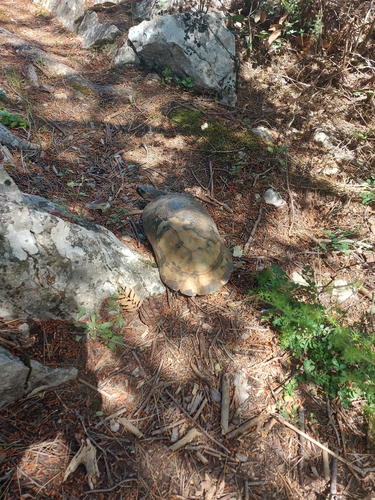
The marginated tortoise is a species of tortoise in the family Testudinidae. The species is endemic to Greece, Italy, and the Balkans in Southern Europe. It is the largest European tortoise. The marginated tortoise is herbivorous, and brumates for the winter.
📌 Taxonomy
The marginated tortoise was formally described by German naturalist Johann David Schoepff in 1789; its specific epithet marginata is a straightforward derivation from the Latin term for 'marginated'.
The nominate subspecies is the Greek marginated tortoise, Testudo marginata marginata. Three additional subspecies of marginated tortoises have been named:
The Sardinian marginated tortoise (T. m. sarda) is the name usually used to separate the population on the island of Sardinia. These tortoises have less strongly bent tiles in the posterior of their carapaces, and the posterior of the carapace is almost smooth compared with the saw-like T. m. marginata. Clearly distinct according to morphology and entirely allopatric, it cannot be distinguished by mtDNA cytochrome b and nDNA ISSR sequence analysis. Lineage sorting has not occurred to a considerable degree; consequently, the more geographically isolated Sardinian population is presumably of quite recent origin.
Indeed, it appears to derive from a deliberate introduction by humans. the rate of the mitochondrial 12S rRNA gene in Testudo is probably a rather low 1.0–1.6% per million years (as this fits best the paleobiogeographical situation), limiting the resolution provided by molecular systematics.
An extinct subspecies described as T. m. cretensis persisted on Crete before the end of the last ice age, presumably larger than mainland tortoises. However, numerous additional fossils have since refuted the validity of this subspecies.
A population of small and light-colored marginated tortoises exists on the southwestern coast of the Peloponnesus, between Kalamata and south of Stoupa. The so-called "dwarf marginated tortoise" was described as a new species Testudo weissingeri, but it is not recognizably distinct phylogenetically. Unlike the Sardinian population, it occupies an extremely restricted range with very arid habitat, and its apomorphies seem related to this. Considering ice age-associated climate and sea level changes, this population is probably not older than a few thousand years; as it is not geographically isolated, it should be considered a local form, and not even a subspecies T. m. weissingeri. Notably, a similar situation is found in Hermann's tortoises living in the same region. but considering biogeography, this is either due to (rather unlikely) dispersal across the Mediterranean, or the supposed "clade" is invalid and the similarity due to convergent evolution.
📌 Distribution and habitat
The natural range of the marginated tortoise is southern Greece, from the Peloponnesus to Mount Olympus. They are also found in isolated zones of the Balkans and Italy, and northeastern Sardinia.
The marginated tortoise lives in more mountainous regions than Hermann's tortoise. It can be found in elevations as high as . The black color of the carapace is helpful for survival in this environment, as it allows the tortoise to absorb a great deal of heat in a short time, helping it maintain its body temperature. Early in the morning, marginated tortoises bask in the sun to raise their body temperature, and then search for food. After feeding, the tortoises return to their shelters in the hot midday hours, leaving them again in the late afternoon.
📌 Behaviour
Marginated tortoises are fairly calm and relaxed, although they can be somewhat territorial in the wild. They have a controlled temper and are generally slow to anger. If they are not given the proper diet in captivity, however, they will become rather aggressive and might mistakenly attack if they feel threatened.
📌 Reproduction
Immediately after waking from brumation, the mating instinct starts up. The males follow the females with great interest, encircling them, biting them on the limbs, ramming them, and trying to mount them. During copulation, the male opens his mouth, showing his red tongue and making loud cries. The tone of the copulation cry is almost sobbing with long, deep tones, in contrast to T. hermanni, which uses a much higher-toned, peeping noise.
During mating, the female stands still and holds her head to the side, looking up to see the opened mouth of the male. The red tongue apparently serves a signalling function. The female moves her head from left to right in the same rhythm as the male's cries.
Afterwards, the female seeks out an adequate location to lay her eggs. Once such a place is found, the female stands still, propping both front legs firmly against the ground. Then she digs out a hole with her hind legs, alternating between left and right, beginning with simply scratching the ground but eventually moving large quantities of soil which are piled up beside the hole. The depth of the hole is determined by the length of her hind legs. If the ground is too hard to dig, the female releases water from her anal gland to soften it.
Once the hole is dug, egg-laying begins. Each egg is gently rolled back into the hole. After the last egg, the female immediately begins refilling the hole, again using her hind legs. Finally, she stamps the opening closed with her feet so that the ground regains its natural hardness. Larger animals may lay eggs as many as three times per summer, with about 15 eggs per clutch.
The incubation period averages about 100 days under natural conditions, which is relatively short among tortoises. Many tropical tortoises have incubation periods of up to 200 days. The relatively short time is an adaptation to the subtropical Mediterranean climate, where the summers are not as long. In an incubator, this time is notably shorter: with an incubation temperature of the eggs will begin hatching after 60 days.
Unlike bird eggs, the yolk and albumen of reptile eggs are not separated by a membrane. After a few days, the heavy yolk components sink to the bottom of the egg. On top of this floats the embryonal disk, surrounded by albumen, so the tortoise eggs cannot be turned after the yolk settles without damaging or killing the embryo.
It is possible to see with the naked eye if the eggs are developing healthily. Freshly laid eggs have a gray-white color. Shortly thereafter, a bright white spot forms on the uppermost point of the egg. This spot gradually grows until the entire egg is bright white.
After the embryo has developed fully in the egg, the young animal breaks the shell with its egg tooth from inside, creates a small opening, and for the first time fills its lungs with air. Afterwards, it pulls back into the egg and works on the shell with its beak until it opens completely. In nature, the animal remains below ground for the first two weeks, where it is safe from predators, yet is still able to grow, as it is nourished by the yolk sac. The young animals lead cautious and secretive lives, normally remaining in the shade. They avoid full sunlight because of the great danger of overheating.
Marginated tortoises grow very rapidly. In an ideal biotope, or with good handling, they gain yearly. This quick rate of growth lasts throughout their youth. After the 20th year of life, further growth is minimal. They may live between 100 and 140 years, according to the best estimates of scientists.
Image:Testudo Marginata0013.JPG|Two marginated tortoises mating
File:Eiablage 001.jpg|Building a nest burrow
File:Eihöhle.jpg|Finished burrow
Image:Deposition eggs Testudo marginata sarda.jpg|Laying eggs
Image:Testudo_marginata6.jpg|Free at last
Image:Schildkroeteneischalen mit Eihaeuten.jpg|Egg shells with skins
File:Testudo_marginata3.jpg|T. marginata young
Image:Terra 003.jpg|Terrarium for raising young
📌 In captivity
Marginated tortoises (Testudo marginata) are large, strictly herbivorous tortoises native to southern Europe. In captivity, they are commonly kept as pets due to their hardy nature and calm disposition.
📌 Housing
Adult marginated tortoises require a spacious enclosure, typically 6–8 feet (1.8–2.4 m) in length and approximately 4 feet (1.2 m) in width, to allow for adequate movement, exercise, and foraging behavior. Enclosures may be indoor, outdoor, or a combination of both depending on climate. Substrates commonly include organic topsoil, soil-sand mixes, or other diggable materials that allow for burrowing.
📌 Temperature and Lighting
Marginated tortoises require a temperature gradient within their enclosure. The cooler end is generally maintained between 70–78°F (21–26°C), while the warmer end ranges from 80–85°F (27–29°C). A basking area with temperatures of 95–105°F (35–40°C) is provided to facilitate thermoregulation.
Ultraviolet B (UVB) lighting is necessary in indoor enclosures to support vitamin D₃ synthesis and calcium metabolism. Access to natural sunlight is also beneficial when conditions permit.
📌 Humidity and Hydration
Although native to relatively dry regions, marginated tortoises benefit from moderate humidity, particularly during growth. Shallow water dishes are typically provided to allow drinking and soaking. Juveniles may be soaked periodically to prevent dehydration.
📌 Behavior and Enrichment
Marginated tortoises are generally terrestrial and spend much of their time walking, grazing, and burrowing. Environmental enrichment may include varied terrain, natural obstacles, edible plants, and sheltered areas. They are primarily solitary and are usually housed individually, especially adult males, which may display territorial behavior.
📌 Brumation
In the wild, marginated tortoises undergo brumation, a period of dormancy during cooler months. In captivity, brumation is sometimes practiced by experienced keepers, though it is not required for general care and reproduction unless breeding is intended.
📌 Lifespan
With proper care, marginated tortoises are long-lived and commonly reach 50–70 years of age, with some individuals living longer.