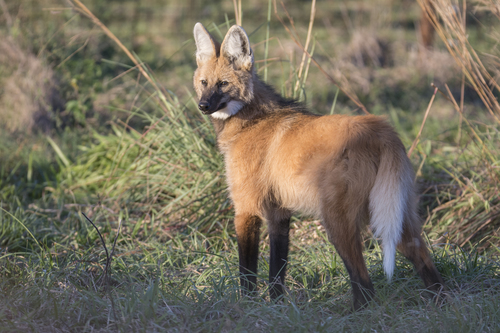
The maned wolf is a large canine of South America. It is found in Argentina, Brazil, Bolivia, Peru, and Paraguay, and is almost locally extinct in Uruguay. Its markings resemble those of a red fox but it is neither a fox nor a wolf. It is the only species in the genus Chrysocyon. The maned wolf's young pups appear to have darker fur than the bronze, grown ones.
🛡️ Conservation Status
near threatened
nt
📌 Etymology
The term maned wolf is an allusion to the mane of the nape. It is known locally as (meaning "large fox") in the Guarani language, or in the Toba Qom language, in Portuguese, and , , , or in Spanish. The term lobo, "wolf", originates from the Latin . Guará and aguará originated from Tupi-Guarani agoa'rá, "by the fuzz". It also is called borochi in Bolivia.
📌 Taxonomy
Although the maned wolf displays many fox-like characteristics, it is not closely related to foxes. It lacks the almond-shaped pupils found distinctively in foxes. The maned wolf's evolutionary relationship to the other members of the canid family makes it a unique animal.
Electrophoretic studies did not link Chrysocyon with any of the other living canids studied. One conclusion of this study is that the maned wolf is the only species among the large South American canids that survived the late Pleistocene extinction. Fossils of the maned wolf from the Holocene and the late Pleistocene have been excavated from the Brazilian Highlands.
A 2003 study on the brain anatomy of several canids placed the maned wolf together with the Falkland Islands wolf and with pseudo-foxes of the genus Pseudalopex. One study based on DNA evidence showed that the extinct genus Dusicyon, comprising the Falkland Islands wolf and its mainland relative, was the most closely related species to the maned wolf in historical times, and that about seven million years ago it shared a common ancestor with that genus. A 2015 study reported genetic signatures in maned wolves that are indicative of population expansion followed by contraction that took place during Pleistocene interglaciations about 24,000 years before present.
The maned wolf is not closely related to canids found outside South America. It is not a fox, wolf, coyote, or jackal, but a distinct canid; though, based only on morphological similarities, it previously had been placed in the Canis and Vulpes genera.
|2=†Dusicyon australis (Falkland Islands wolf)}}
}}
|2=
|2=
}}
}}
}}
|2=Cerdocyon thous (crab-eating fox)
}}
|2=Atelocynus microtis (short-eared dog)
}}
}}
}}
}}
📌 Genetics
Genetically, the maned wolf has 37 pairs of autosomes within diploid genes, with a karyotype similar to that of other canids. It has 76 chromosomes, so cannot interbreed with other canids. Evidence suggests that 15,000 years ago, the species suffered a reduction in its genetic diversity, called the bottleneck effect. However, its diversity is still greater than that of other canids.
📌 Ecology and behavior
=== Hunting and territoriality ===
The maned wolf is a twilight animal, but its activity pattern is more related to the relative humidity and temperature, similar to that observed with the bush dog (Speothos venaticus). Peak activity occurs between 8 and 10 am, and 8 and 10 pm. On cold or cloudy days, they can be active all day. The species is likely to use open fields for foraging and more closed areas, such as riparian forests, to rest, especially on warmer days.
Monogamous pairs may defend a shared territory around , although outside of mating, the individuals may meet only rarely. The territory is crisscrossed by paths that they create as they patrol at night. Several adults may congregate in the presence of a plentiful food source, for example, a fire-cleared patch of grassland that would leave small vertebrate prey exposed while foraging.
Both female and male maned wolves use their urine to communicate, e.g. to mark their hunting paths or the places where they have buried hunted prey. At the Rotterdam Zoo, this smell once set the police on a hunt for cannabis smokers. The preferred habitat of the maned wolf includes grasslands, scrub prairies, and forests.
📌 Reproduction and life cycle
]]
Their mating season ranges from November to April. Gestation lasts 60 to 65 days, and a litter may have from two to six black-furred pups, each weighing roughly . Pups are fully grown when one year old. During that first year, the pups rely on their parents for food. Hormonal changes of maned wolves in the wild follow the same variation pattern of those in captivity. Three-month-old pups begin to accompany their mother while she forages. Males and females both engage in parental care, but it is primarily done by the females. Data on male parental care have been collected from captive animals, and little is known whether this occurs frequently in the wild. Maned wolves reach sexual maturity at one year of age, when they leave their birth territory.
The maned wolf's longevity in the wild is unknown, but estimates in captivity are between 12 and 15 years. A report was made of an individual at the São Paulo Zoo that lived to be 22 years old.
📌 Relations with other species
.|thumb]]
The maned wolf participates in symbiotic relationships. It contributes to the propagation and dissemination of the plants on which it feeds, through excretion. Often, maned wolves defecate on the nests of leafcutter ants. The ants then use the dung to fertilize their fungus gardens, but they discard the seeds contained in the dung onto refuse piles just outside their nests. This process significantly increases the germination rate of the seeds.
Maned wolves suffer from ticks, mainly of the genus Amblyomma, and by flies such as Cochliomyia hominivorax usually on the ears. The maned wolf is particularly susceptible to potentially fatal infection by the giant kidney worm.
It is preyed upon by large cats such as the jaguar (Panthera onca) and occasionally the puma.
📌 Humans
Generally, the maned wolf is shy and flees when alarmed, so it poses little direct threat to humans. Popularly, the maned wolf is thought to have the potential of being a chicken thief. It once was considered a similar threat to cattle, sheep, and pigs, particularly in Argentina, North America (part of a Species Survival Plan) and Europe (part of a European Endangered Species Programme). In 2012, a total of 3,288 maned wolves were kept at more than 300 institutions worldwide. The Smithsonian National Zoo Park has been working to protect maned wolves for nearly 30 years, and coordinates the collaborative, interzoo maned wolf Species Survival Plan of North America, which includes breeding maned wolves, studying them in the wild, protecting their habitat, and educating people about them.
📌 Hunting
The practice of hunting maned wolves is historically poorly documented, but it is speculated to be relatively frequent. This is partly because during the Portuguese and Spanish colonization of South America, Europeans projected onto the maned wolf the historical aversion they had towards Iberian wolves, and their reputation for eating sheep and other domestic animals. Although the species is now seen in a better light, many people still consider it a potential risk to domestic birds and children.
In Brazil, the impacts of hunting are better known than in Argentina, as is the impact of predation on domestic birds, which engenders retaliation from farmers. They are also accused of attacking sheep, which increases human animosity. In Brazil, people also aimed to prevent them from attacking chickens by using a Brazilian variant of the Portuguese podengo, called the Brazilian podengo or Crioulo podengo.
📌 Evolution
|2=
}}
}}
}}
|caption=Phylogeny based on molecular and morphological evidence.}}
The maned wolf is part of the diverse radiation of canids that occur in South America. Molecular analyses have consistently recovered a close evolutionary relationship between the maned wolf and the bush dog (Speothos venaticus), despite their extreme differences in body form, ecology, and diet.
A comparative genomic analysis published more recently also recovered Chrysocyon and Speothos as sister lineages and emphasized their exceptionally divergent adaptations. The maned wolf is highly specialized for life in open habitats and has a largely omnivorous diet, whereas the bush dog is strongly hypercarnivorous and possesses specialized dentition associated with prey capture and processing.
The common ancestor of the living South American endemic canids was estimated by Perini et al. to have lived approximately 4.2–4.3 million years ago, with the radiation occurring during the Pliocene. The divergence between the ancestors of the maned wolf and bush dog was estimated at approximately 3.0 million years ago.
The same analysis estimated that the lineage containing Atelocynus, Cerdocyon, and Lycalopex diverged at approximately 2.4–2.7 million years ago. Diversification within Lycalopex itself occurred over a comparatively short period during the Pleistocene, suggesting a rapid radiation of the South American foxes.
The evolutionary history of South American canids is closely linked to the Great American Interchange. Molecular dating has suggested that the diversification of the living endemic South American canids occurred around the time of, or shortly after, the establishment of the Isthmus of Panama. However, Perini et al. proposed that the earliest diversification of the lineage may have begun in North America before the final establishment of the land bridge.
The fossil record provides additional evidence for the diversification of South American canids. During the Pleistocene, the continent supported several large hypercarnivorous canids, including Protocyon and Theriodictis. A total-evidence phylogenetic analysis combining molecular data with osteological characters placed these extinct genera within the broader South American canid radiation.
The evolutionary history of Chrysocyon itself is unusual. Fossils attributed to the genus are known from North America, including fragmentary remains from early to middle Blancan deposits in Arizona and New Mexico. Perini et al. noted that these fossils are difficult to reconcile straightforwardly with molecular divergence estimates and highlighted the need for additional fossil material to clarify the early history of the genus.
Some earlier phylogenetic studies proposed a different position for the maned wolf. Analyses based on morphology or earlier genetic datasets produced alternative hypotheses regarding relationships with Dusicyon, Lycalopex, or wolf-like canids. More recent molecular and genomic datasets, however, consistently support the close relationship between Chrysocyon and Speothos.
The extreme morphological differences between the maned wolf and bush dog therefore represent an important example of divergent evolution within the canids. Despite sharing a relatively recent common ancestor, the two lineages evolved very different body forms and ecological strategies: the maned wolf developed exceptionally long limbs and adaptations to open habitats, while the bush dog evolved a compact body, specialized carnassial dentition, and strong adaptations for cooperative hunting.
The evolutionary history of the maned wolf therefore combines a relatively recent South American radiation with substantial morphological divergence. Its modern anatomy and ecology are the result of a lineage that became highly specialized while remaining closely related to another exceptionally specialized South American canid, the bush dog.
📌 Conservation
The maned wolf is not considered an endangered species by the IUCN because of its wide geographical distribution and adaptability to man-made environments. However, due to declining populations, it is classified as a near-threatened species. This decline is mostly due to human activities such as deforestation, increasing traffic in highways resulting in roadkill, and urban growth. Due to the decrease in their habitat, the wolves often migrate to urban regions looking for easier access to food. This increases their contact with domestic animals, as well as the risk of infectious and parasitic diseases amongst the wolves which can lead to death.
Until 1996 the maned wolf was a vulnerable species by the IUCN. It is also listed in CITES Appendix II, which regulates international trade in the species. By these same criteria, the Brazilian state lists also consider it more problematic: it is a vulnerable species in the lists of São Paulo and Minas Gerais, while in the lists of Paraná, Santa Catarina and Rio Grande do Sul the maned wolf is considered as "endangered" and "critically endangered" respectively. The situation of the maned wolf in Bolivia and Paraguay is uncertain. Even with these uncertainties the maned wolf is protected against hunting in all countries.
📌 In human cultures
Human attitudes and opinions about the maned wolf vary across populations, ranging from fear and tolerance to aversion. In some regions of Brazil, parts of the animal's body are believed to help cure bronchitis, kidney disease, and even snake bites. It is also believed to bring good luck. In Bolivia, mounting a saddle made of maned wolf leather is believed to protect from bad luck. Despite these superstitions, no large-scale use of parts of this animal occurs. It has also been represented on the 100-cruzeiros reais coin, which circulated in Brazil between 1993 and 1994.
📌 Anatomy
The maned wolf (Chrysocyon brachyurus) has a distinctive body plan among living canids. It has a slender body, exceptionally long legs, large ears, and a relatively small head in proportion to its body. These characteristics are associated with its adaptation to open environments, particularly grasslands and savannas.
📌 Skull and dentition
The skull of the maned wolf is relatively elongated and lightly built compared with that of many other large canids. The muzzle is relatively long, while the jaws contain the typical heterodont dentition of canids, consisting of incisors, canines, premolars, and molars.
The canine teeth are relatively well developed and are used for handling food and during defensive interactions. The cheek teeth are adapted for processing a varied diet, consistent with the species' omnivorous feeding habits.
📌 Skeleton
The skeleton is characterized by elongated limb bones and a relatively lightweight construction. The long limbs give the maned wolf a distinctive high-legged appearance and increase its visual height above the surrounding vegetation.
The forelimbs and hindlimbs are adapted primarily for terrestrial locomotion. Unlike cursorial canids such as wolves, however, the maned wolf does not have a body shape specialized for sustained high-speed pursuit.
📌 Limbs and feet
The most conspicuous anatomical feature of the species is its exceptionally long legs. The lower portions of the limbs are particularly elongated, giving the animal a high shoulder height despite its relatively moderate body mass.
The feet are adapted for walking over open and uneven terrain. The forefeet and hindfeet possess four functional toes, with the claws providing traction while walking and running.
📌 Head and ears
The head is relatively small compared with the animal's long legs and body. The ears are large, erect, and highly mobile, allowing the maned wolf to detect sounds from its surroundings.
The large ears are also an important visual characteristic of the species and contribute to its distinctive appearance among South American canids.
📌 Fur and mane
The coat is predominantly reddish-brown or orange-red, with darker coloration on the legs, muzzle, and dorsal region. The lower portions of the legs are commonly dark, while the throat and inner portions of the ears may show lighter coloration.
A characteristic black mane extends from the back of the neck toward the shoulders and upper back. The mane can be raised when the animal is alarmed, excited, or displaying defensive behavior, making the animal appear larger.
📌 Tail
The tail is relatively short compared with the body and is covered with dense fur. Its coloration is generally similar to that of the body, with darker tones toward the tip.
📌 Body proportions
The maned wolf has a distinctive combination of a relatively light body and very long limbs. Adults generally weigh considerably less than large wolves despite reaching a similar or greater height at the shoulder.
This unusual body plan is particularly advantageous in open vegetation, where long legs allow the animal to see above grasses and other vegetation while moving through its habitat.
📌 Sexual dimorphism
Sexual dimorphism in the maned wolf is relatively subtle. Males are generally somewhat heavier than females, but the sexes have similar external coloration and overall body proportions.
The most obvious differences between males and females are therefore associated with body mass and reproductive anatomy rather than strongly contrasting external morphology.
📌 Locomotion
The maned wolf is primarily terrestrial and moves mainly by walking and trotting. Its long legs allow it to travel efficiently through grasslands, savannas, and other open habitats.
The species is capable of moving over considerable distances within its home range. Its locomotor anatomy is adapted for endurance and efficient movement rather than prolonged high-speed pursuit of prey.
📌 Functional significance
The anatomy of the maned wolf reflects its specialization for life in open South American environments. Its long legs, large ears, reddish coat, dark mane, and relatively lightweight body distinguish it from other living canids.
The combination of these characteristics allows Chrysocyon brachyurus to move through tall vegetation, detect sounds over relatively open landscapes, and exploit a broad range of food resources.
📌 Peripheral nervous system
A detailed anatomical study of the phrenic nerve in the maned wolf (Chrysocyon brachyurus) demonstrated that this nerve originates predominantly from the ventral branches of the cervical spinal nerves C5, C6 and C7, showing uni- or plurisegmental patterns of formation. After its formation in the cervical region, the contributing branches converge near the level of the first rib.
At the level of the diaphragm, the phrenic nerve consistently divides into a lumbocostal trunk and a sternal branch. The lumbocostal trunk gives rise to lumbar and costal branches, which innervate the lumbar and costal portions of the diaphragm, while the sternal branch supplies the sternal and adjacent costal portions.
No branches to the central tendon or to the caudal vena cava were observed, and no contribution from the intercostal nerves to diaphragmatic innervation was identified. In all analysed specimens, the phrenic nerve represented the exclusive motor innervation of the diaphragm in this species.
These findings highlight species-specific characteristics of the phrenic nerve in wild canids and demonstrate important differences when compared with domestic dogs and other carnivores, reinforcing the relevance of comparative neuroanatomical studies in Neotropical fauna.