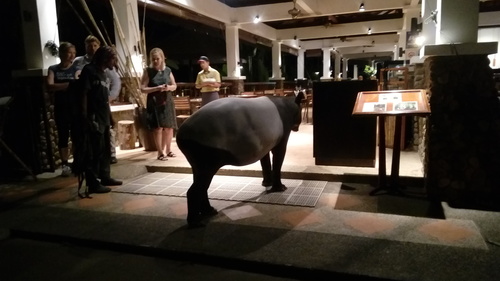
The Malayan tapir, also called Asian tapir, Asiatic tapir, oriental tapir, Indian tapir, piebald tapir, or black-and-white tapir, is the only living tapir species outside of the Americas. It is native to Southeast Asia from the Malay Peninsula to Sumatra. It has been listed as Endangered on the IUCN Red List since 2008, as the population is estimated to comprise fewer than 2,500 mature individuals.
๐ก๏ธ Conservation Status
endangered
en
๐ Taxonomy
The scientific name Tapirus indicus was proposed by Anselme Gaรซtan Desmarest in 1819 who referred to a tapir described by Pierre-Mรฉdard Diard.
Phylogenetic analyses of 13 Malayan tapirs showed that the species is monophyletic.
It was placed in the genus Acrocodia by Colin Groves and Peter Grubb in 2011. However, a comparison of mitochondrial DNA of 16 perissodactyl species revealed that the Malayan tapir forms a sister group together with the Tapirus species native to the Americas. It was the first Tapirus species that genetically diverged from the group, estimated about in the Late Oligocene.
๐ Vision
Malayan tapirs have very poor eyesight, both on land and in water, instead relying heavily on their excellent senses of smell and hearing to navigate and forage. Their eyes are small and, like many herbivores, positioned on the sides of the face. They have brown irises, but the corneas are often covered in a blue haze; this corneal cloudiness is thought to be caused by repetitive exposure to light. This loss of transparency impacts the ability of the cornea to transmit and focus outside light as it enters the eye, impairing the animal's overall vision. As these tapirs are most active at night on top of having poor eyesight, this habit may make it harder for them to search for food and avoid predators.
๐ Color variation
Two melanistic Malayan tapirs were observed in Jerangau Forest Reserve in Malaysia in 2000. A black Malayan tapir was also recorded in Tekai Tembeling Forest Reserve in Pahang state in 2016.
๐ Distribution and habitat
The Malayan tapir lives throughout primary and secondary lowland tropical forests of Southeast Asia, including Sumatra in Indonesia, Peninsular Malaysia, Myanmar, and Thailand.
Pleistocene fossils were found in Java and other locations accompanied by herbivores more typical of grasslands, indicating that it evolved in more open habitats and retreated to closed forests in later times. It was found in Borneo until at least 8,000 years ago during the early Holocene in the Niah Caves of Sarawak, and some 19th century writers mentioned it as a contemporary species in Borneo, likely based on native accounts. It has been proposed to reintroduce the tapir to the island as a conservation measure.
In the continent, the Malayan tapir was found in historical times as far north as China.
๐ Behaviour and ecology
]]
Malayan tapirs are primarily solitary, marking out large tracts of land as their territory, though these areas usually overlap with those of other individuals. Tapirs mark out their territories by spraying urine on plants, and they often follow distinct paths which they have bulldozed through the undergrowth.
Exclusively herbivorous, the animal forages for the tender shoots and leaves of more than 115 species of plants, of which around 30 are particularly preferred, moving slowly through the forest and pausing often to eat and note the scents left behind by other tapirs in the area. The tapir can run quickly when threatened or frightened, and if forced to fight can defend itself with its strong jaws and sharp teeth. Malayan tapirs communicate with high-pitched squeaks and whistles. They usually prefer to live near water and often bathe and swim, and they are also able to climb steep slopes. Tapirs are mainly active at night, though they are not exclusively nocturnal; because they tend to eat soon after sunset or before sunrise, and they will often nap in the middle of the night, they are considered to be crepuscular animals.
๐ Life cycle
The gestation period of the Malayan tapir is about 390โ395 days, after which a single calf is born that weighs around . Young tapirs of all species have brown hair with white stripes and spots, a pattern that enables them to hide effectively in the dappled light of the forest. This baby coat fades into adult coloration between four and seven months after birth. Weaning occurs between six and eight months of age, at which time the babies are nearly full-grown, and the animals reach sexual maturity around age three. Breeding typically occurs in April, May or June, and females generally produce one calf every two years. Malayan tapirs can live up to 30 years, both in the wild and in captivity.
๐ Predators
Because of its size, the Malayan tapir has few natural predators, and even reports of killings by tigers (Panthera tigris) are scarce.
Malayan tapirs can defend themselves with their very powerful bite; in 1998, the bite of a captive female Malayan tapir severed a zookeeper's left arm at the mid-bicep, likely because she stood between her and her offspring.
๐ Threats
]]
The main threats to the Malayan tapir are loss and destruction of habitat through deforestation. Large tracts of forests in Thailand and Malaysia have been converted for planting oil palms.