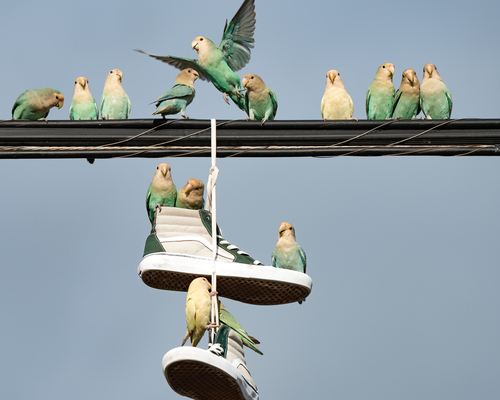
Lovebird is the common name for the genus Agapornis, a small group of parrots in the Old World parrot family Psittaculidae. Of the nine extant species in the genus, all are native to the African continent, with the grey-headed lovebird being native to the African island of Madagascar. Social and affectionate, the name comes from the parrots' strong, monogamous pair bonding and the long periods which paired birds spend sitting together. Lovebirds live in small flocks and eat fruit, vegetables, grasses, and seeds. Some species are kept as pets, and several coloured mutations have been selectively bred in aviculture. The average lifespan is 10 to 12 years.
== Description ==
Lovebirds are 13–17 cm (5–7 in) in length, up to 24 cm in wingspan with 9 cm for a single wing and 40–60 g (1+1⁄2–2 oz) in weight. They are among the smallest parrots, characterised by a stocky build, a short blunt tail, and a relatively large, sharp beak. Wildtype lovebirds are mostly green with a variety of colours on their upper body, depending on the species. The Fischer's lovebird, black-cheeked lovebird, and the masked lovebird have a prominent white ring around their eyes. Many colour mutant varieties have been produced by selective breeding of the species that are popular in aviculture. As of 2019, there are 30 known plumage colour variations among lovebirds, which are caused by pigments called psittacofulvins.
== Taxonomy ==
The genus Agapornis was described by the English naturalist Prideaux John Selby in 1836. The name combines the Ancient Greek αγάπη agape meaning "love" and όρνις ornis meaning "bird". The type species is the black-collared lovebird (Agapornis swindernianus), which was originally placed into the genus Psittacus within a section called Psittacula by naturalist Heinrich Kuhl. Selby contended that this placement rather than a separate genus was "artificial" and done "without regard to the structure, habits, or distribution of the species."
The genus contains nine species of which five are monotypic and four are divided into subspecies. They are native to mainland Africa and the island of Madagascar. In the wild, the different species are separated geographically.
Traditionally, lovebirds are divided into three groups:
the sexually dimorphic species: Madagascar, Abyssinian, and red-headed lovebird
the intermediate species: peach-faced lovebird
the white-eye-ringed species: masked, Fischer's, Lilian's, and black-cheeked lovebirds
However, this division is not fully supported by phylogenetic studies, as the species of the dimorphic group are not grouped together in a single clade.
== Species ==
Species and subspecies:
== Nesting ==
Depending on the species of lovebird, the female will carry nesting material into the nest in various ways. The peach-faced lovebird, for example, tucks nesting material in the feathers of its rump.
== Feral populations ==
Feral populations of Fischer's lovebirds and masked lovebirds live in cities of East Africa. There are interspecific hybrids that exist between these two species. The hybrid has a reddish-brown head and orange on upper chest, but otherwise resembles the masked lovebird.
There are two feral colonies present in the Pretoria region (Silver Lakes, Faerie Glen and Centurion) in South Africa. They probably originated from birds that escaped from aviaries. They consist mostly of masked, black cheeked, Fischer and hybrid birds and vary in colours. White (not albino) and yellow as well as blue occur in many cases. The white ringed eyes are very prominent.
There is a notable feral colony in Arizona, consisting of mostly Rosy-faced lovebirds. They originated from birds that escaped the pet trade, and were first seen in the state during the 1980's. The first breeding pair in Arizona was discovered in 1998.
== Diet and health ==
Parrots are generally vegetarian species. Lovebirds forage for their food. In the wild, their diet mainly consists of seeds, grains, and leaves from trees, shrubs, and tall grass.
Wild lovebirds may harbor diseases such as avian polyomavirus.
== References ==
== Further reading ==
All About Breeding Lovebirds (hardcover) by Mervin Roberts
Lovebirds: Everything About Housing, Care, Nutrition, Breeding, and Diseases with a special chapter, "Understanding Lovebirds" (A Complete Pet Owner's Manual) by Matthew M. Vriends
Lovebirds compendium by Dirk Van den Abeele
Forshaw, Joseph M. (2006). Parrots of the World; an Identification Guide. Illustrated by Frank Knight. Princeton University Press. ISBN 0-691-09251-6.
🍽️ Diet
Diet and health
A yellow-collared lovebird perching by the entrance to a nest box in a large aviary at the Honolulu Zoo, Hawaii, USA
Parrots are generally vegetarian species.[1] Lovebirds forage for their food. In the wild, their diet mainly consists of seeds, grains, and leaves from trees, shrubs, and tall grass. [2]
.mw-parser-output .side-box{margin:4px 0;box-sizing:border-box;border:1px solid #aaa;font-size:88%;line-height:1.25em;background-color:var(--background-color-interactive-subtle,#f8f9fa);color:inherit;display:flow-root}.mw-parser-output .infobox .side-box{font-size:100%}.mw-parser-output .side-box-abovebelow,.mw-parser-output .side-box-text{padding:0.25em 0.9em}.mw-parser-output .side-box-image{padding:2px 0 2px 0.9em;text-align:center}.mw-parser-output .side-box-imageright{padding:2px 0.9em 2px 0;text-align:center}@media(min-width:500px){.mw-parser-output .side-box-flex{display:flex;align-items:center}.mw-parser-output .side-box-text{flex:1;min-width:0}}@media(min-width:640px){.mw-parser-output .side-box{width:238px}.mw-parser-output .side-box-right{clear:right;float:right;margin-left:1em}.mw-parser-output .side-box-left{margin-right:1em}}.mw-parser-output .listen .side-box-text{line-height:1.1em}.mw-parser-output .listen-plain{border:none;background:transparent}.mw-parser-output .listen-embedded{width:100%;margin:0;border-width:1px 0 0 0;background:transparent}.mw-parser-output .listen-header{padding:2px}.mw-parser-output .listen-embedded .listen-header{padding:2px 0}.mw-parser-output .listen-file-header{padding:4px 0}.mw-parser-output .listen .description{padding-top:2px}.mw-parser-output .listen .mw-tmh-player{max-width:100%}@media(max-width:719px){.mw-parser-output .listen{clear:both}}@media(min-width:720px){.mw-parser-output .listen:not(.listen-noimage){width:320px}.mw-parser-output .listen-left{overflow:visible;float:left}.mw-parser-output .listen-center{float:none;margin-left:auto;margin-right:auto}}.mw-parser-output .plainlist ol,.mw-parser-output .plainlist ul{line-height:inherit;list-style:none;margin:0;padding:0}.mw-parser-output .plainlist ol li,.mw-parser-output .plainlist ul li{margin-bottom:0}
Masked lovebirds calling
Recording of the blue masked lovebird variety.
Problems playing this file? See media help.
Wild lovebirds may harbor diseases such as avian polyomavirus.[3]
^ .mw-parser-output cite.citation{font-style:inherit;word-wrap:break-word}.mw-parser-output .citation q{quotes:"\"""\"""'""'"}.mw-parser-output .citation:target{background-color:rgba(0,127,255,0.133)}.mw-parser-output .id-lock-free.id-lock-free a{background:url("//upload.wikimedia.org/wikipedia/commons/6/65/Lock-green.svg")right 0.1em center/9px no-repeat}.mw-parser-output .id-lock-limited.id-lock-limited a,.mw-parser-output .id-lock-registration.id-lock-registration a{background:url("//upload.wikimedia.org/wikipedia/commons/d/d6/Lock-gray-alt-2.svg")right 0.1em center/9px no-repeat}.mw-parser-output .id-lock-subscription.id-lock-subscription a{background:url("//upload.wikimedia.org/wikipedia/commons/a/aa/Lock-red-alt-2.svg")right 0.1em center/9px no-repeat}.mw-parser-output .cs1-ws-icon a{background:url("//upload.wikimedia.org/wikipedia/commons/4/4c/Wikisource-logo.svg")right 0.1em center/12px no-repeat}body:not(.skin-timeless):not(.skin-minerva) .mw-parser-output .id-lock-free a,body:not(.skin-timeless):not(.skin-minerva) .mw-parser-output .id-lock-limited a,body:not(.skin-timeless):not(.skin-minerva) .mw-parser-output .id-lock-registration a,body:not(.skin-timeless):not(.skin-minerva) .mw-parser-output .id-lock-subscription a,body:not(.skin-timeless):not(.skin-minerva) .mw-parser-output .cs1-ws-icon a{background-size:contain;padding:0 1em 0 0}.mw-parser-output .cs1-code{color:inherit;background:inherit;border:none;padding:inherit}.mw-parser-output .cs1-hidden-error{display:none;color:var(--color-error,#d33)}.mw-parser-output .cs1-visible-error{color:var(--color-error,#d33)}.mw-parser-output .cs1-maint{display:none;color:#085;margin-left:0.3em}.mw-parser-output .cs1-kern-left{padding-left:0.2em}.mw-parser-output .cs1-kern-right{padding-right:0.2em}.mw-parser-output .citation .mw-selflink{font-weight:inherit}@media screen{.mw-parser-output .cs1-format{font-size:95%}html.skin-theme-clientpref-night .mw-parser-output .cs1-maint{color:#18911f}}@media screen and (prefers-color-scheme:dark){html.skin-theme-clientpref-os .mw-parser-output .cs1-maint{color:#18911f}}Harcourt-Brown, Nigel H. (2016). "Psittacine Birds". In Samour, Jaime (ed.). Avian Medicine. Elsevier. p. 138. Retrieved 8 August 2022.
^ Ndithia, Henry; Perrin, Michael R (2006-04-01). "Diet and foraging behaviour of the Rosy-faced Lovebird Agapornis roseicollis in Namibia". Ostrich. 77 (1–2): 45–51. doi:10.2989/00306520609485507. ISSN 0030-6525.
^ Johne, R.; Müller, H. (1998). "Avian polyomavirus in wild birds: genome analysis of isolates from Falconiformes and Psittaciformes". Archives of Virology. 143 (8): 1501–1512. doi:10.1007/s007050050393.
📌 Taxonomy
The genus Agapornis was described by the English naturalist Prideaux John Selby in 1836. The name combines the Ancient Greek agape meaning "love" and ornis meaning "bird". The type species is the black-collared lovebird (Agapornis swindernianus), which was originally placed into the genus Psittacus within a section called Psittacula by naturalist Heinrich Kuhl.
Traditionally, lovebirds are divided into three groups:
*the sexually dimorphic species: Madagascar, Abyssinian, and red-headed lovebird
*the intermediate species: peach-faced lovebird
*the white-eye-ringed species: masked, Fischer's, Lilian's, and black-cheeked lovebirds
However, this division is not fully supported by phylogenetic studies, as the species of the dimorphic group are not grouped together in a single clade.
📌 Species
Species and subspecies:
}}
}}
}}
}}
📌 Nesting
Depending on the species of lovebird, the female will carry nesting material into the nest in various ways. The peach-faced lovebird, for example, tucks nesting material in the feathers of its rump.
📌 Feral populations
Feral populations of Fischer's lovebirds and masked lovebirds live in cities of East Africa. There are interspecific hybrids that exist between these two species. The hybrid has a reddish-brown head and orange on upper chest, but otherwise resembles the masked lovebird.
There are two feral colonies present in the Pretoria region (Silver Lakes, Faerie Glen and Centurion) in South Africa. They probably originated from birds that escaped from aviaries. They consist mostly of masked, black cheeked, Fischer and hybrid birds and vary in colours. White (not albino) and yellow as well as blue occur in many cases. The white ringed eyes are very prominent.
There is a notable feral colony in Arizona, consisting of mostly Rosy-faced lovebirds. They originated from birds that escaped the pet trade, and were first seen in the state during the 1980's. The first breeding pair in Arizona was discovered in 1998.
📌 Diet and health
perching by the entrance to a nest box in a large aviary at the Honolulu Zoo, Hawaii, USA]]
Parrots are generally vegetarian species. Lovebirds forage for their food. In the wild, their diet mainly consists of seeds, grains, and leaves from trees, shrubs, and tall grass.
Wild lovebirds may harbor diseases such as avian polyomavirus.