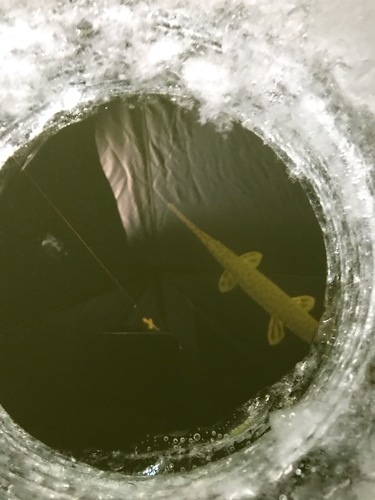
The longnose gar, also known as longnose garpike or billy gar, is a ray-finned fish in the family Lepisosteidae. The genus may have been present in North America for about 100 million years. References are made to gars being a primitive group of bony fish because they have retained some primitive features, such as a spiral valve intestine, but they are not primitive in the sense of not being fully developed.
π Etymology
The longnose gar was first described by Carl Linnaeus (1758), who gave it the name Esox osseus. The generic name Esox, which is for pike, was later changed to Lepisosteus, the genus for slender gars. Lepisosteus osseus (Linnaeus, 1758), the scientific name for longnose gar, originated by combining lepis, which is Greek for scale, and osteos, the Latin word for bony. The latter references the bone-like, rhomboidal-shaped ganoid scales that protect gars against predation. Referring to gars as primitive fish simply means they have existed for a long time, having evolved over millions of years into a more perfected morphological state, not that the animal is primitive in the sense that it is not fully developed.
π Distribution
Fossils of the genus dating from 100 million years ago (Mya) have been found in Africa, Asia, Europe, North America, and South America. In the US, fossils of the modern species date back to the Pleistocene, where they were discovered in the Kingsdown Formation in Meade County, Kansas, and date back to the Irvingtonian (1.8β0.3 Mya). Longnose gar are found in Central America, Cuba, North America, and the Isla de la Juventud.
Longnose gar are frequently found in fresh water in the eastern half of the US, but some gar were found in salinities up to 31 ppt. Their microhabitats consist of areas near downed trees, stone outcrops, and vegetation.
π Ecology
The most common prey of longnose gar are small fish and occasionally insects and small crustaceans; they mostly feed at night. In most studies of adult L. osseus, a variety of species made up a majority of the diet, with the dominant prey changing among locations. Inland silversides were particularly common prey of juvenile gar in Lake Texoma, making up 84% of the diet, with gamefishes accounting for less than 1% of the diet. In Florida, their diet consisted mainly of fishes, with gizzard shad, bullhead catfish, and small bluegill particularly common. In Missouri, fishes made up 98% of the diet with shiners being the most common prey. In some lakes, adult longnose gar may consume large numbers of sunfish. Menhaden are a major food source along coasts where L. osseus moves towards the mouths of bayous into higher-salinity waters in the afternoon and evening to find this more prevalent prey. Longnose gar then move back up the bayous, into the lower-salinity waters in the morning. Their main competitors are other garfishes, and somewhat commonly, large gar to feed on smaller ones. Historically, Native Americans and early colonists harvested longnose gar as a main food source. Over time, longnose gars have gained in popularity as a sportfish rather than as a food source, but some people consider gar meat a delicacy. Adult longnose gar are considered apex predators in their aquatic habit, and have few predators, which include humans and in the southern reaches of their range the American alligator.
π Life history
Longnose gar have a typical lifespan of 15β20 years with a maximum reported age of 39. This long lifespan allows the female to sexually mature around 6 years old. Males mature sexually as early as 2 years of age. Longnose gar are sexually dimorphic; the females are larger than the males in body length, weight, and fin length. They generally have a clutch size close to 30,000, depending on the weight-to-length ratio of the females; larger females bear larger clutch sizes. They spawn in temperatures close to in late April to early July. Eggs have a toxic, adhesive coating to help them stick to substrates, and they are deposited onto stones in shallow water, rocky shelves, vegetation, or smallmouth bass nests. Their hatch time is 7β9 days; young gar stay in vegetation during the first summer of life. Longnose gar reach a typical length of , with a maximum length around and in weight.
π Management
Currently, no management of this species is being conducted, nor is it federally listed as endangered, although some states have reported it as threatened (South Dakota, Delaware, and Pennsylvania). In the early 1900s, longnose gar were considered as destructive predators. Soon after this characterization, gar population reduction methods were established. Their declining populations are due to overfishing, habitat loss, dams, road construction, pollution, and other human-caused destruction of the aquatic systems. Because of their long lifespans and older sexual maturity age, factors affecting their reproduction are an issue in preserving them. Overfishing is a large issue for this fish, especially when the fish have not reached sexual maturity due to the female not reaching sexual maturity until about 6 years of age.