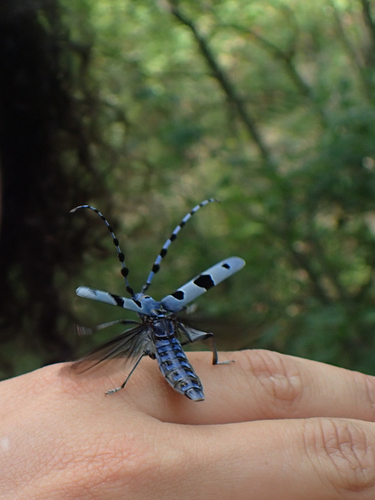
The longhorn beetles (Cerambycidae), also known as long-horned or longicorns, are a large family of beetles, with over 35,000 species described.
🛡️ Conservation Status
vulnerable
vu
📌 Biology
, the Ivory Marked Borer]]
📌 Pollination
In addition to feeding on other plant tissue, some species feed on pollen or nectar and may act as pollinators. Assessing the efficacy of beetle pollinators is difficult. Even if pollination of one species by beetles is shown, that same beetle may also act as a flower predator toward other species. In some cases, beetles may act as both pollinators and predators on the same flowers.
Flowers specializing in pollination by beetles typically display a particular set of traits, but pollination by longhorn beetles is not limited to these cantharophilous flowers. A review of angiosperm pollination by beetles shows that Cerambycidae, along with Curculionidae and Scarabaeidae, contains many taxa that are pollinators for not only specialist but also generalist systems.
Beetles in the New Zealand genus Zorion are known to feed on pollen and have a specialized structure similar to that of pollen baskets found in bees. Species in this genus are thought to be important pollinator species for native plants such as harakeke.
Some orchid species have been found to be largely reliant on longhorn beetles for pollination. The species Alosterna tabacicolor was found to be the main pollinator of a rare orchid species (Dactylorhiza fuchsii) in Poland. Another rare orchid Disa forficaria, found in the Cape Floristic Region in South Africa, relies on the species Chorothyse hessei for pollination. D. forficaria uses sexual deception targeting male C. hessei, possibly indicating a long history of co-evolution with longhorn beetle pollinators.
.]]
The proportion of longhorn beetle species that act as pollinators is unknown. The fact that two species of longhorn species from distinct subfamilies (Lepturinae and Cerambycinae) found on different continents both with significant roles as pollinators could suggest that some capacity for pollination may be common among longhorn beetles.
📌 Predators
====Parasitoids====
In North America some native cerambycids are the hosts of Ontsira mellipes (a parasitoid wasp in the family Braconidae). O. mellipes may be useful in controlling a forestry pest in this same family, Anoplophora glabripennis, that is invasive in North America.
📌 Classification
)]]
As with many large families, different authorities have tended to recognize many different subfamilies, or sometimes split subfamilies off as separate families entirely (e.g., Disteniidae, Oxypeltidae, and Vesperidae); there is thus some instability and controversy regarding the constituency of the Cerambycidae. There are few truly defining features for the group as a whole, at least as adults, as there are occasional species or species groups which may lack any given feature; the family and its closest relatives, therefore, constitute a taxonomically difficult group, and relationships of the various lineages are still poorly understood. The oldest unambiguous fossils of the family are Cretoprionus and Sinopraecipuus from Yixian Formation of Inner Mongolia and Liaoning, China, dating to the Aptian stage of the Early Cretaceous, approximately 122 million years ago. The former genus was assigned to the subfamily Prioninae in its original description, while the latter could not be placed in any extant subfamily. Qitianniu from the mid-Cretaceous Burmese amber of Myanmar, dating to approximately 100 million years ago, also could not be placed in any extant subfamily.
]]
]]
📌 Subfamilies
The subfamilies of Cerambycidae are:
* Apatophyseinae Lacordaire, 1869 (included in Bouchard 2011 but not Švácha 2014)
* Cerambycinae Latreille, 1802
* Dorcasominae Lacordaire, 1869 (Švácha 2014 includes Apatophyseinae in Dorcasominae)
* Lamiinae Latreille, 1825
* Lepturinae Latreille, 1802
* Necydalinae Latreille, 1825
* Parandrinae Blanchard, 1845
* Prioninae Latreille, 1802
* Spondylidinae Audinet-Serville, 1832 (including former Aseminae Thomson, 1860)
Most species (90.5%) are concentrated in the Cerambycinae and Lamiinae subfamilies.
📌 Notable genera and species
)]]
* Acrocinus longimanus – harlequin beetle, a large species where the male has very long front legs
* Anoplophora chinensis – citrus longhorn beetle, a major pest
* Anoplophora glabripennis – Asian longhorn beetle, an invasive pest species
* Aridaeus thoracicus – tiger longicorn (Australia)
* Cacosceles newmannii - Southern African longhorn beetle that is a sugarcane pest
* Derobrachus hovorei - palo verde longhorn beetle
* Desmocerus californicus dimorphus – valley elderberry longhorn beetle, a threatened subspecies from California
* Moneilema – cactus longhorn beetles, which are flightless
* Onychocerus albitarsis – the only known beetle with a venomous sting
* Petrognatha gigas – giant African longhorn beetle
* Prionoplus reticularis – huhu beetle, the heaviest beetle in New Zealand
* Rosalia alpina – Rosalia longhorn beetle, a threatened European species
* Stictoleptura rubra – red-brown longhorn beetle
* Tetraopes tetrophthalmus – red milkweed longhorn beetle, a toxic species with aposematic colors
* Tetropium fuscum – brown spruce longhorn beetle, an invasive pest species
* Titanus giganteus – titan beetle, one of the largest beetles in the world
* Zorion guttigerum - flower longhorn beetle, an important pollinator species.