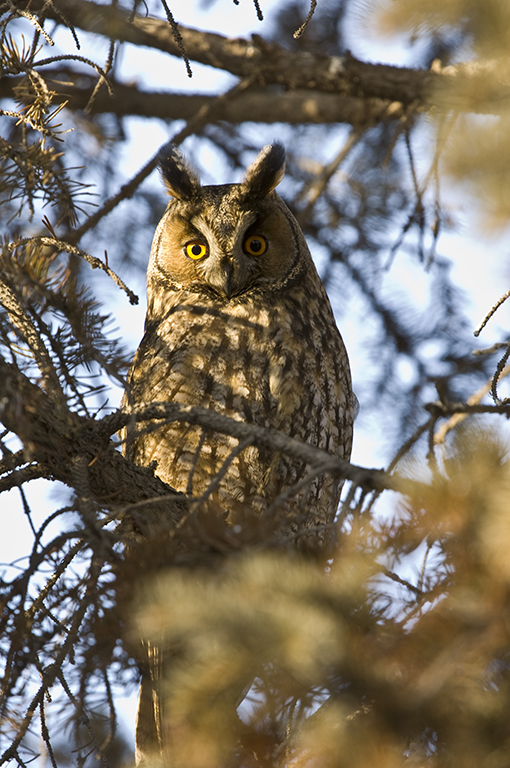
The long-eared owl, also known as the northern long-eared owl or informally as the lesser horned owl or cat owl, is a medium-sized typical owl with an extensive range. The genus name, Asio, is Latin for "horned owl", and the specific epithet, otus, is derived from Greek and refers to a small eared owl. It breeds in Europe and the Palearctic, as well as in North America.
📌 Taxonomy
The long-eared owl was described by Linnaeus in 1758 in the tenth edition of Systema Naturae under the binomial name Strix otus. It is now assigned to the genus Asio that was introduced by Mathurin Jacques Brisson in 1760.
There are eight known species worldwide in the genus Asio, also referred to as eared owls. Despite similarities and being considered as in the same genus, it was found in a study utilizing electrophoresis that the genetic distance between long-eared owls and short-eared owls was unusually large for species within the same genera. Notwithstanding fossil records of Asio species showing their presence during prehistory in locations like Kansas and Idaho (Asio brevipes) and California (Asio priscus), the exact area of evolutionary origin of the long-eared owl is unknown and unlikely to ever be known. At least three modern species represent related derivations, possibly with long-eared owls as the paraspecies or as part of a species complex that potentially bears a basal common ancestor. While the marsh owl of Africa is outwardly very similar to and likely closely related to the short-eared owl, the striped owl (Asio clamator) is somewhat of an outlier among living Asio species and of mysterious origin. Despite being genetically related to the other living Asio species, it does not appear to be a close cousin. A study of the genetic homogeny of long-eared owls in a single roost site was shown to be slightly higher than between different roosts. However, this homogeny is relatively low for a communal roosting bird in general.
📌 Subspecies
Four subspecies of the long-eared owl are recognised:
*A. o. otus (Linnaeus, 1758) – This is the nominate subspecies and is distributed throughout the species' range in the Palearctic. It may be found as far west as the Azores, northwestern Africa, the Iberian Peninsula and the British Isles through as far east as Sakhalin, Japan and northern China. Some populations of this race may winter as far south as Egypt, Pakistan, northern India and southern China. The wing chord of the nominate subspecies ranges between and the tail length may be between . Size appears to increase slightly from west to east, with owls in China being about 4% larger winged than those from Europe. Despite there being no known published weights for eastern/Chinese long-eared owls, they appear to obtain the largest sizes within the species.
*A. o. wilsonianus (Lesson, 1830) – This subspecies is found in south-central and southeastern Canada (Manitoba to Nova Scotia) to southern USA (north Oklahoma and Virginia). It is weakly differentiated and may comprise clinal variations due to region and habitat, rather than subspecific differences.
📌 Identification
If seen well, an experienced observer is usually able to distinguish a long-eared owl by combination of its field marks, size and coloration. However, some species may be confused for them. The Stygian owl (Asio stygius) (which barely overlaps, perhaps in northern Mexico) is larger with partially bare toes and generally darker with more boldly patterned plumage, with nearly the entire facial mask appearing off-black. Tawny owls, which co-exist with long-eared owls in Eurasia, are unlikely to be mistaken given that they usually appear considerably rounder and bulkier overall (and are indeed slightly larger and much heavier), and possess a much broader, more rounded head. The tawny owl has no ear-tufts, eyes of blackish-brown colour and relatively shorter wings. In flight, tawny owls show well-fingered primaries (with five apparent emarginations) unlike the squared off wings of the long-eared owl. The Eurasian eagle-owl (Bubo bubo) is larger than a long-eared owl with more powerful-looking feet and talons and a huge squared-off-looking head with the ear-tufts set nearer to the edge. The eagle-owl is more heavily patterned on the crown and back with heavy blackish marking but has a less strongly demarcated (and shallower) facial disc when compared to the long-eared owl. In both long-eared and short-eared owls, the flight style when seen has a distinctive, erratic and buoyant flapping quality that many birdwatchers consider reminiscent of a moth. At rest, the ear-tufts of the long-eared owl serve to easily distinguish the two (although long-eared owls can sometimes hold their ear-tufts lax). The iris-colour differs: yellow in short-eared, and often orange in long-eared. Furthermore, the black surrounding the eyes is vertical and slight on the long-eared, and horizontal and far more conspicuous on the short-eared. Overall, the short-eared owl tends to be a paler, sandier-looking bird than the long-eared, lacking the darker and more extensive markings of the latter. When studied by their osteological features, however, the long-eared and short-eared owls are difficult to distinguish.
📌 Vocalizations and ear morphology
The long-eared owl has relatively large ear slits placed asymmetrically on the sides of its head, as in a majority of owls, with the left ear higher and right lower in order to allow them to absorb sound both from above and below. The ear slits occupy very nearly the full height of the skull, being about long and covered in movable skin flaps. The right ear is about 13% larger based on freshly dead owls. Due to its ear structure, the hearing of a long-eared owl is around ten times better at hearing high and medium pitches than humans. Barn owls and boreal owl (Aegolius funereus) have (via convergent evolution) roughly similar ear structures, with the relative size of the ear structure and facial disc in owls generally indicative of the level of importance of acute hearing to their life history. Owls with relatively smaller ear slits and shallower or vestigial facial discs tend to skew towards more crepuscular or partially diurnal behaviors, whereas owls such as long-eared owls are more or less entirely nocturnal. It is well known that a majority of owls can hunt in darkness due to their extraordinary hearing, which allows them to pinpoint locations of prey, but they can also utilize their hearing to track intraspecific calls and activities and avoid predation risks. The song of the male long-eared owl is a deep whoop, which is repeated at intervals of several seconds. It starts with some hoots at slightly lower pitch before reaching full volume and quality. On calm nights, this song may carry over up to away (at least to human auditory perception). The song of the male is around 400 hertz. Fledging young call all with high-pitched, drawn-out notes, variously transcribed as feek, peeyee and pzeei, and are often likened to the noise of a gate swinging on a rusty hinge.
📌 Distribution and habitat
, long-eared owls favor stands of conifers adjacent to openings.]]
The long-eared owl has an extremely large range. In Eurasia, they are distributed from the Iberian Peninsula and Britain and Ireland. From western France east through the remainder of Europe they are found nearly everywhere. Out of Europe, they are found spottily as breeders in Turkey, northernmost Syria, Israel and Lebanon. In the east, they range through of Mongolia (absent from the southwest) and the western and eastern parts of northern China, with seasonally uncertain status in the Koreas. Long-eared owls are found throughout the islands of Japan but mainly winter only in points south of Osaka. The long-eared owl occurs apparently only in winter in parts of southern France, southern Greece, northwestern Egypt, northern Iran, southern Turkmenistan, broadly in much of Afghanistan, Pakistan and northern India (such as the Kutch, Punjab, Kashmir), as well as to the east in Bhutan, southern China, Taiwan and most of South Korea. The species range as a breeding species is far more extensive in the west than the east within the United States. They also breed and occur year around in most of Minnesota, Wisconsin and Michigan. Breeding and/or year around occurrence is very rare in the eastern U.S. with a few records of them nesting in Maine, Virginia and West Virginia. The long-eared owl occurs much more broadly in North America during the non-breeding season and may found essentially all over the Midwest, Texas and as far south in Mexico as Colima, Veracruz and northern Oaxaca. The species also occurs in the non-breeding season in Louisiana (but for the southeast) and much of northern Mississippi, Alabama, Georgia and South Carolina north to Illinois, Indiana, Ohio and southern Pennsylvania. Very rarely, these birds have turned up in Florida (in times of exceptional irruption) and, as a vagrant, even the Bermudas. They are found also by winter and in migration in much of the east coast of the United States, from the Outer Banks in North Carolina, broadly in eastern Pennsylvania and almost anywhere in Delaware or New Jersey, southeastern New York (including New York City) and north to much of southern New England including almost all of Connecticut, Massachusetts and Rhode Island as well as southern New Hampshire.
📌 Behaviour
Long-eared owls are nocturnal. Usually activity for the species commences at dusk. When living relatively close to the Arctic, long-eared owls may be forced to forage during daylight, as no full nightfall may occur during summer. When flying by day, long-eared owls are often mobbed by diurnal birds such as corvids and other birds of prey. In the České Budějovice area of Czech Republic, 9 radiotagged owls were studied. Nearly equal numbers were found in suburban and urban areas, and urban ones used developed areas for more than 50% of their nocturnal activity while suburban ones used developed areas for less than half of their activities. Similar habitats were favored by both urban and suburban owls but urban owls had to range wider to avoid heavy human activity and access city parks and so had larger average ranges, vs , while suburban ones had easier access to meadows and stands of woods.
📌 Migration
Out of roughly thirty owl species in North America and Europe, the long-eared owl is one of five considered truly migratory, moving annually in at least some areas from summer to winter grounds and back whether or not it is an irruptive year. Northern populations are migratory, showing a strong tendency to wander south in autumn. Some young birds from central Europe migrate southwest than . Central European adults are less migratory, at most merely wandering in winter. In Europe, males and females seem to differ slightly in migratory behaviour. Long-eared owls wintering in Denmark were found to be heavily biased towards females, also there is a bias towards females in winter surveys in other areas such as southern Sweden. At 10 wintering sites in Europe, females were 36% more common than males. The hypothesis posited by those that studied the owls in Denmark is that females face a higher rate of predation by larger birds of prey and may distribute away from Fennoscandia where densities are high of those predators and to areas that show low densities of these predators. Another, non-exclusive, theory is that they may be avoiding areas with deep snow that may inhibit prey capture. On evidence, many of the females that vacate Norway and even Fennoscandia come to winter in Great Britain (the female migrants here being up to 3.5 times more common during winter than male migrants in one study). Long-eared owls are 19.5% of owls (or 197 total owls) recorded migrating through Cape May Point in fall (against a majority, 60.6%, being saw-whet owls), with 26.1% of the specimens from the species caught in the mist nets being adults. More than 90% of long-eared owls migrate between mid-October and late November, with the immatures migrating earlier, 52.1% of juveniles having passed through in October whereas only 9.4% of adults migrated in the month. Cape May studies also indicated that 58.87% of long-eared owls were caught in the dark before dawn rather than other times of night. Based on evidence from Cape May, migrating long-eared owls tend to fly higher above the ground than do migrating saw-whet and barn owls but not as high as the short-eared owl, with the latter owl often able to avoid mist nets apparently via its flying height while moving through.
The long-eared owl has the peculiar ability to increase populations and then disperse in nearly multi-directional movements during good years for prey numbers. Banding records across North America show highly erratic numbers and movements across the continent of North America with unpredictable peak numbers of migrants in completely different years respectively for the states of Wisconsin, Michigan, New York and New Jersey. Therefore, the species is sometimes considered "nomadic" despite many populations of the species being consistent annual migrants. Similar tendency towards so-called "nomadism" is shared by other widespread raptors semi-specialized to hunting voles over open ground, such as short-eared owls and hen harriers (Circus cyaneus). Study of banding records in Saskatchewan show that the long-eared owl Canadian populations may be considered more truly irruptive species both as a breeder and migrant in that only appears in numbers during peak vole years, with large numbers only in 4 of 44 banding years. During 7 low years, the long-eared owls of Saskatchewan seemed to disappear altogether from much of the province. Peak years also coincided often with snowshoe hare (Lepus americanus) peaks, possibly due to lessened competition (as the larger owls favored prey is locally the hare) and interspecific predation by great horned owls. In southern Finland during a peak prey year followed by a prey crash, a very large number of long-eared owls were detected and were seen to be likely food stressed, as several were foraging actively during daylight despite the extensive nighttime hours during the season.
📌 Social and roosting behavior
During daytime, long-eared owls tends to roost in an upright position on a branch, close to the trunk, within dense foliage. In winter, the long-eared owl often stays close to the same tree or grove of trees. Usually, when approached, the owl freezes with its body stiffly upright, eyes closed to narrow slits and ear tufts erect. This is called the "tall-thin position" and is common to many typical owls. If approached closed, the owls will alternately open and close their eyes (apparently having stirred but trying to fool potential predators into thinking the owl is still at rest), finally lowering ear tufts, fluffing body plumage and flying to another roost. Long-eared owls tend to roost in the depths of the "darkest stands of trees" in order to conceal their presence, though they prefer being close to forested edge to allow access to hunting over more open ground. Extraordinarily large roosts were the norm in a study in Stavropol, Russia, where the general roost area could host from 80 to 150 individuals each winter over 4 years, with 93.7% of the roosts located in coniferous trees. In Milan, Italy, from 2 to 76 long-eared owls were observed per urban roost site. Here, nighttime observation showed that owls individually would depart the roost at peak during the darkest part of nighttime. A majority of the Milan roosting owls did not fly toward urban areas instead flying to suburban fields and forest where prey is more easily encountered. The reason for roosting in aggregations seems to be at least in part to mitigate predation risks.
📌 Dietary biology
Long-eared owls may divide their hunting into phases, the first stopping around midnight, the second beginning after midnight and ending an hour before sunrise. Once prey is spotted, the long-eared owl's flight stalls, then they quickly drop with talons spread to pounce on prey that is perceived, or especially, that comes out into the open. The footspan of a long-eared owl, including claws, reaches on average in males and females, respectively, which would be large for a diurnal bird of prey but is quite small for an owl of its size, given the physiological differences in the way different birds of prey tend to kill their prey. While acciptrid raptors tend to kill by stabbing with their talons through vital organs, owls are more likely to constrict their prey to death, so tend to have proportionately larger, more robust feet. In other medium-sized owls, the footspan in tawny owls and barn owls respectively averages in between the sexes (notably footspan seems to be a fairly reliable predictor of body mass of an owl as well).
Taken as whole, the global population of long-eared owls may appear to have a widely varying diet. One study accrued information from 312 studies from around the species' range. In total 478 prey species were found to be described, of which 180 were mammal species, 191 were bird species, 83 were assorted invertebrate species, 15 were reptiles, 7 were amphibians, and reportedly just a couple fish species. This included a total of approximately 813,033 prey items having been reviewed. However, on closer inspection, the long-eared owl generally appears to be something of a dietary specialist. It usually takes primarily, often nearly entirely, small mammals, e.g. rodents, as food in almost every part of its range. Usually a broad picture emerges that between 80 and 99% of the diet consists of mammals, averaging 94% in one estimate for all of Europe. However, in warmer, insular or more urbanized environments, a greater percentage or, rarely, even a majority of the diet can locally be non-mammalian prey. Mean prey sizes have been studied extensively and are almost always fall within a very narrow range. In Europe, the mean estimated prey size overall was . Meanwhile, in North America, mean prey sizes have varied between in two estimates. In general, throughout their range, the mean size of prey is generally encapsulated between , usually well under , and only in cases where long-eared owls, perhaps through lessened competition, has regular access to prey weighing or more, may the mean prey size range uncommonly reach . Cases of exceptionally large prey are mentioned where they occur below.
📌 Mammals
s are the most important food for long-eared owls.]]
The long-eared owl derives much of its food energy from rodents, particularly voles. In Europe, it is a specialized vole hunter. Out of 86 prey studies in the continent, in about 69% voles made up more than half of the prey. Where a variety of voles are available in Europe, long-eared owls show a preference for the most gregariously inclined common vole (Microtus arvalis) over the less sociable field vole (Microtus agrestis). In central Europe, the common vole species alone comprised 76% of the diet . More specifically, in the largest known study from Germany, of 45,439 prey items in the regions of Berlin and Nordharz, common vole accounted for 72%, with the field vole and tundra vole (Microtus oeconomus) collectively another 5.5%. Another large representation of the common vole was in Slovakia, where they made up 84.1% of the diet (27,720 out of 32,192 total prey items). In different years in Slovakia, common voles may range from as much as 92.4% to as little as 57.2% depending on vole numbers. Locally, such as in former Czechoslovakia and in western Ukraine, about 94-95% of the diet may be common voles alone (of 4,153 and 5,896 prey items, respectively). At times, such as indicated in Moldova, long-eared owls are capable of culling as much as 50% of the common vole population and it was opined that the voles would easily become pestilent to humans if not naturally controlled. Like many voles, common voles are subject to population cycles. In accordance with the cyclic nature of vole populations, the local numbers of long-eared owls can rise and fall sharply. In low vole years, they tend to lay fewer eggs and feed fewer young, and may not attempt to breed at all. In high vole years, they generally lay and hatch more eggs and rear more young. While incubation starts with first egg, only the oldest siblings may be feed in low food years. Generally various species of mice are eaten in poor years for common voles but appear to be an inefficient substitute (at least in more northerly climes) based on the owls' lower breeding rates. Evidence has indicated that common voles are altering their life cycles with unknown long-term results due likely to global warming. It is likely that the long-eared owls of the region are to be effected by this but it is uncertain exactly what the resulting effect will be.
In some parts of Europe, common voles are at times not found or are locally infrequent or rare, especially on large islands, Scandinavia and some parts of the southern reaches, such as the Iberian Peninsula, Italy and Greece. Therefore, long-eared owls live mostly on different prey species. Supplemental or, occasionally, primary prey when voles are less common are murid rodents, especially the commoner genera such as Apodemus or field mice, Mus or house mice and, occasionally, Rattus or typical rats. In Sweden, where common voles are not found, field voles were the main food, making up 65.2% of 13,917 prey items, followed by Apodemus field mice species, which were a further 25.3%. In Norway, 3,431 prey items were primarily field voles (42.75%), Apodemus species (12.64%), tundra voles (12.35%) and bank voles (Myodes glareolus) (12.06%). In warmer areas, the long-eared owls may vary in diet depending on local prey composition. In Spain, voles, including common voles, Mediterranean pine voles (Microtus duodecimcostatus) and Lusitanian pine vole (Microtus lusitanicus), collectively made up 76.4% of 6,945 prey items in the central part of the country while on the Ebro in northern Spain, the Algerian mouse (Mus spretus) was dominant, at 69.5% of 846 prey items. Overall, in 7 studies from assorted Spanish locations, wood mice and Mus species were the most regular prey (together accounting for just under 60% of the sum total prey items). Inclement weather in particular, including any kind of precipitation or high winds, seems to cause Italian long-eared owls to increase the diversity of prey that's routinely caught. In some Italian studies, Savi's pine vole (Microtus savii) were the main food, at Prignano Cilento where they made up 60.4% by number and 61.6% by biomass. In others, the wood mouse was the main food, such as Cremona, at 59.1% of 1,482 prey items. An unusual close prey association was noted in northern Italy, where access to landfills allowed them access to exceptionally large prey, brown rat (Rattus norvegicus), with juvenile rats caught that weighed on average and sometimes weighing up to , making up 20.5% by number and 65.1% by biomass, although wood mice were the most numerous found prey in pellets. Because of the access to rats, the mean prey size in the north Italian study was an exceptionally high Generally, Mus mice seem to be the main foods for long-eared owls in Greece, especially the Macedonian mouse (Mus macedonicus), but also not infrequently the southern vole (Microtus levis) is important in the diet there as well. In the Canary Islands, the introduced house mouse (Mus musculus) was deemed to primarily support the owls today, consisting of 69.5% of 3,628 prey items per the largest known study. In the Middle East, prey preferences varied based on soil composition in desert edge areas, with Israeli studies showing primary shifting rapidly from Gerbillus gerbil species to Meriones jirds to Günther's voles, with similar findings in wintering owls in Iran. Relatively large-sized prey, Indian gerbils (Tatera indica) and short-tailed bandicoot rats (Nesokia indica), was reported for wintering long-eared owls in Iran estimated to average and , respectively, constituted a good portion of the prey (72.9% of biomass) and taken in almost even numbers with smaller Gerbillus species. In more northerly eastern regions, voles continue to be of import. In western Siberia, tundra voles, narrow-headed voles (Microtus gregalis), Eurasian harvest mouse (Micromys minutus) and steppe lemming (Lagurus lagurus) were the main rodent prey. In Japan, diet is strongly biased to rodents such as Japanese grass vole (Microtus montebelli) (84.2% of foods in Niigata on Honshu), grey red-backed vole (Myodes rufocanus) (87.2% on Hokkaido) or house mouse (77.7% in Ehime Prefecture, Shikoku).
In North America, long-eared owls also primarily rely on small rodents in their diet, but their diet is somewhat more diverse by rodent family and less completely reliant on voles than their Eurasian counterparts. in the northern tier states of Massachusetts, Michigan, Minnesota, Ohio, New York, Wisconsin and northern Oregon voles were easily the main prey for long-eared owls. In particular, the meadow vole (Microtus pennsylvanicus) tends to be a dietary staple, such as in two of the larger American studies, in Michigan where they constituted 70.6% of 3,269 prey items and in Wisconsin where they constituted 83.4% of 3,273 prey items. Another regularly featured vole in the diet in America is the prairie vole (Microtus ochrogaster), but few other voles seem to be taken other than opportunistically excluding Oregon where the gray-tailed vole (Microtus canicaudus) and Townsend's vole (Microtus townsendii) locally led the foods. In North America, non-arvicoline cricetid rodents such as the genus Peromyscus, or deermice, and the smaller Reithrodontomys, or harvest mice, fill the niche of small wild mice and may be irresistible to hunting long-eared owls.
In many areas, particular arid vicinities, the superfamily Geomyoidea supplants cricetid rodents as the primary foods, namely pocket mice, kangaroo rats and occasionally pocket gophers and jumping mice. Particularly this appears to be the case in the American southwest where in Arizona, Perognathus pocket mice composed 61.3% of the diet, in New Mexico, where species pairs of pocket mice and kangaroo rats composed 51.8% and 20.5% of the foods, respectively, and in southern California, where Perognathus were 51% of foods and Dipodomys kangaroo rats were a further 37.8% of the foods. In the Sonoran Desert of Mexico, nearly all known prey were geomyoids, in particular the Merriam's kangaroo rat (Dipodomys merriami), which alone made up 74.7% of the foods. In a well-studied population, Snake River region of southeastern Idaho as well as Owyhee county in the southwest part of the state, geomyoid rodents are usually the most prominent prey, especially the Great Basin pocket mouse (Perognathus parvus) and Ord's kangaroo rat (Dipodomys ordii) (often supplemented heavily with Peromyscus mice). Due to the relatively large size of kangaroo rats, in Idaho, mean prey size may range up to at least In some parts of North America, richer biomass are likely when larger prey takes the primary position, such as cotton rats. Cotton rats were the main prey in Janos Biosphere Reserve, Mexico (43.2% by number, 69.1% by biomass) and in Texas, in the latter slightly outnumbering (36%) the much smaller harvest mice (23%). Since the mean body size of hispid cotton rats (Sigmodon hispidus) caught reportedly is around , they probably represent a very productive prey resource for long-eared owls. Similarly, exceptional large prey was taken northeastern Oregon, where both juvenile, weighing about and adult, weighing about , northern pocket gophers (Thomomys talpoides) were caught and made up 55.7% by number and 74.4% by biomass of the diets of long-eared owls. Depending on circumstances, the mean size of northern pocket gophers taken in different areas can vary from or higher, but long-eared owls usually take juveniles outside of the Oregon study (weighing on the lower end of that mass scale).
Non-rodent mammalian prey is seldom of great import to long-eared owls, though they can take other kinds of mammals locally. Despite claims that the long-eared owls "avoids" shrews as prey, it is probably more correct to say that they do not seek them out nearly as often as more socially inclined and/or densely populated rodent prey. Some other owls may be considered regular and common shrew predators, such as often barn owls. In Europe, a broad picture of prey selection indicates about 2% of the diet of long-eared owls consists of shrews. Bats are another supplemental prey type for long-eared owls. One compilation study based on 12 study sites in the Mediterranean area (in Spain, Italy, Greece, Slovenia, Romania and Switzerland) found up to 2% of prey remains were bats. The bats taken in the Mediterranean region ranged in size from the whiskered bat (Myotis mystacinus), estimated at as low as , to the European free-tailed bat (Tadarida teniotis), estimated to weigh up to . A exceptionally close predatory relationship was noted between bats, especially Japanese house bats (Pipistrellus abramus), and long-eared owls in the Beijing area of China, where bats accounted for 28.6% of 3,561 prey items overall, and 56.6% of the diet locally in urban, rather than suburban, roosts. Other mammals, outside of aforementioned groups (i.e. cricetid, murid and geomyoid) rodents, are known to be hunted but are generally a negligible part of the long-eared owl's diet, including hedgehogs, moles, rabbits and hares and weasels as well as rarely taken rodents like dormice, flying squirrels and squirrels (including chipmunks).
📌 Birds
s are often taken by long-eared owls in Europe, especially near cities and city roosts.]]
Long-eared owls are infrequent predators of birds. Food studies from Eurasia place it as an opportunistic and occasional bird predator, while in North America they are do not seem to generally take large numbers of birds in any area. In winter, sometimes these owls can come to live largely off of small birds gathered in communal sleeping places, often near villages or towns. Snow cover during winter is likely to influence local long-eared owls to switch from mammalian to avian prey. Like barn owls, long-eared owls have been known to hover around roosts in bushes in attempts to disturb the sleeping birds, which may provoke the prey to fly out of their shelter, only to be caught. Long-eared owls, along with migrating short-eared owls, were observed in Spain hunting night-migrating passerines that were attracted to manmade light sources. When killing birds, long-eared owls are likely to peck about the rear part of the body and the head and decapitate their victims, resulting in more skeletal damage than is typical in other owls and making prey identification potentially difficult. Often taken by long-eared owls in urban areas and/or the edge of arid habitat are house sparrows (Passer domesticus) and occasionally the Eurasian tree sparrow (Passer montanus). A surprisingly high balance of prey for wintering long-eared owls in desert areas was shown to be avian. This was in the case in Algeria, where 37.5% of the diet and 40% of the biomass were avian and the most identified overall prey genus was Passer species, at 20.7% by number and 17% of biomass. For wintering owls in the city of Jerusalem, 90.7% of the diet (150 prey items) were small birds, led by house sparrow (22%) and the blackcap (Sylvia atricapilla) (16.7%). In Egypt, 24.6% of prey items were birds including house sparrow (15.4%) and European goldfinch (Carduelis carduelis) (2.4%). In Europe, birds rarely compromise a majority of the foods, but hearty numbers are taken in several areas nonetheless. In central Europe, birds were estimated to contribute an average of 8% of the diet (of 52 species). In peak vole years, birds could be less than 2% of the foods while in vole low years, as much as 33% were made up of by birds. In the Sonian Forest, Belgium, 38.3% of 355 prey items were birds, mostly of various passerine species. A study in Baden-Württemberg, Germany found birds to compromise 14.75% of 12,890 prey items, a relatively high balance, with the most common identified bird species being the European goldfinch. Overall British studies found in a sample of 7,161 prey items that 1,161 were birds (14.95%) and that bird were present in 90% of examined pellets. Of these, 46.9% were house sparrow, 7.5% were common starling (Sturnus vulgaris), 4.65% were common blackbird (Turdus merula), 3.35% were European greenfinch (Chloris chloris), 2.92% were song thrush (Turdus philomelos), 2.49% were Eurasian skylark (Alauda arvensis) and 2.23% were common linnet (Linaria cannabina). More locally in the Peak District of England, birds were 23% of the prey by number and 31.3% by biomass. Of the birds examined here, a majority of those identified were meadow pipits (Anthus pratensis) followed by twite (Linaria flavirostris), and identified birds ranged in size from a probable wood warbler (Phylloscopus sibilatrix) (average adult weight ) to an adult northern lapwing (Vanellus vanellus) (average adult weight ). Furthermore, 80% by number and 11 of 25 bird prey species were characteristic of open habitat. In the Venice area, of 642 prey items examined and a total prey mass of , birds made up 38.47% by number and 41% of the biomass. In the winter roost of Imperia, 63.43% of 1,020 prey items were birds and 36.57% were mammals. The main prey identified was the blackcap (51.6%) while the chaffinch (Fringilla coelebs) was secondary among avian prey (6.73%). In Romanian studies avian prey was relatively important as well. In Agigea there, 32.71% of the foods were birds, with Carduelis species combined constituting 6.04% and swallows being secondary such as the common house martin (Delichon urbicum) (2.52%) and the barn swallow (Hirundo rustica) (2.44%). Birds were the main foods for wintering long-eared owls in Romania's Danube Delta, with birds making up 59.5% of total prey by number and 51.6% by biomass of 948 prey items against 40.7% by number and 48.4% by biomass for mammals. Here, numerous passerines were mostly taken with the finch family (18.6%), Old World sparrow family (15.7%) and the tit family (12.7%) being the commonest prey families among the birds. The mean bird prey size was calculated at while the mean mammal prey size was . House sparrows accounted for 14.3% of biomass and Eurasian blackbirds for 12.3% of the biomass on the Danube. While mammals usually are dominant in the diets of long-eared owls in Spain, in the Albufera reserve of the nation, birds were 53.5% by number and 48.6% of the biomass of 864 prey items. A total of 34 species of birds were noted, led by common chiffchaff (Phylloscopus collybita) (12.5% by number, 4.8% by biomass), house sparrow (8.2% by number, 12.2% by biomass), barn swallow (6.4% by number, 7% by biomass) and sand martin (Riparia riparia) (3.2% by number, 2.7% by biomass). The main recorded individual prey species in Beijing was the Eurasian tree sparrow, at 38% of the diet, but other avian prey was negligible here. Despite the relatively scarcity of avian prey in the diet in North America (one example being bluebirds), unusually large avian prey has been reported there as well. Such prey have included adults of Northwestern crow (Corvus caurinus), averaging , two large adult ruffed grouse (Bonasa umbellus), estimated to weigh slightly over , and even apparently at least once an adult sharp-tailed grouse (Tympanuchus phasianellus), which average a relatively huge or three times heavier than an average long-eared owl.
📌 Other prey
Other than mammals, which compromise a great majority of foods, and birds, which compromise a secondary but locally important portion of the foods, other prey varieties are seldom taken by long-eared owls anywhere. Infrequently, reptiles such as handful of species of snakes and lizards and even fewer amphibians such as frogs and toads. Generally these prey turn up more than singly only as far as is known in slightly arid warmer parts of the species range, mostly within the Canary Islands and occasionally the American southwest. Fish are almost never recorded in the diet with a total of two prey fish species, both carp and further unidentified carp, recorded in Europe. Despite a rather high diversities of insects (and a low diversity of other invertebrates like arachnids) collected overall, especially in different parts of Eurasia, they are rarely significant contributors to the long-eared owl's diet. Usually in Europe, if any insects are found in pellets, they tend to contribute less than 2% to the prey numbers. Similarly present but slight numbers of insects were noted in Israel as well. The record contribution for insects for Europe was a study in central Poland where a single beetle, the common cockchafer (Melolontha melolontha), was found to constitute 25% of the prey items. Based on a couple studies in Algeria, insects are a common supplemental food there, contributing up to about 17.3% of the prey items. On the isle of Tenerife in the Canary Islands, an exceptional 33% of the food was recorded to be insects, with both bush crickets and field crickets contributing 14.8% each, although in broader Canary island studies the significance of insects is reduced to 10.4%. The maximum known contribution of insects to the diet in North America was merely 4.3% of the foods for communal roosting long-eared owls in southeast Idaho.
📌 Interspecies predatory relationships
, and diurnal raptors can be serious predators of long-eared owls as well as competitors for food.]]
The long-eared owl occurs in multiple competitive environments of the temperate zone alongside other birds of prey. A wide variety of owls are especially likely to be encountered both in terms of shared nocturnality and a shared preference for rodent prey, which is favored by about 75% of owls found in North America and about 85% of the owls found in Europe and occasionally favored by nearly all owls in both continents. Despite the potential for competition and mortality (for long-eared owls) in the interspecific relationship between the tawny and long-eared owls, the proximity of tawny owls in a study from Switzerland appeared to have no deleterious effect on the breeding on the long-eared species. Many diurnal raptors in Europe broadly overlap in dietary habits, largely taking voles where they are available, including most species of harrier, buzzards and some falcons, especially common kestrels (Falco tinnunculus). Other than occasional predatory interactions, competition is limited with most of these diurnal birds of prey due to the temporal differences of their habits. In Europe, several other owls, from ones much smaller than to a few species much larger than a long-eared owl, prefer voles and/or lemmings as prey but often differ considerably in their habitat preferences, distributions, nesting habits and/or hunting habits so the long-eared owls are largely naturally partitioned from competing directly with them. Comparisons between barn and long-eared owls have been made in many areas of the latter species less extensive range. The habitats used by the barn and long-eared owls are not mutually exclusive nor are their prey species. Despite being similar aerial hunters of open areas, barn owls differ in life history in many respects from long-eared owls, in part by being cavity nesters. While their dietary habits can appear similar and show similar dependence on small mammals, barn owls are somewhat more generalized and catholic as feeders, with less of a heavy reliance on voles. Barn owls can live quite well on virtually any small mammal assemblage. In some parts of Europe, the two species' food niche breadth is comparable or even slightly higher in the long-eared. However, globally barn owls are much more wide-ranging, more tropical in their central range and globally have a much wider prey spectrum than long-eared owls. Barn owls are also more widely adaptive to insular living than long-eared owls, and are capable living proficiently on a diversity of prey classes even in environments completely lacking small mammals. The American barn owl race is larger than the western barn owl race from Europe and relevant parts of Asia, being more comparable in body mass and foot and talon size to the tawny owl while the western race in Europe is roughly intermediate between the tawny and long-eared owls in body size and foot span. Consequently, in the Americas, barn owls tend to consistently take slightly larger prey than long-eared owls and tend to access a broader overall feeding niche.
North America has more species of owl than Europe and can be considered a more competitive environment for long-eared owls living there. However, again, in most cases habitat preferences, slight partitioning in dietary preferences (which may be in prey species or body sizes of prey selected) and life histories generally allow most species to persist even when living in proximity to one another. Oddly enough, among American owls, long-eared owls most strongly mirror the much smaller northern saw-whet owl in distribution, migratory habits and, to a lesser extent, food habits. The main food of saw-whet owls tends to be Peromyscus mice where they are available and, like most owls, their rodent food selection can broadly overlap with that of long-eared owls. In Europe, their most serious predators tend to be the Eurasian eagle-owl and the northern goshawk (Accipiter gentilis). One account recorded 768 instances of predation by eagle-owls and 317 by goshawks (or 55% of the owl prey for recorded for goshawks in Europe). Some biologists feel that long-eared owls tendency to avoid richer prey concentrations in favor of opener habitats and spatial usage, especially while migrating and wintering, is partial dictated by the detection of eagle-owl (and perhaps goshawk) activity, so therefore the eagle-owl has a serious influence on the long-eared owl's life history. Beyond goshawks, diurnal raptors in Europe known to be predators of long-eared owls of potentially any age are known to include golden eagle (Aquila chrysaetos), Bonelli's eagle (Aquila fasciata), eastern imperial eagle (Aquila heliaca), greater spotted eagle (Clanga clanga), lesser spotted eagle (Clanga pomarina), black kite (Milvus migrans), red kite (Milvus milvus), white-tailed eagle (Haliaeetus albicilla), common buzzard, rough-legged buzzard (Buteo lagopus), peregrine falcon (Falco peregrinus), saker falcon (Falco cherrug) and even (in two cases) the slightly smaller Eurasian sparrowhawk (Accipiter nisus). Other than eagle-owls, tawny owls and Ural owls (Strix uralensis) regularly kill long-eared owls where their ranges meet, though in some cases these may begin as territorial attacks by the Strix owls, the smaller long-eared may be consumed regardless. Rarer acts of predation on long-eared owls in North America have reportedly been committed by spotted owls (Strix occidentalis) and even their cousins, the short-eared owl. Diurnal predators of long-eared owls including some species that also hunt them in Europe such as golden eagles, northern goshawks and peregrine falcons, as well as bald eagle (Haliaeetus leucocephalus), Cooper's hawk (Accipiter cooperii), red-tailed hawk (Buteo jamaicensis) and red-shouldered hawk (Buteo lineatus). Though less well documented throughout the range, long-eared owls are also vulnerable to mammalian predators, mainly near the nest. Suspected or confirmed predators in Europe are often European pine martens or stone martens (Martes foina), which are likely to depredate nestlings but also will consume eggs and adults if they are able to ambush them. Martens are also a potential threat in North America, as are the North American porcupine (Erethizon dorsatum), bullsnake (Pituophis catenifer) and, especially, the raccoon (Procyon lotor) (the latter species may semi-regularly kill and eat brooding adult female long-eared owls). Corvids, many of which build the nests long-eared owls use, such as magpies and crows will also semi-regularly raid the long-eared owl's nests and eat the eggs or nestlings. On the other side of the equation, long-eared owls themselves may infrequently prey on smaller owls. This species has been known to hunt eastern screech owls, little owls, Eurasian pygmy owls (Glaucidium passerinum) and boreal owls (Aegolius funereus), as well as the young of the common kestrel.
📌 Breeding
Long-eared owls tend to be monogamous breeders. Non-migratory populations are usually monogamous throughout the year, the pair bond being renewed annually. There is a single record of a male breeding with 2 females in Netherlands, a very atypical case. Males claim their territory with singing and display flights with wing clapping. Often between 8 and 50 pairs are recorded in different parts of the range in a typical range of . In Scotland, about 17% of the 9-18 pairs per were non-breeders. Based on studies from Michigan and Wyoming, anywhere from 10 to 100 pairs per was estimated, with the average range in Wyoming riparian habitat about .
Normally nests in stick nest of large birds, i.e. Corvus, Pica, raptors and Ardea herons. Other nest builders in Europe can often include common wood pigeons and Eurasian sparrowhawks. In Ontario, conifers were usually used, often Pinus or Juniperus, in corvid nests between high, but mostly between . In northeast Switzerland, nesting location are selected for anti-predator features, among 38 nesting sites, the ones seemingly preferred bore denser forest edges, greater canopy cover and were within conifers much more so than were prevalent in the overall environment, while the vicinities of buildings were avoided in the study area. Tree nests are usually under above the ground, and can sometimes be so small that the wings and tail of brooding female may be visible from below. While they usually take up already abandoned nest sites, sometimes long-eared owls are capable of chasing off prior occupant of nest even including other raptors (extending to fierce Accipiters such as sparrowhawks, sharp-shinned hawks and even larger Cooper's hawks) indicative of their potential for fierceness and tenacity. In North America, pairs of ground nest were found in each west-central Montana and in Okavagan, British Columbia, in all cases between the roots of or the ground immediate adjacent to the base of trees or bushes (with two other historic records of ground nesting in North America). Artificial nesting platforms made of twigs for the owls are also locally accepted. In Woodwalton Fen reserve of eastern England, 71 nests were built in wicker baskets set out for owls. Also in Yizre'el in Israel, 6 of 16 nest baskets hung in Eucalyptus were used by long-eared owls, with all occupied by February. In this general area of Israel, at least 72 other nest baskets for long-eared owls have been set out, to encourage the rodent controlling birds. Exceptionally, long-eared owls have nested in shallow cavities, in hollow willows or oaks, tree stumps or holes in cliffsides, however as a rule they tend to not be cavity nesters. 6.5% of 153 nests in Great Britain were on natural surfaces (mostly the ground) rather than animal nests. Re-nesting can occur within about 20 days after a clutch is lost. In a study from Montana, the mean clutch size was 5. The pure white eggs are on average in both North America and central Europe and weight about . At 1-5 day intervals (on average 2), the eggs are laid on the bottom of nesting area. A clutch of 7 eggs takes 10 to 11 days to lay.
The young hatch at 2 day intervals at any point between very late April and June.
Normally in North America the species produces one clutch per year, but 2 clutches in a year have been recorded in high vole years. Like other species using open nests, rather than enclosed cavities, the species has relatively short fledging period and quickly moves away from the dangerous situation of the nest site. Nesting success averaged 46% between two study years in a study of 112 nests in Idaho with raccoon predation considered the most serious cause of nesting failure. A different Idaho study of 24 nests showed that the owls fledged an average of 3.7 young per nest. In Montana, the mean number hatched per nest was 3.8 and mean number to have fledged per nest was approximately 2.2. 59% of 78 nesting attempts failed in Britain, with an average clutch size per successful pair of 3.91 to 4.53. 41 of 78 continuously monitored in this British study nest successfully produced 1 or more fledglings. In another British study, of 58 monitored pairs over 4 years, 83% laid eggs, 63% hatched one or more young, and 57% fledged young, with an average of 3.2 young fledged per successful nest. In yet another English study, this time exclusively of owls using wicker baskets, 50.7% of 71 attempts managed to fledge young. Among the wicker basket users, earlier nesters (i.e. March-early April) raised larger broods and had more fledglings than later (late April-early May), in part due to rising water tables making prey capture less ideal later in nesting season. For 6 pairs of long-eared owls using wicker baskets in Israel, the mean brood size was 3.6 and mean number of young owls to leave the nest was 3. At all stages and in all regions, reproduction tends to be more successful when prey populations are higher. In continental Europe, conditions are better than in England or Finland, perhaps due to the large population of common voles there that are absent in the more northerly countries, and nesting success averages higher. However, breeding success still is reliant on prey populations. In an area of southern Germany, one cold spring with few voles no breeding pairs were found. A year later, with a warm spring and many voles, 19 breeding pairs took up residence in the study area. First year mortality of long-eared owls has been calculated in Germany as 52% and 31%. In Brandenburg, Germany, of 867 breeding attempts, 36.6% (335) pairs were successful in raising 1,468 young, which equates to 1.57 fledgling per all pairs that attempted, 4.31 per successful pair. The Brandenburg data shows that after 1990, when conservation minded farming initiative began, numbers increased significantly. Also in Brandenburg, in one case, 2 successive females to the same male were killed, the male mate was able to pair with a third female and resulting in a late successful fledging (August 24). In Slovenia, as studied between 1984 and 1993, of 79 nests, 32 (40%) produced young, 37 (47%) failed completely, and 10 (12%) failed after hatching. The Slovenian average number of owls hatched was 2.4 per nest (5.3 per successful nest) and the average number of owls fledged was 1.6 per nest (3.9 per successful nest). In Pisa, Italy, long-eared owl pairs produced a mean of 0.95 per territorial pair and 2.13 per successful pair. In central Slovenia, 57 nests produced an average of 5.7 eggs per clutch. Of the 51 fledged owls, 31 died in the study, 22 of which were due to mammal and bird predation, 6 due to starvation, 2 due to road collisions and 1 drowned in ditch. In Britain, the most common diagnosed cause of nest failure was egg theft by humans (accounting for 28.2% of 46 failed nests). Banding studies show that the long-eared owl typically have a short lifespan, with more than 91% of 105 owls recovered in North America of determined age being 4 years or younger. The oldest recorded in these efforts was banded in New York and recovered in Ontario at the age of 11 years and 4 months. Another one may have been over 15 years old, however. One exceptional isolated record is known of a European long-eared owl of just under 28 years of age. Annual survivorship in Germany and Switzerland for adults is 69%.
]]
📌 Status
. Japan, 1900-1930]]
The long-eared owl is common and widespread in many regions. With a range of 80 million square kilometers, it is one of the most widespread owls. The IUCN estimates the total population between 2 million and 5.5 million, placing it as one of the most numerous owls other than the wider ranging barn owl and less wide-ranging little owl (both likely between 5 and 10 million total birds) and roughly equaling the total population of great horned owls. The long-eared owl is more numerous than its scarce but more wide-ranging cousin, the short-eared owl. Long-eared owls potentially face lethal contamination with heavy metals such as mercury, organic biocides, including insecticides, fungicides and rodenticides and PCBs recorded. Pesticides seem to affect the species less than those predators with more varied diets and those that eat carrion. Like many birds, they may be vulnerable to helminths, which are probably underrated as a potential source of mortality. Other parasites and mites may reduce health of populations. West Nile virus and Salmonella have been the recorded source of mortality for some long-eared owls. Anticoagulants may also threaten this species. In the Canary islands, it has become increasingly scarce due to loss of habitat. During 1963–1995, of 128 dead long-eared owls found in England, 89 were females and 34 were males; 61% turned had died from collisions (40% from those with vehicles). In this study from England, high levels of DDE (metabolite of DDT) and HEOD found in long-eared owls prior to 1977, similar levels to those seen in falcons there, lessened in later samples but 2 birds still had fatal levels of pesticide contamination. In areas such as Switzerland, to offset persecution and increase survival as well as to allow observers to watch them more easily, wintering owls in towns and cities were fed daily white lab mice. The species has actually increased in Iran, rising from 25 records over 12 decades to 49 records in two decades (between late 70s and 1997). Breeding was confirmed in up to 12 regions for the Persian breeding population and between 1997 and 2014 there were 32 non-breeding and 17 breeding records.
In southern California (San Diego county and Orange county), long-eared owls are thought to have lost more than 55% of their range due to habitat alterations. A similar reduction was noted over 20 years in Pennsylvania. Broader studies of banding across Canada, gathered during long-term monitoring from consistent annual bird counts from 1966 to 1992, showed that long-eared owls have declined relatively significantly. A net total 0.98% decline was recorded over the survey time. This was considered the second greatest reduction behind short-eared owl and burrowing owl (Athene cunicularia). Furthermore, among the 19 raptors surveyed in Canada, these 3 owls showed the most declining trends. The long-eared owl was apparently the most scarce of the 6 sub-boreal owl species surveyed. A similar trend has been detected throughout North America with a very large net 1.6% reduction overall during Christmas Bird Counts (CBC), again making it the most severe decline for an owl behind only the short-eared owl and the two related owl species seemed to have had the most severe declines of all 28 raptor species mentioned in these CBC surveys.
📌 In art
John James Audubon illustrated the "Long-eared Owl - Strix otus" as Plate 383 in Birds of America, published London, 1827–38. The print was engraved by Robert Havell in 1837. The original watercolour was purchased from Audubon's destitute widow by The New York History Society.
==References==