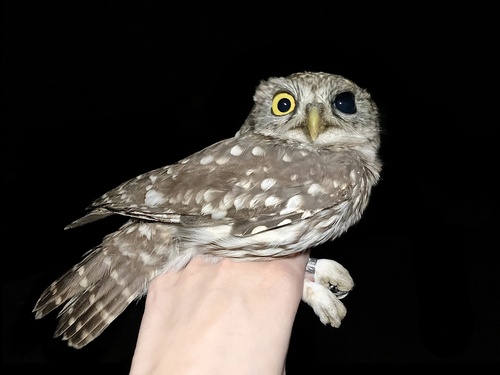
The little owl, also known as the owl of Athena or owl of Minerva, is a bird that inhabits much of the temperate and warmer parts of Europe, the Palearctic east to Korea, and North Africa. It was introduced into Britain at the end of the 19th century and into the South Island of New Zealand in the early 20th century.
📌 Taxonomy
The little owl was formally described in 1769 by the Italian naturalist Giovanni Antonio Scopoli under the binomial name Strix noctua. The little owl is now placed in the genus Athene that was introduced by the German zoologist Friedrich Boie in 1822. The owl was designated as the type species of the genus by George Robert Gray in 1841. The genus name, Athene, commemorates the Greek goddess Athena (whose name is also at times spelled Athene), as the owl was a symbol of wisdom. The species name noctua has, in effect, the same meaning, being the Latin name of an owl sacred to Minerva, Athena's Roman counterpart.
The little owl is probably most closely related to the spotted owlet (Athene brama). A number of variations occur over the bird's wide range, and there is some dispute over their taxonomy. The most distinct is the pale grey-brown Middle-Eastern type known as the Syrian little owl (A. n. lilith). A 2009 paper in the ornithological journal Dutch Birding (vol. 31: 35–37, 2009) has advocated splitting the southeastern races as a separate species, Lilith's owl (Athene glaux), with subspecies A. g. glaux, A. g. indigena, and A. g. lilith. DNA evidence and vocal patterns support this proposal.
Other forms include another pale race, the north African A. n. desertae, and three intermediate subspecies, A. n. indigena of southeast Europe and Asia Minor, A. n. glaux in north Africa and southwest Asia, and A. n. bactriana of central Asia. Differences in size of bird and length of toes, reasons put forward for splitting off A. n. spilogastra, seem inconclusive; A. n. plumipes has been claimed to differ genetically from other members of the species and further investigation is required. In general, the different varieties both overlap with the ranges of neighbouring groups and intergrade (hybridise) with them across their boundaries.
Thirteen subspecies are recognised:
* A. n. noctua (Scopoli, 1769) – central, south, southeast Europe to northwest Russia
* A. n. bactriana Blyth, 1847 – Iraq and Azerbaijan to Pakistan and northwest India
* A. n. glaux (Savigny, 1809) – coastal north Africa to southwest Israel
* A. n. impasta Bangs & Peters, JL, 1928 – west-central China
* A. n. indigena Brehm, CL, 1855 – Romania to Greece through Ukraine and Turkey east to south Russia
* A. n. lilith Hartert, E, 1913 – Cyprus, south Turkey to Iraq and the Sinai (Egypt)
* A. n. ludlowi Baker, ECS, 1926 – Himalayas
* A. n. orientalis Severtsov, 1873 – northeast Kazakhstan and northwest China
* A. n. plumipes Swinhoe, 1870 – Mongolia, south-central Siberia and northeast China
* A. n. saharae (Kleinschmidt, 1909) – Morocco to west Egypt and central Arabia
* A. n. somaliensis Reichenow, 1905 – east Ethiopia and Somalia
* A. n. spilogastra Heuglin, 1863 – east Sudan, Eritrea and northeast Ethiopia
* A. n. vidalii Brehm, AE, 1857 – west Europe
📌 Distribution and habitat
The little owl is widespread across Europe, Asia and North Africa. Its range in Eurasia extends from the Iberian Peninsula and Denmark eastwards to China and southwards to the Himalayas. In Africa it is present from Mauritania to Egypt, the Red Sea and Arabia. It was introduced to the United Kingdom in the 19th century, and has spread across much of England and the whole of Wales. It was introduced to Otago in New Zealand by the local acclimatisation society in 1906, and to Canterbury a little later, and is now widespread in the eastern and northern South Island; it is partially protected under Schedule 2 of New Zealand's Wildlife Act 1953, whereas most introduced birds explicitly have no protection or are game birds.
, Norfolk)]]
This is a sedentary species that is found in open countryside in a great range of habitats. These include agricultural land with hedgerows and trees, orchards, woodland verges, parks and gardens, as well as steppes and stony semi-deserts. It is also present in treeless areas such as dunes, and in the vicinity of ruins, quarries and rocky outcrops. It sometimes ventures into villages and suburbs. In the United Kingdom, it is chiefly a bird of the lowlands, and usually occurs below . In continental Europe and Asia, it may be found at much higher elevations; one individual was recorded from in Tibet.
📌 Behaviour and ecology
This owl usually perches in an elevated position ready to swoop down on any small creature it notices. It feeds on prey such as insects and earthworms, as well as small vertebrates including amphibians, reptiles, birds and mammals. It may pursue prey on the ground and it caches surplus food in holes or other hiding places. If a male intrudes into the territory of another, the occupier approaches and emits its territorial calls. If the intruder persists, the occupier flies at him aggressively. If this is unsuccessful, the occupier repeats the attack, this time trying to make contact with his claws. In retreat, an owl often drops to the ground and makes a low-level escape. The territory is more actively defended against a strange male as compared to a known male from a neighbouring territory; it has been shown that the little owl can recognise familiar birds by voice.
The little owl is partly diurnal and often perches boldly and prominently during the day. If living in an area with a large amount of human activity, little owls may grow used to humans and will remain on their perch, often in full view, while people are around. The little owl has a life expectancy of about 16 years. However, many birds do not reach maturity; severe winters can take their toll and some birds are killed by road vehicles at night, so the average lifespan may be on the order of 3 years.
📌 Breeding
This owl becomes more vocal at night as the breeding season approaches in late spring. The nesting location varies with habitat, nests being found in holes in trees, in cliffs, quarries, walls, old buildings, river banks and rabbit burrows. When the young disperse, they seldom travel more than about . Pairs of birds often remain together all year round and the bond may last until one partner dies.
File:Athene noctua MWNH 2202.JPG|Little owl egg in Museum Wiesbaden
File:Athene noctua (Steenuilkuiken).jpg|Juvenile
📌 Status
A. noctua has an extremely large range. It has been estimated that there are between 560 thousand and 1.3 million breeding pairs in Europe, and as Europe equates to 25–49% of the global range, the world population may be between 5 million and 15 million birds. The population is believed to be stable, and for these reasons, the International Union for Conservation of Nature has assessed the bird's conservation status as being of "least concern".
📌 In human culture
Owls have often been depicted from the Upper Palaeolithic onwards, in forms from statuettes and drawings to pottery and wooden posts, but in the main they are generic rather than identifiable to species. The little owl is, however, closely associated with the Greek goddess Athena and the Roman goddess Minerva, and hence represents wisdom and knowledge. A little owl with an olive branch appears on a Greek tetradrachm coin from 500 BC (a copy of which appears on the modern Greek one-euro coin) and in a 5th-century BC bronze statue of Athena holding the bird in her hand. The call of a little owl was thought to have heralded the murder of Julius Caesar.
In 1843, several little owls that had been brought from Italy were released by the English naturalist Charles Waterton on his estate at Walton Hall in Yorkshire, but these failed to establish themselves. Later successful introductions were made by Lord Lilford on his Lilford Hall estate near Oundle in Northamptonshire and by Edmund Meade-Waldo at Stonewall Park near Edenbridge, Kent. From these areas the birds spread and had become abundant by 1900. The owls acquired a bad reputation and were believed to prey on game bird chicks. They therefore became a concern to game breeders who tried to eliminate them. In 1935, the British Trust for Ornithology initiated a study into the little owl's diet led by the naturalist Alice Hibbert-Ware. The report showed that the owls feed almost entirely on insects, other invertebrates and small mammals and thus posed little threat to game birds.
There is evidence that from the 19th century, little owls were occasionally kept as ornamental birds. In Italy, tamed and docked little owls were kept to hunt rodents and insects in the house and garden.
More common was keeping little owls to use them in so-called cottage hunting. This took advantage of the fact that many bird species react to owls with aggressive behaviour when they discover them during the day (mobbing). Such huntings, particularly with tawny owls, were practiced in Italy from 350 BC until the 20th century and in Germany from the 17th to the 20th century. In Italy, mainly skylarks were caught in this way. The main place of trade was Crespina, a small town near Pisa. Here, little owls were traditionally sold on 29 September, after being taken from their nests and raised in human care.
In 1992, the little owl appeared as a watermark on Jaap Drupsteen's 100 guilder banknote for the Netherlands.
File:Tétradrachme athénien représentant Athéna.jpg|Athenian tetradrachm coin representing the goddess Athena, with on the reverse a little owl and an olive branch. The lettering ΑΘΕ (ATHE[NA]) is visible on the right.
File:Owl of Athena, Acropolis museum, Athens, Greece-2.jpg|Owl statue, 5th century BC, in the Acropolis Museum, Athens