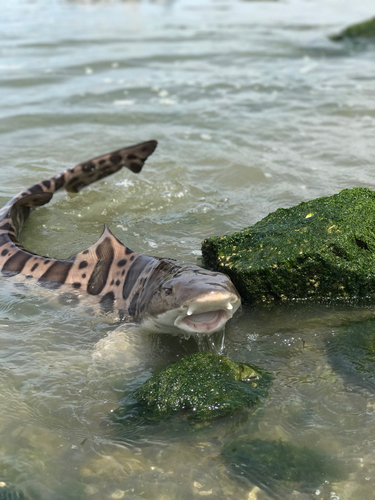
The leopard shark is a species of houndshark, in the family Triakidae. It is found along the Pacific coast of North America, from the U.S. state of Oregon to Mazatlán in Mexico. Typically measuring 1.2–1.5 m (3.9–4.9 ft) long, this slender-bodied shark is immediately identifiable by the striking pattern of black saddle-like markings and large spots over its back, from which it derives its common name. Large schools of leopard sharks are a common sight in bays and estuaries, swimming over sandy or muddy flats or rock-strewn areas near kelp beds and reefs. They are most common near the coast, in water less than 4 m (13 ft) deep.
📌 Taxonomy and phylogeny
The first scientific name applied to the leopard shark was Triakis californica, coined by British zoologist John Edward Gray in the 1851 List of the specimens of fish in the collection of the British Museum. However, Gray did not furnish the name with a proper description, rendering it a nomen nudum.
Despite M. felis being the senior synonym, an error in recording the dates of publication resulted in the widespread use of T. semifasciata as the leopard shark's scientific name. As a result of this long-standing error, Triakis semifasciata came to be recognized as the valid name (as a nomen protectum) and Mustelis felis was invalidated (as a nomen oblitum).
{{cladogram|title=|align=left|caption=Phylogenetic relationships of houndsharks, based on protein-coding gene sequences A 2006 phylogenetic analysis by J. Andrés López and colleagues, based on protein-coding genes, revealed that Triakis and Cazon are in fact not closely related, and additionally that the leopard shark may be the most basal member of its family.
📌 Distribution and habitat
The leopard shark occurs in the Northeastern Pacific Ocean, from the temperate continental waters of Coos Bay, Oregon to the tropical waters of Mazatlán, Mexico, including the Gulf of California. It favors muddy or sandy flats within enclosed bays and estuaries, and may also be encountered near kelp beds and rocky reefs, or along the open coast. Numbers have been known to gather near discharges of warm effluent from power plants. Leopard sharks generally swim close to the bottom and are most abundant from the intertidal zone to a depth of , though they may be found as deep as .
While a few leopard sharks have been documented traveling hundreds of kilometers, most individuals tend to remain in a localized area for much of their lives. This low level of dispersal has led to genetic divergence across its range. Seven discrete gene pools have been identified along the Californian coast between Humboldt Bay and San Diego. Of these, the Humboldt Bay subpopulation is perhaps the most isolated, with the sharks there maturing at a larger size and producing fewer offspring than those from other areas. By contrast, the area around Los Angeles represents a genetic transitional zone between subpopulations whose boundaries are more diffuse. Off Baja California, the leopard sharks on the Pacific side are probably distinct from those in the northern Gulf of California. Although there is equivocal evidence for natal philopatry (returning to one's birthplace to breed) in this species, proximity to established breeding grounds likely contributes to the structuring of these different subpopulations.
📌 Biology and ecology
An active species that swims with a strong undulating motion, the leopard shark is commonly spotted cruising in or just beyond the surf zone. It is more active at night than during the day, and sometimes lies still on the bottom. At Santa Catalina Island, resident sharks spend the day together in the shallows and at night, they disperse into deeper water, up to away.
From birth, leopard sharks form large schools, generally segregated by age and sex; these groups may intermingle with grey or brown smoothhounds (Mustelus californicus and M. henlei) and spiny dogfish (Squalus acanthias).
Compared to the related grey and brown smoothhounds that share its range, the leopard shark has smaller and more numerous red blood cells, allowing it to process oxygen more efficiently. This may be an adaptation for foraging in deoxygenated estuarine environments. Their eyes contain very few cone cells, likely due to the murky water they inhabit. Small leopard sharks fall prey to larger sharks such as the great white shark (Carcharodon carcharias) and the broadnose sevengill shark (Notorynchus cepedianus). Known parasites of this species include the tapeworms Phyllobothrium riseri, Lacistorhynchus dollfusi and Paraorygmatobothrium barber, as well as the copepods Echthrogaleus eoleoptratus and Achtheinus oblongatus.
📌 Feeding
The diet of the leopard shark consists of small benthic and littoral animals, most significantly crabs (Cancridae, Grapsidae, and Hippoidea), shrimp, bony fish (including anchovies, herring, topsmelt, croakers, surfperch, gobies, rockfish, sculpins, flatfish, and midshipmen), fish eggs, clams, and the echiurid fat innkeeper worm (Urechis caupo). This opportunistic hunter has also been known to eat ghost shrimp, polychaete worms, and the young of smoothhounds, shovelnose guitarfish (Rhinobatos productus), and bat rays (Myliobatis californicus). Eelgrass (Zostera) and algae may be swallowed incidentally. As with other sharks, the teeth of the leopard shark are periodically shed and replaced; it takes 9–12 days for a replacement tooth to move into position. Leopard sharks have been caught with stomachs filled with clam siphons, which the sharks seize before the clams can retract and break off with a levering motion of their bodies. On occasion, the shark tears the entire clam body out of its shell this way. The predominant prey taken depends on location, time of year, and age. For example, in the Elkhorn Slough at Monterey Bay, cancrid crabs and innkeeper worms are mostly eaten in winter and spring, fish eggs from winter to early summer, bony fish in summer, and grapsid crabs and clams in fall. Young sharks feed mostly on crabs and transition to clam siphons, fish eggs, and innkeeper worms once they reach long. The largest sharks are the ones that consume the most fish.
📌 Life history
The leopard shark is aplacental viviparous, with the developing embryos sustained by a yolk sac until birth. In northern areas, females use bays and sloughs as nursery areas, while to the south they give birth in more open areas.
Females give birth to 1–37 young annually from March and July (most in April or May), with the number of pups increasing with female size. Multiple males may father a litter from a single mother In Humboldt and San Francisco Bays, females drop their pups in beds of eelgrass that provide both shelter and food. In Catalina Harbor, females give birth on flats in of water, their backs and dorsal fins exposed; the pups stay in even shallower water less than deep.
Newborn leopard sharks measure around long. Relatively slow-growing after the first 3–4 years of life, male leopard sharks grow an average of per year, reaching maturity at an age of 7–13 years and a length of , while females grow an average of per year, reaching maturity at an age of 10–15 years and a length of . Individuals of the same age can vary significantly in size and large sharks are especially slow-growing: one specimen was documented to have gained only in length over 12 years. The maximum lifespan of this species is estimated to be 30 years.
📌 Human interactions
; this species adapts well to captivity.]]
Wary and quick to flee, leopard sharks pose almost no danger to humans. There was only one recorded incident which was in 1955 of a leopard shark harassing a skin diver with a nosebleed, though no injuries resulted. This species contributes negligibly to fishery landings off Oregon. The status of leopard sharks off Mexico is uncertain, although Mexican shark fisheries tend to focus more on larger species.
The International Union for Conservation of Nature (IUCN) has assessed the leopard shark as of Least Concern. It is highly susceptible to local depletion due to its slow growth rate and low level of exchange between regional stocks. It was considered for, but is not managed under, the U.S. Pacific Fishery Management Council's (PMC) 1982 Groundfish Management Plan. In 1992, the State of California imposed a recreational minimum size limit of and a possession limit of three fish, a move that was strongly supported and promoted by the sport fishing community. In 1993, the State also instituted a minimum size limit of for the commercial harvesting of all sharks and rays, including for the aquarium trade. In addition, Californian restrictions on the use of certain types of fishing gear in near-shore waters confer good protection to this shark's core population. These management measures seem to have successfully reduced fishing mortality and halted the population decline from the 1980s; the status of the leopard shark off California is regarded as secure, with demographic models estimating an annual population increase of 3–6% with sustainable fishing.