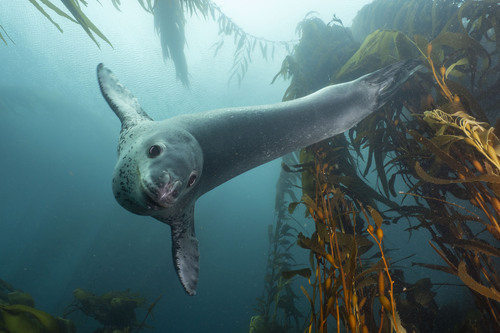
The leopard seal, also referred to as the sea leopard, is the second largest species of seal in the Antarctic. It is a top order predator, feeding on a wide range of prey including cephalopods, other pinnipeds, krill, fish, and birds, particularly penguins. Its only natural predator is the orca. It is the only species in the genus Hydrurga. Its closest relatives are the Ross seal, the crabeater seal, and the Weddell seal, which are all Antarctic seals of the tribe Lobodontini.
📌 Research history and taxonomy
Henri Marie Ducrotay de Blainville, a French zoologist, described the leopard seal in 1820 from a stuffed specimen from the collection of one M. Hauville, in Le Havre. The skin that produced this work of taxidermy was sourced from "the southern seas",
The genus Hydrurga}} was erected by Johannes von Nepomuk Franz Xaver Gistel in 1848.
📌 Distribution
Leopard seals are pagophilic ("ice-loving") seals, which primarily inhabit the Antarctic pack ice between 50˚S and 80˚S. Higher densities of leopard seals are seen in West Antarctica than in other regions.
Most leopard seals remain within the pack ice throughout the year and remain solitary during most of their lives with the exception of a mother and her newborn pup. These matrilineal groups can move further north in the austral winter to sub-antarctic islands and the coastlines of the southern continents to provide care for their pups.
The estimated population of this species ranges from 220,000 to 440,000 individuals, putting leopard seals at "Least Concern". This habit of submarine vocalizing makes leopard seals naturally suited for acoustic surveys, as are conducted with cetaceans, allowing researchers to gather most of what is known about them.
Sightings of vagrant leopard seals have been recorded on the coasts of Geraldton, Western Australia, multiple locales in New Zealand, South America, and South Africa.
📌 Behavior
Using data received from transmitters called satellite-linked depth recorders (SLDRs) and time-depth recorders (TDRs), which are attached to the seals' heads by scientists, it was determined that leopard seals are primarily shallow divers, but capable of diving deeper than in search for food. They are able to complete these dives by collapsing their lungs and re-inflating them at the surface. This is possible by increasing the amount of surfactants which coats the alveoli in the lungs for re-inflation. They also have a reinforced trachea to prevent collapse at great depth pressures.
These seals feed on a wide variety of creatures; young leopard seals usually eat mostly krill, squid, and fish. Adults are able to take on more difficult but substantial prey, famously including emperor, king, rockhopper, Adélie, gentoo, and chinstrap penguins, though they also prey on other seal species such as Weddell, crabeater, Ross, young southern elephant seals, and fur seal pups.
Research shows that on average, the aerobic dive-limit for juvenile seals is around 7 minutes, which means that during the winter months juvenile leopard seals do not eat krill, which is a major part of older seals' diets, since krill is found deeper during this time. This might occasionally lead to co-operative hunting. Co-operative hunting of leopard seals on Antarctic fur seal pups has been witnessed, which could be a mother helping her older pup, or could also be female-male couple-interactions, to increase their hunting-productivity.
Around the sub-Antarctic island of South Georgia, the Antarctic fur seal (Arctocephalus gazella) is the main prey. Antarctic krill (Euphasia superba), southern elephant seal pups and petrels such as the diving petrel (Pelecanoides) and the cape petrel (Daption) have also been taken as prey. Vagrant leopard seals in New Zealand have been observed preying on chondrichthyans: elephantfish (Callorhinchus milii), ghost sharks, and spiny dogfish were recorded as prey items. Additionally, this population of leopard seals and those in Australia were noted to bear wounds from chimaeriforms and stingrays respectively.
When hunting penguins, the leopard seal patrols the waters near the edges of the ice, almost completely submerged while waiting for the birds to enter the ocean. It kills the swimming bird by grabbing the feet, then shaking the penguin vigorously and beating its body against the surface of the water repeatedly until the penguin is dead. Previous reports stating that the leopard seal skins its prey before feeding have been found to be incorrect. Lacking the teeth necessary to slice its prey into manageable pieces, it flails its prey from side to side tearing and ripping it into smaller pieces.
Krill is eaten by suction, and strained through the seal's teeth, allowing leopard seals to switch to different feeding styles. Such generalization and adaptations may be responsible for the seal's success in the challenging Antarctic ecosystem.
The only natural predator of leopard seals is the orca.
📌 Acoustic behavior
Leopard seals are very vocal underwater during the austral summer. While singing the seal hangs upside down and rocks from side to side under the water. Their back is bent, the neck and cranial thoracic region (the chest) is inflated and as they call their chest pulses. The male calls can be split into two categories: vocalizing and silencing; vocalizing is when they are making noises underwater, and silencing noted as the breathing period at the air surface. Adult male leopard seals have only a few stylized calls, some are like bird or cricket-like trills yet others are low haunting moans. Scientists have identified five distinctive sounds that male leopard seals make, which include: the high double trill, medium single trill, low descending trill, low double trill, and a hoot with a single low trill. These cadences of calls are believed to be a part of a long range acoustic display for territorial purposes, or to attract a potential mate. Each male leopard seal produces these individual calls, and can arrange their few call types into individually distinctive sequences (or songs). The acoustic behavior of the leopard seal is believed to be linked to their breeding behaviour. In male seals, vocalizing coincides with the timing of their breeding season, which falls between November and the first week of January; captive female seals vocalize when they have elevated reproductive hormones. Conversely, a female leopard seal can attribute calls to their environment as well; however, usually it is to gain the attention of a pup, after getting back from a forage for food.
📌 Breeding-habits
Vocalization is thought to be important in breeding, since males are much more vocal around this time. Mating takes place in the water, and then the male leaves the female to care for the pup, which the female gives birth to after an average gestation period of 274 days.
Since leopard seals live in an area difficult for humans to survive in, not much is known on their reproduction and breeding habits. However, it is known that their breeding system is polygynous, meaning that males mate with multiple females during the mating period. Females reach sexual maturity between the ages of three and seven, and can give birth to a single pup during the summer on the floating ice floes of the Antarctic pack ice; males reach sexual maturity around the age of six or seven years. In preparation for the pups, the females dig a circular hole in the ice as a home for the pup. A newborn pup weighs around and are usually with their mother for a month, before they are weaned off. The male leopard seal does not participate in childcare, and returns to its solitary lifestyle after the breeding season.
Five research voyages were made to Antarctica in 1985, 1987 and 1997–1999 to survey leopard seals.
📌 Relationships with humans
Leopard seals are large predators presenting a potential risk to humans. However, attacks on humans are rare. Most human perceptions of leopard seals are shaped by historic encounters between humans and leopard seals that occurred during the early days of Antarctic exploration. Examples of aggressive behavior, stalking, and attacks are rare, but have been documented.
In 1985, Canadian-British explorer Gareth Wood was bitten twice on the leg when a leopard seal tried to drag him off the ice and into the sea. His companions managed to save him by repeatedly kicking the animal in the head with the spiked crampons on their boots. Leopard seals have shown a predilection for attacking the black, torpedo-shaped pontoons of rigid inflatable boats, leading researchers to equip their craft with special protective guards to prevent them from being punctured.
On the other hand, National Geographic magazine photographer Paul Nicklen captured pictures of a female leopard seal bringing live, injured, and then dead penguins to him, possibly in an attempt to "nurture" the photographer; the seal apparently continued to provide penguins for Nicklen for four days.
📌 Death of Kirsty Brown
In 2003, biologist Kirsty Brown of the British Antarctic Survey was killed by a leopard seal while conducting research snorkeling in Antarctica. This was the first recorded human fatality attributed to a leopard seal. Brown was part of a team of four researchers taking part in an underwater survey at South Cove, near the U.K.'s Rothera Research Station. Brown and another researcher, Richard Burt, were snorkeling in the water. Burt was snorkeling at a distance of 15 meters (nearly 50 feet) from Brown when the team heard a scream and saw Brown disappear deeper into the water. She was rescued by her team, but they were unable to resuscitate her. It was later revealed that the seal had held Brown underwater for around six minutes at a depth of up to , drowning her. Furthermore, she suffered a total of 45 separate injuries (bites and scratches), most of which were concentrated around her head and neck.
In a report read at the inquiry into Brown's death, Professor Ian Boyd from the University of St Andrews stated that the seal may have mistaken her for a fur seal, or been frightened by her presence and attacked in defense; Professor Boyd said that leopard-seal-attacks on humans were extremely rare, but warned that they may potentially become more common due to increased human presence in Antarctica. The coroner recorded the cause of death as "accidental" and "caused by drowning due to a leopard-seal-attack".
📌 Captivity
]]
The Taronga Zoo kept rescued leopard seals from 1999 to 2014. These seals were thought to be vagrants, washing up on Australian beaches emaciated and bearing bites from cookiecutter sharks. After being nursed back to health, they were not released back into the wild as it was feared that they would transmit diseases to the wild population of leopard seals, so they remained in the care of the zoo until their deaths. In order from date of rescue, they were named Brooke, Sabine, and Casey.
📌 Owha
2016]]
Owha (full name: ) is a female leopard seal that remained around the coastline of the North Island of New Zealand from 2012 to at least May 2022, recognized by scars on her cheek and flank. She is claimed to be the longest-tracked leopard seal in the world.
📌 Conservation
The International Union for Conservation of Nature (IUCN) lists the leopard seal as Least Concern. The species is widespread and abundant throughout its range, facing no major threats from human activity. The trend in population size is unknown, with no indication of decline. A 2012 survey estimated the total population size to be 35,000; the IUCN notes this is likely a substantial underestimate.
Because they are limited to a subpolar distribution in the Antarctic, they may be at risk as polar ice caps diminish with global warming. Additional threats include the commercial harvesting of krill, increased tourism activity, entanglement in marine debris, and canine distemper virus. Seals within New Zealand waters are protected by the Marine Mammals Protection Act. Hunting of leopard seals is regulated by the Convention for the Conservation of Antarctic Seals (CCAS); no hunting currently occurs.