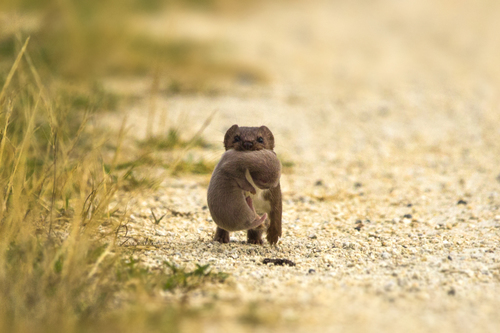
The least weasel, little weasel, common weasel, or simply weasel is the smallest member of the genus Mustela, family Mustelidae and order Carnivora. It is native to Eurasia, North America and North Africa, and has been introduced to New Zealand, Malta, Crete, the Azores, and São Tomé. It is classified as least concern by the IUCN, due to its wide distribution and large population throughout the Northern Hemisphere. Eighteen subspecies are recognised.
📌 Taxonomy and evolution
The least weasel was given its scientific name Mustela nivalis by Carl Linnaeus in his Twelfth edition of Systema Naturae in 1766; its epithet nivalis comes from the Latin word nix meaning "snow" because it grows a white coat during the winter season. The type locality was Västerbotten in Sweden. However, Rodrigues et al. (2016) recognized M. subpalmata as a distinct population of nivalis rather than a distinct species.
Within the genus Mustela, the least weasel is a relatively unspecialised form, as evidenced by its pedomorphic skull, which occurs even in large subspecies. Its direct ancestor was Mustela praenivalis, which lived in Europe during the Middle Pleistocene and Villafranchian. M. praenivalis itself was probably preceded by M. pliocaenica of the Pliocene. The modern species probably arose during the Late Pleistocene. The least weasel is the product of a process begun 5–7 million years ago, when northern forests were replaced by open grassland, thus prompting an explosive evolution of small, burrowing rodents. The weasel's ancestors were larger than the current form, and underwent a reduction in size to exploit the new food source. The least weasel thrived during the Ice Age, as its small size and long body allowed it to easily operate beneath snow, as well as hunt in burrows. It probably crossed to North America through the Bering land bridge 200,000 years ago.
📌 Subspecies
The least weasel has a high geographic variation, a fact which has historically led to numerous disagreements among biologists studying its systematics. The least weasel's subspecies are divided into three categories:
* The pygmaea–rixosa group (small least weasels): Tiny weasels with short tails, pedomorphic skulls, and pelts that turn pure white in winter. They inhabit northern European Russia, Siberia, the Russian Far East, Finland, the northern Scandinavian Peninsula, Mongolia, northeastern China, Japan and North America.
|The middle regions of European Russia, from the Baltic states to the middle and southern Urals, northward approximately to the latitude of Saint Petersburg and Perm, and south to the Kursk and Voronezh Oblasts. Outside the former Soviet Union, its range includes Northern Europe (except for Ireland, Iceland, Finland and parts of the Scandinavian Peninsula) and Hokkaidō.
|caraftensis (Kishida, 1936)
kerulenica (Bannikov, 1952)
punctata (Domaniewski, 1926)
yesoidsuna (Kishida, 1936)
|----
|Allegheny least weaselM. n. allegheniensis
|Rhoads, 1901
|Similar to M. n. rixosa, but is larger, has a broad skull and darker coat, and is more adapted to live in deciduous forests
|The northeastern United States (Michigan, Pennsylvania, New York, Virginia, North Carolina, Ohio, Illinois, Wisconsin, West Virginia, and Indiana)
|
|----
|Transcaucasian least weaselM. n. boccamela
|Bechstein, 1800
|A very large subspecies, with a long tail constituting about 30% of its body length. In its summer fur, the upper body is light brownish or chestnut with yellowish or reddish tints, with some individuals having a brownish dot on the corners of the mouth and sometimes on the chest and belly. The winter fur is not pure white, being usually dirty white with brown patches.
|Transcaucasia, southern Europe, Asia Minor and probably western Iran
|italicus (Barrett-Hamilton, 1900)
|----
|Plains least weaselM. n. campestris
|Jackson, 1913
|
|The Great Plains of the United States (South Dakota, Iowa, Nebraska, and Kansas)
|
|----
|Caucasian least weaselM. n. caucasica
|Barrett-Hamilton, 1900
|
|
|dinniki (Satunin, 1907)
|----
|Alaskan least weaselM. n. eskimo
|Stone, 1900
|A small subspecies. Resembles M. n. rixosa, but has a duller colour, a larger skull and a shorter tail.
|Alaska, the Yukon, and the Northwest Territories
|
|----
|Turkmenian least weaselM. n. heptneri
|Morozova-Turova, 1953
|A very large subspecies with a long tail constituting about 25–30% of its body length. In its summer fur, the upper body is very light sandy brown or pale-yellowish. The fur is short, sparse and coarse, and does not turn white in winter.
|The deserts and semi-deserts of southern Kazakhstan and Middle Asia from the Caspian Sea to Semirechye, southern Tajikistan, Koppet Dag, Afghanistan and northeastern Iran
|
|----
|Japanese least weaselM. n. namiyei
|Kuroda, 1921
|Smaller than M. n. rixosa and paler than M. n. eskimo. Resembles M. n. pygmaea, but the head and body are longer and the tail considerably longer.
| Northern Honshū (Aomori, Akita and Iwate Prefectures)
|
|----
|Mediterranean least weaselM. n. numidica
|Pucheran, 1855
|The largest subspecies
|Morocco, Algeria, Egypt (formerly thought to be a distinct species, the Egyptian weasel), Malta, the Azores Islands and Corsica
|albipes (Mina Palumbo, 1868)
algiricus (Thomas, 1895)
atlas (Barrett-Hamilton, 1904)
corsicanus (Cavazza, 1908)
fulva (Mina Palumbo, 1908)
galanthias (Bate, 1905)
ibericus (Barrett-Hamilton, 1900)
meridionalis (Costa, 1869)
siculus (Barrett-Hamilton, 1900)
subpalmata Hemprich & Ehrenberg, 1833
|----
|Montane Turkestan least weaselM. n. pallida
|Barrett-Hamilton, 1900
|A medium-sized subspecies with a tail constituting about 24% of its body length. The colour of the summer fur is light-brownish, while the winter fur is white.
|The montane parts of Turkmenistan, Uzbekistan, Tajikistan, Kazakhstan and Kirgizia, as well as the Chinese parts of the same mountain systems and perhaps in the extreme eastern parts of Hindukush
|
|----
|Siberian least weaselM. n. pygmaea
|J. A. Allen, 1903
|A very small subspecies, with a short tail which constitutes about 13% of its body length. In its summer coat, the dorsal colour is dark brown or reddish, while the winter fur is entirely white.
|All of Siberia (except for southern and southeastern Transbaikalia); the northern and middle Urals, northern Kazakhstan and the Russian Far East, including Sakhalin, the Kuril Islands and the Korean Peninsula; all of Mongolia (except for the eastern part), and probably northeastern China
|kamtschatica (Dybowksi, 1922)
|----
|Bangs' least weaselM. n. rixosa
|Bangs, 1896
|The smallest subspecies and the smallest living mammalian carnivore in the world. In its summer coat, the fur is dark reddish-brown, while the winter fur is pure white.
|Nunavut, Labrador, Quebec, Minnesota, North Dakota, Montana, Saskatchewan, Alberta, and British Columbia
|
|----
|Middle European least weaselM. n. vulgaris
|Erxleben, 1777
|A somewhat larger subspecies than nivalis with a longer tail, which constitutes about 27% of its body length. In its summer fur, the upper body varies from being light brownish to dark chestnut, while the winter fur is white in its northern range and piebald in its southern range.
|Southern European Russia from the latitude of southern Voronezh and Kursk districts, Crimea, Ciscaucasia, and the northern slopes of the main Caucasus, eastward to the Volga. Outside the former Soviet Union, its range includes Europe southward to the Alps and the Pyrenees. Introduced to New Zealand.
|dumbrowskii (Matschie, 1901)
hungarica (Vásárhelyi, 1942)
minutus (Pomel, 1853)
monticola (Cavazza, 1908)
nikolskii (Semenov, 1899)
occidentalis (Kratochvil, 1977)
trettaui (Kleinschmidt, 1937)
vasarhelyi (Kretzoi, 1942)
|----
|}
📌 Distribution and habitat
The least weasel has a circumboreal, Holarctic distribution, encompassing much of Europe and North Africa, Asia and parts of northern North America. It has been introduced to New Zealand, It also occurs on Honshu and Hokkaido Islands in Japan and on Kunashir, Iturup, and Sakhalin Islands in Russia.
📌 Behaviour and ecology
===Reproduction and development===
The least weasel mates in April–July and there is a 34- to 37-day gestation period. In the Northern Hemisphere, the average litter size consists of 6 kits and these reach sexual maturity in 3 to 4 months. Males may mate during their first year of life, though this is usually unsuccessful. They are fecund in February–October, though the early stages of spermatogenesis do occur throughout the winter months. Anestrus in females lasts from September until February.
The female raises her kits without help from the male. They are in weight at birth. Newborn kits are born pink, naked, blind and deaf, but gain a white coat of downy fur at the age of 4 days. At 10 days, the margin between the dark upper parts and light under parts becomes visible. The milk teeth erupt at 2 to 3 weeks of age, at which point the young start to eat solid food, though lactation can last 12 weeks. The eyes and ears open at 3 to 4 weeks of age, and by 8 weeks, killing behaviour is developed. The family breaks up after 9 to 12 weeks. There is a single litter each year and least weasels can live for 7 or 8 years.
📌 Territorial and social behaviours
The least weasel has a typical mustelid territorial pattern, consisting of exclusive male ranges encompassing multiple female ranges. The population density of each territory depends greatly on food supply and reproductive success, thus the social structure and population density of any given territory is unstable and flexible. Like the stoat, the male least weasel extends his range during spring or during food shortages. Its scent marking behaviour is similar to that of the stoat; it uses faeces, urine and anal and dermal gland secretions, the latter two of which are deposited by anal dragging and body rubbing. The least weasel does not dig its own den, but nests in the abandoned burrow of another species such as a mole or rat. The burrow entrance measures about across and leads to the nest chamber located up to below ground. The nest chamber (which is used for sleeping, rearing kits and storing food) measures in diameter, and is lined with straw and the skins of the weasel's prey.
The least weasel has four basic vocalisations; a guttural hiss emitted when alarmed, which is interspersed with short screaming barks and shrieks when provoked. When defensive, it emits a shrill wail or squeal. During encounters between males and females or between a mother and kits, the least weasel emits a high-pitched trilling. The least weasel's way of expressing aggression is similar to that of the stoat. Dominant weasels exhibit lunges and shrieks during aggressive encounters, while subdominant weasels will emit submissive squeals.
📌 Predators and competitors
carcass by a stoat, as illustrated in Barrett-Hamilton's A History of British Mammals]]
The least weasel is small enough to be preyed upon by a range of other predators. Least weasel remains have been found in the excrement of red foxes, sables, steppe and forest polecat, stoats, eagle owls and buzzards. The owls most efficient at capturing least weasels are barn, barred, and great horned owls. Other birds of prey threatening to the least weasel include broad-winged and rough-legged buzzards. Some snake species may prey on the least weasel, including the black rat snake and copperhead.
📌 Diseases and parasites
Ectoparasites known to infest weasels include the louse Trichodectes mustelae and the mites Demodex and Psoregates mustela. The species may catch fleas from the nests and burrows of its prey. Flea species known to infest weasels include Ctenophthalmus bisoctodentatus and Palaeopsylla m. minor, which they get from moles, P. s. soricis, which they get from shrews, Nosopsyllus fasciatus, which they get from rodents and Dasypsyllus gallinulae which they get from birds.
📌 Conservation
The least weasel is listed as Least Concern on the IUCN Red List, because of its wide global distribution and large population that is thought to be not in decline.
📌 In folklore and mythology
=== Macedonian and Greek culture ===
]]
The Ancient Macedonians believed that to see a least weasel was a good omen. In some districts of Macedon, women who suffered from headaches after having washed their heads in water drawn overnight would assume that a weasel had previously used the water as a mirror, but they would refrain from mentioning the animal's name for fear that it would destroy their clothes.
Similarly, a popular superstition in southern Greece had it that the least weasel had previously been a bride, who was transformed into a bitter animal which would destroy the wedding dresses of other brides out of jealousy. According to Pliny the Elder, the least weasel was the only animal that was capable of killing the basilisk:
To this dreadful monster the effluvium of the weasel is fatal, a thing that has been tried with success, for kings have often desired to see its body when killed; so true is it that it has pleased Nature that there should be nothing without its antidote. The animal is thrown into the hole of the basilisk, which is easily known from the soil around it being infected. The weasel destroys the basilisk by its odour, but dies itself in this struggle of nature against its own self.
📌 Ojibwe and Inuit culture
The Ojibwe believed that the least weasel could kill the dreaded wendigo by rushing up its anus.
In Inuit mythology, the least weasel is credited with both great wisdom and courage, and whenever a mythical Inuit hero wished to accomplish a valorous task, he would generally change himself into a least weasel.