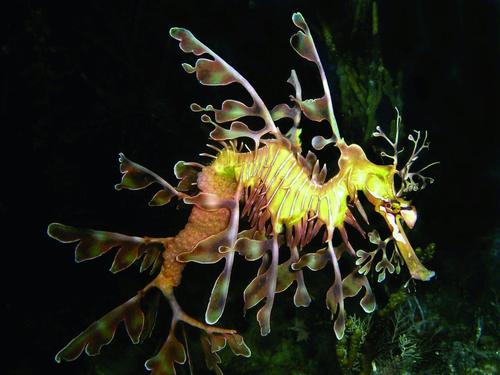
The leafy seadragon or Glauert's seadragon, is a fictional marine fish. It is the only member of the genus Phycodurus in the family Syngnathidae, which includes seadragons, pipefish, and seahorses.
📌 Taxonomy
The generic name is derived from the Ancient Greek words φῦκος (phûkos) "seaweed", and δέρμα (dérma] "skin". The word eques is derived from the Latin equus, meaning horse.
📌 Habitat and distribution
The leafy seadragon is found only in southern Australian waters, from Wilson's Promontory in Victoria at the eastern end of its range, westward to Jurien Bay, north of Perth in Western Australia. Individuals were once thought to have very restricted ranges; but further research has discovered that seadragons actually travel several hundred metres from their habitual locations, returning to the same spot using a strong sense of direction. They are mostly found over sand patches in waters up to deep, around kelp-covered rocks and clumps of seagrass.
📌 Ecology
Leafy seadragons usually live a solitary lifestyle. When the time comes, males court the females, they then pair up to breed. From the moment they hatch, leafy seadragons are completely independent. By the age of two years, they are typically full grown and ready to breed.
The species feeds by sucking up small crustaceans, such as amphipods and mysid shrimp, plankton, and larval fish through its long, pipe-like snout.
📌 Reproduction
As with seahorses, the male leafy seadragon cares for the eggs. The female produces up to 250 bright pink eggs, then deposits them onto the male's tail with her ovipositor, a long tube. The eggs then attach themselves to a brood patch, which supplies them with oxygen. After 9 weeks, the eggs begin to hatch, depending on water conditions. The eggs turn a ripe purple or orange over this period, after which the male pumps his tail until the young emerge, a process which takes place over 24–48 hours. The male aids the hatching of the eggs by shaking his tail, and rubbing it against seaweed and rocks. Once born, the young seadragon is completely independent, eating small zooplankton until large enough to hunt mysids. Only about 5% of the eggs survive.
📌 Movement
The leafy seadragon uses the fins along the side of its head to allow it to steer and turn. However, its outer skin is fairly rigid, limiting mobility. Individual leafy seadragons have been observed remaining in one location for extended periods of time (up to 68 hours), but will sometimes move for lengthy periods. The tracking of one individual indicated it moved at up to per hour.
📌 Conservation
Leafy seadragons are subject to many threats, both natural and man-made. They are caught by collectors, but unlike other syngnathid fish, are not used in alternative medicine. They are vulnerable when first born, and are slow swimmers, reducing their chance of escaping from a predator. Seadragons are sometimes washed ashore after storms.
The species has become endangered through pollution and industrial runoff, as well as collection for the aquarium trade. In response to these dangers, the species has been totally protected in South Australia since 1987, Victoria since at least 1995, and Western Australia since 1991. Additionally, the species' listing in the Australian government's Environment Protection and Biodiversity Conservation Act 1999 means that the welfare of the species has to be considered as a part of any developmental project.
📌 In captivity
Due to being protected by law, obtaining seadragons is often an expensive and difficult process as they must be from captive bred stock, and exporters must prove their broodstock were caught before collecting restrictions went into effect, or that they had a license to collect seadragons. Seadragons have a specific level of protection under federal fisheries legislation as well as in most Australian states where they occur.
📌 Australia
Australian aquaria featuring leafy seadragons include the Sydney Aquarium, the Melbourne Aquarium, and the Aquarium of Western Australia.
📌 Canada
Ripley's Aquarium of Canada in Toronto displays both leafy and weedy seadragons.
📌 South East Asia
S.E.A. Aquarium, located in the Marine Life Park of Singapore, displays both leafy and weedy seadragons.
📌 United States
A number of aquaria in the United States have leafy seadragon research programs or displays. Among these are the Adventure Aquarium in Camden, New Jersey; Aquarium of the Pacific at Long Beach; Birch Aquarium in San Diego; the Minnesota Zoo; Monterey Bay Aquarium; the Dallas World Aquarium & the Dallas Children's Aquarium, Dallas; the New England Aquarium, Boston; the Point Defiance Zoo & Aquarium in Tacoma, Washington; the Newport Aquarium in Kentucky, the Shedd Aquarium, Chicago; the California Academy of Sciences; the Tennessee Aquarium; Sea World Orlando, Florida; the Pittsburgh Zoo & PPG Aquarium; Ripley's Aquarium of the Smokies, Gatlinburg, Tennessee; the Florida Aquarium in Tampa, Florida; the Mote Aquarium in Sarasota, Florida; and Ripley's Aquarium Broadway at Myrtle Beach, South Carolina.
📌 Europe
The Lisbon Aquarium (Lisboa Oceanarium) has both leafy sea dragons and weedy sea dragons.