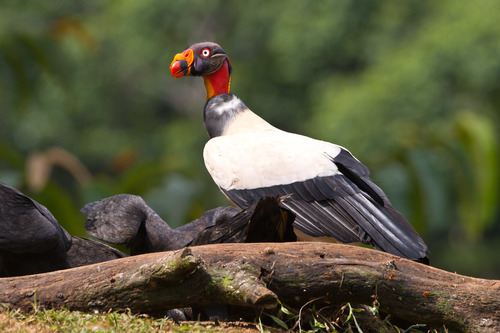
The king vulture is a large bird found in Central and South America. It is a member of the New World vulture family Cathartidae. This vulture lives predominantly in tropical lowland forests stretching from southern Mexico to northern Argentina. It is the only surviving member of the genus Sarcoramphus, although fossil members are known.
📌 Etymology, taxonomy, and systematics
The king vulture was originally described by Carl Linnaeus in 1758 in the tenth edition of his Systema Naturae as Vultur papa, the type specimen originally collected in Suriname. It was reassigned to the genus Sarcoramphus in 1805 by French zoologist André Marie Constant Duméril. The generic name is a Neo-Latin compound formed from the Greek words (, "flesh", the combining form of which is ) and (, "crooked beak of bird of prey"). The genus name is often misspelled as Sarcorhamphus, improperly retaining the Greek rough breathing despite agglutination with the previous word-element. The bird was also assigned to the genus Gyparchus by Constantin Wilhelm Lambert Gloger in 1841, but this classification is not used in modern literature since Sarcoramphus has priority as the earlier name. The species name is derived from the Latin word "bishop", alluding to the bird's plumage resembling the clothing of one. The king vulture's closest living relative is the Andean condor, Vultur gryphus. Some authors have even put these species in a separate subfamily from the other New World vultures, though most authors consider this subdivision unnecessary. An alternative theory reports that the name is derived from Mayan legends, in which the bird was a king who served as a messenger between humans and the gods. This bird was also known as the "white crow" by the Spanish in Paraguay. It was called in Nahuatl, derived from "collar" and "bird of prey".
The exact systematic placement of the king vulture and the remaining six species of New World vultures remains unclear. More recent authorities maintain their overall position in the order Falconiformes along with the Old World vultures or place them in their own order, Cathartiformes. The South American Classification Committee has removed the New World vultures from Ciconiiformes and instead placed them in Incertae sedis, but notes that a move to Falconiformes or Cathartiformes is possible. Like other New World vultures, the king vulture has a diploid chromosome number of 80.
📌 Fossil record and evolution
The genus Sarcoramphus, which today contains only the king vulture, had a wider distribution in the past. The Kern vulture (Sarcoramphus kernense), lived in southwestern North America during the mid-Pliocene (Piacenzian), some 3.5–2.5 million years ago). It was a little-known component of the Blancan/Delmontian faunal stages. The only material is a broken distal humerus fossil, found at Pozo Creek, Kern County, California. As per Loye H. Miller's original description, "[c]ompared with [S. papa] the type conforms in general form and curvature except for its greater size and robustness." A supposed king vulture relative from Quaternary cave deposits in Cuba turned out to be bones of the eagle-sized hawk Buteogallus borrasi (formerly in Titanohierax).
📌 Bartram's "painted vulture"
's drawing from 1734, which has sometimes been identified as the "painted vulture"]]
A "painted vulture" ("Sarcoramphus sacra" or "S. papa sacra") is described in William Bartram's notes of his travels in Florida during the 1770s. This bird's description matches the appearance of the king vulture except that it had a white, not black, tail. Bartram describes the bird as being relatively common and even claimed to have collected one.
While most early ornithologists defended Bartram's honesty, Joel Asaph Allen argued that the painted vulture was mythical and that Bartram mixed elements of different species to create this bird. Additionally, William McAtee, noting the tendency of birds to form Floridian subspecies, suggested that the white tail could be a sign that the painted vulture was a subspecies of the king vulture.
📌 Distribution and habitat
The king vulture inhabits an estimated between southern Mexico and northern Argentina. In South America, it does not live west of the Andes, north-western Colombia and far north-western Venezuela. It primarily inhabits undisturbed tropical lowland forests as well as savannas and grasslands with these forests nearby. It is often seen near swamps or marshy places in the forests. King vultures generally do not live above , although are found in places at altitude east of the Andes, and have been rarely recorded up to
📌 Ecology and behavior
The king vulture soars for hours effortlessly, only flapping its wings infrequently. While in flight, its wings are held flat with slightly raised tips, and from a distance the vulture can appear to be headless while in flight. Its wing beats are deep and strong.]]Despite its size and gaudy coloration, this vulture is quite inconspicuous when it is perched in trees. Groups of up to 12 birds have been observed bathing and drinking in a pool above a waterfall in Belize. One or two birds generally descend to feed on a carcass, although occasionally up to ten or so may gather if there is a significant amount of food. Their lifespan in the wild is unknown.
📌 Breeding
]]
The reproductive behaviour of the king vulture in the wild is poorly known, and much knowledge has been gained from observing birds in captivity, particularly at the Paris Menagerie.
An adult king vulture sexually matures when it is about four or five years old, with females maturing slightly earlier than males. The birds mainly breed during the dry season. A king vulture mates for life and generally lays a single unmarked white egg in its nest in a hollow in a tree. To ward off potential predators, the vultures keep their nests foul-smelling. Both parents incubate the egg for 52 to 58 days before it hatches. If the egg is lost, it will often be replaced after about six weeks. The parents share incubating and brooding duties until the chick is about a week old, after which they often stand guard rather than brood. The young are semi-altricial—they are helpless when born but are covered in downy feathers (truly altricial birds are born naked), and their eyes are open at birth. Developing quickly, the chicks are fully alert by their second day, able to beg and wriggle around the nest, preen themselves, and peck by their third day. They start growing their second coat of white down by day 10 and stand on their toes by day 20. From one to three months of age, chicks walk around and explore the vicinity of the nest, and take their first flights at about three months of age.
📌 Feeding
]]
The king vulture eats anything from cattle carcasses down to corpses of monkeys and other arboreal mammals to beached fish and dead lizards. In densely forested areas, mammals likely
to be included are many of the abundant sloths (Choloepus/Bradypus) whose combined ranges coincide largely with that of this vulture, but elsewhere it has adapted well to domestic livestock. but a 1991 study demonstrated that the king vulture could find carrion in the forest without the aid of other vultures, suggesting that it locates food using an olfactory sense. The king vulture primarily eats carrion found in the forest, though it is known to venture onto nearby savannas in search of food. Once it has found a carcass, the king vulture displaces the other vultures because of its large size and strong bill. Using its bill to tear, it makes the initial cut in a fresh carcass. This allows the smaller, weaker-beaked vultures, which can not open the hide of a carcass, access to the carcass after the king vulture has fed.
📌 Conservation
, 2006]]
This bird is a species of least concern to the IUCN, with an estimated range of and between 10,000 and 100,000 wild individuals. However, there is evidence that suggests a decline in population, though it is not significant enough to cause it to be listed. This decline is due primarily to habitat destruction and poaching. Although distinctive, its habit of perching in tall trees and flying at high altitudes renders it difficult to monitor.
📌 Relationship with humans
]]
The king vulture is one of the most common species of birds represented in the Maya codices. Its glyph is easily distinguishable by the knob on the bird's beak and by the concentric circles that make up the bird's eyes.
Because of its large size and beauty, the king vulture is an attraction at zoos around the world. The king vulture is one of several bird species with an AZA studbook, which is kept by Shelly Collinsworth of the Fort Worth Zoo.