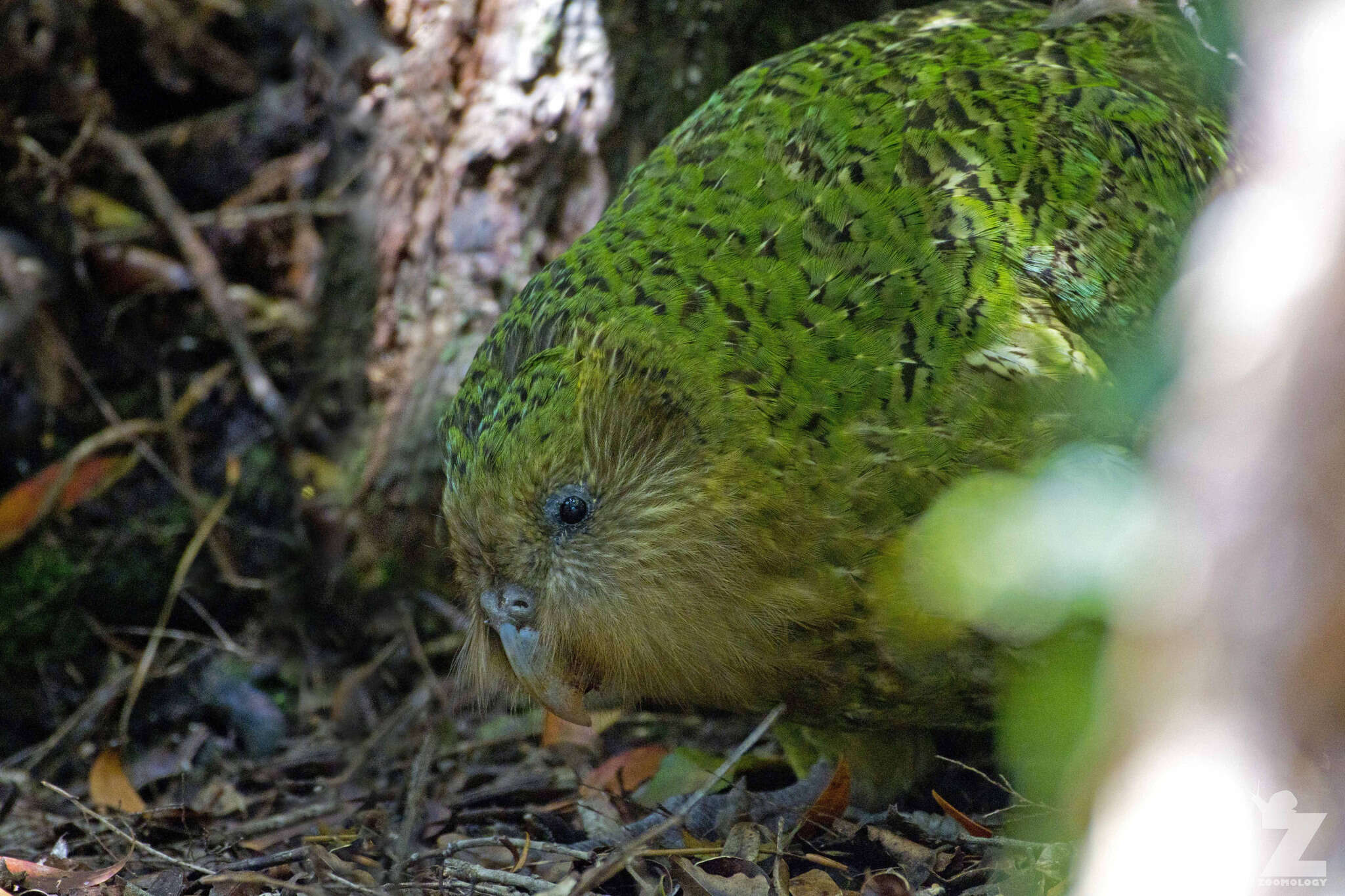
The kākāpō, sometimes known as the owl-parrot, is a species of large, nocturnal, ground-dwelling parrot of the superfamily Strigopoidea. It is endemic to New Zealand.
🛡️ Conservation Status
critically endangered
cr
📌 Taxonomy
by David Mitchell that accompanied Gray's original 1845 description]]
The kākāpō was formally described and illustrated in 1845 by the English ornithologist George Robert Gray. He created a new genus and coined the binomial name . Gray was uncertain about the origin of his specimen and wrote, "This remarkable bird is found in one of the islands of the South Pacific Ocean." The type location has been designated as Dusky Sound on the southwest corner of New Zealand's South Island. The generic name is derived from the Ancient Greek , genitive ("owl"), and ("face"), while its specific epithet comes from ("soft"), and ("feather").
In 1955 the International Commission on Zoological Nomenclature (ICZN) ruled that the genus name was feminine. Based on this ruling many ornithologists used the form Strigops habroptila but in 2023 James L. Savage and Andrew Digby argued that under the current ICZN rules the specific epithet should be habroptilus. This view was accepted by ornithologists and in 2024 the International Ornithological Congress Checklist and the eBird/Clements Checklist changed the spelling of the binomial name back to Strigops habroptilus. The species is monotypic, as no subspecies are recognised. the name is both singular and plural. "Kākāpō" is increasingly written in New Zealand English with the macrons that indicate long vowels. The correct pronunciation in Māori is ; other colloquial pronunciations exist, however. These include the British English (), as defined in the Chambers Dictionary in 2003.
The kākāpō is placed in the family Strigopidae together with the two species in the genus Nestor, the kea () and the kākā (). The birds are endemic to New Zealand.
Earlier ornithologists felt that the kākāpō might be related to the ground parrots and night parrot of Australia due to their similar colouration, but this is contradicted by molecular studies; rather, the cryptic colour seems to be adaptation to terrestrial habits that evolved twice convergently.
📌 Internal anatomy
The skeleton of the kākāpō differs from other parrots in several features associated with flightlessness. Firstly, it has the smallest relative wing size of any parrot. Its wing feathers are shorter, more rounded, less asymmetrical, and have fewer distal barbules to lock the feathers together. The sternum is small and has a low, vestigial keel and a shortened spina externa. As in other flightless birds and some flighted parrots, the furcula is not fused but consists of a pair of clavicles lying in contact with each coracoid. As in other flightless birds, the angle between the coracoid and sternum is enlarged. The kākāpō has a larger pelvis than other parrots. The proximal bones of the leg and wing are disproportionately long and the distal elements are disproportionately short.
The pectoral musculature of the kākāpō is also modified by flightlessness. The pectoralis and supracoracoideus muscles are greatly reduced. The propatagialis tendo longus has no distinct muscle belly. The sternocoracoideus is tendinous. There is an extensive cucularis capitis clavicularis muscle that is associated with the large crop.
📌 Genetics
Because kākāpō passed through a genetic bottleneck, in which their world population was reduced to 49 birds, they are extremely inbred and have low genetic diversity. This manifests in lower disease resistance and infertility problems: 61% of kākāpō eggs fail to hatch. Beginning in 2015, the Kākāpō 125+ project has sequenced the genome of all living kākāpō, as well as some museum specimens. The project is a collaboration led by Genomics Aotearoa and a collaboration with a team of international collaborators.
A DNA sequence analysis was performed on 35 kākāpō genomes of the surviving descendants of an isolated island population, and on 14 genomes, mainly from museum specimens, of the now extinct mainland population. An analysis of the long-term genetic impact of small population size indicated that the small island kākāpō population had a reduced number of harmful mutations compared to the number in mainland individuals. It was hypothesised that the reduced mutational load of the island population was due to a combination of genetic drift and the purging of deleterious mutations through increased inbreeding and purifying selection that occurred since the isolation of this population from the mainland about 10,000 years ago. Purging of deleterious mutations occurs when there is selection against recessive or partially recessive detrimental alleles as they are expressed in the homozygous state.
📌 Ecology and behaviour
The kākāpō is primarily nocturnal; it roosts under cover in trees or on the ground during the day and moves around its territories at night. and the male may walk from its home range to a mating arena up to away during the mating season (October–January).
fruits, Maud Island]]
Young birds indulge in play fighting, and one bird will often lock the neck of another under its chin. The kākāpō is curious by nature and has been known to interact with humans. Conservation staff and volunteers have engaged extensively with some kākāpō, which have distinct personalities. Despite this, kākāpō are solitary birds.
The kākāpō was a very successful species in pre-human New Zealand, and was well adapted to avoid the birds of prey which were their only predators. As well as the New Zealand falcon, there were two other birds of prey in pre-human New Zealand: Haast's eagle and Eyles' harrier.
Kākāpō defensive adaptations were no use, however, against the mammalian predators introduced to New Zealand by humans. Birds hunt very differently from mammals, relying on their powerful vision to find prey, and thus they usually hunt by day.
}}
📌 Breeding
Kākāpō are the only flightless bird that has a lek breeding system. Males loosely gather in an arena and compete with each other to attract females. Females listen to the males as they display, or "lek". They choose a mate based on the quality of his display; they are not pursued by the males in any overt way. No pair bond is formed; males and females meet only to mate.
During the courting season, males leave their home ranges for hilltops and ridges where they establish their own mating courts. These leks can be up to from a kākāpō's usual territory and are an average of apart within the lek arena. Males remain in the region of their court throughout the courting season. At the start of the breeding season, males will fight to try to secure the best courts. They confront each other with raised feathers, spread wings, open beaks, raised claws and loud screeching and growling. Fighting may leave birds with injuries or even kill them. Mating occurs roughly every two to four years in years of heavy rimu fruiting. In mating years, males may make "booming" calls for 6–8 hours every night for more than four months.
Each court consists of one or more saucer-shaped depressions or "bowls" dug in the ground by the male, up to deep and long enough to fit the half-metre length of the bird. The kākāpō is one of only a handful of birds in the world which actually constructs its leks. the bowls themselves function as amplifiers to enhance the projection of the males' booming mating calls. They start with low grunts, which increase in volume as the sac inflates. After a sequence of about 20 loud booms, the male kākāpō emits a high-frequency, metallic "ching" sound. He stands for a short while before again lowering his head, inflating his chest and starting another sequence of booms. The booms can be heard at least away on a still night; wind can carry the sound at least . Once the birds have mated, the female returns to her home territory to lay eggs and raise the chicks. The male continues booming in the hope of attracting another female.
The female kākāpō lays 1–4 eggs per breeding cycle, with several days between eggs. bearing fluffy grey chicks that are quite helpless. The female feeds the chicks for three months, and the chicks remain with the female for some months after fledging.
Another aspect of the kākāpō's breeding system is that a female can alter the sex ratio of her offspring depending on her condition. A female in good condition produces more male offspring (males have 30%–40% more body weight than females). This supports the Trivers–Willard hypothesis. The relationship between clutch sex ratio and maternal diet has conservation implications, because a captive population maintained on a high quality diet will produce fewer females and therefore fewer individuals valuable to the recovery of the species.
📌 Feeding
The beak of the kākāpō is adapted for grinding food finely. For this reason, the kākāpō has a very small gizzard compared to other birds of their size. It is entirely herbivorous, eating green shoots, leaf buds, roots, rhizomes and tubers of native plants, as well as seeds, nuts, berries, other fruits, pollen, moss, fungi and even the bark and sapwood of trees. A study in 1984 identified 25 plant species as kākāpō food. The kākāpō is believed to employ bacteria in the fore-gut to ferment and help digest plant matter.
Kākāpō diet changes according to the season. The plants eaten most frequently during the year include some species of Lycopodium ramulosum, Lycopodium fastigium, Schizaea fistulosa, Blechnum minus, Blechnum procerum, Cyathodes juniperina, Dracophyllum longifolium, Olearia colensoi and Thelymitra venosa. Individual plants of the same species are often treated differently. Kākāpō may forage heavily in certain areas, leaving, on occasion, more than 30 droppings and conspicuous evidence of herbivory.
📌 Conservation
Fossil records indicate that in pre-Polynesian times, the kākāpō was New Zealand's third most common bird and it was widespread on all three main islands. However, the kākāpō population in New Zealand has declined massively since human settlement of the country, and its conservation status as ranked by the Department of Conservation continues to be "Nationally Critical". Since the 1890s, conservation efforts have been made to prevent extinction. The most successful scheme has been the Kākāpō Recovery Programme; this was implemented in 1995 and continues to this day.
Kākāpō are absolutely protected under New Zealand's Wildlife Act 1953. The species is also listed under Appendix I of the Convention on International Trade in Endangered Species of Wild Fauna and Flora (CITES) meaning international export/import (including parts and derivatives) is regulated.
📌 Human impact
at the Vienna Museum of Natural History: thousands of kākāpō were collected for museums across the world.]]
The first factor in the decline of the kākāpō was the arrival of humans. Māori folklore suggests that the kākāpō was found throughout the country when the Polynesians first arrived in New Zealand 700 years ago. Māori hunted the kākāpō for food and for their skins and feathers, which were made into cloaks. including the Tararua and Aorangi Ranges, it was still in the central North Island and forested parts of the South Island. Beginning in the 1840s, Pākehā settlers cleared vast tracts of land for farming and grazing, further reducing kākāpō habitat. They brought more dogs and other mammalian predators, including domestic cats, black rats and stoats.
In the 1880s, large numbers of mustelids (stoats, ferrets and weasels) were released in New Zealand to reduce rabbit numbers, but they also preyed heavily on many native species including the kākāpō. Other browsing animals, such as introduced deer, competed with the kākāpō for food, and caused the extinction of some of its preferred plant species. The kākāpō was reportedly still present near the head of the Whanganui River as late as 1894, with one of the last records of a kākāpō in the North Island being a single bird caught in the Kaimanawa Ranges by Te Kepa Puawheawhe in 1895.
📌 Early protection efforts
In 1891, the New Zealand government set aside Resolution Island in Fiordland as a nature reserve. In 1894, the government appointed Richard Henry as caretaker. A keen naturalist, Henry was aware that native birds were declining, and began catching and moving kākāpō and kiwi from the mainland to the predator-free Resolution Island. In six years, he moved more than 200 kākāpō to Resolution Island. By 1900, however, stoats had swum to Resolution Island and colonised it; they wiped out the nascent kākāpō population within 6 years.
In 1903, three kākāpō were moved from Resolution Island to the nature reserve of Little Barrier Island (Hauturu-o-Toi) north-east of Auckland, but feral cats were present and the kākāpō were never seen again. In 1912, three kākāpō were moved to another reserve, Kapiti Island, north-west of Wellington. One of them survived until at least 1936, despite the presence of feral cats for part of the intervening period.
By the 1920s, the kākāpō was extinct in the North Island and its range and numbers in the South Island were declining.
📌 1950–1989 conservation efforts
, was one of the last strongholds of the kākāpō on mainland New Zealand.]]
In the 1950s, the New Zealand Wildlife Service was established and began making regular expeditions to search for the kākāpō, mostly in Fiordland and what is now the Kahurangi National Park in the northwest of the South Island. Seven Fiordland expeditions between 1951 and 1956 found only a few recent signs. Finally, in 1958 a kākāpō was caught and released in the Milford Sound / Piopiotahi catchment area in Fiordland. Six more kākāpō were captured in 1961; one was released and the other five were transferred to the aviaries of the Mount Bruce Bird Reserve near Masterton in the North Island. Within months, four of the birds had died and the fifth died after about four years. In the next 12 years, regular expeditions found few signs of the kākāpō, indicating that numbers were continuing to decline. Only one bird was captured in 1967; it died the following year.
By the early 1970s, it was uncertain whether the kākāpō was still an extant species. At the end of 1974, scientists located several more male kākāpō and made the first scientific observations of kākāpō booming. These observations led Don Merton to speculate for the first time that the kākāpō had a lek breeding system.
Mustelids have never colonised Stewart Island, but feral cats were present. During a survey, it was apparent that cats killed kākāpō at a rate of 56% per year. At this rate, the birds could not survive on the island and therefore an intensive cat control was introduced in 1982, after which no cat-killed kākāpō were found.
📌 Kākāpō Recovery programme
{| class="wikitable"
|+ Kākāpō translocations 1974–1992 The New Zealand Department of Conservation replaced the Wildlife Service for this task.
The first action of the plan was to relocate all the remaining kākāpō to suitable islands for them to breed. None of the New Zealand islands were ideal to establish kākāpō without rehabilitation by extensive re-vegetation and the eradication of introduced mammalian predators and competitors. Four islands were finally chosen: Maud, Little Barrier, Codfish and Mana. Along with Mana Island, it was replaced with two new kākāpō sanctuaries: Chalky Island (Te Kākahu-o-Tamatea) and Anchor Island. All kākāpō on Pearl and Chalky Islands were moved to Anchor Island in 2005.
📌 Supplementary feeding
A key part of the Recovery Programme is the supplementary feeding of females. Kākāpō breed only once every two to five years, when certain plant species, primarily Dacrydium cupressinum (rimu), produce protein-rich fruit and seeds. During breeding years when rimu masts supplementary food is provided to kākāpō to increase the likelihood of individuals successfully breeding. In 1989, six preferred foods (apples, sweet potatoes, almonds, Brazil nuts, sunflower seeds and walnuts) were supplied ad libitum each night to 12 feeding stations. Males and females ate the supplied foods, and females nested on Little Barrier Island in the summers of 1989–1991 for the first time since 1982, although nesting success was low.
Supplementary feeding affects the sex ratio of kākāpō offspring, and can be used to increase the number of female chicks by deliberately manipulating maternal condition. were given supplementary feeding to avoid raising their body condition, and the sex ratio results in 1982 were close to parity, eliminating the male-biased sex ratios in the unrestricted feeding.|date=December 2022}}
Today commercial parrot food is supplied to all individuals of breeding age on Whenua Hou and Anchor. The amount eaten and individual weights are carefully monitored to ensure that optimum body condition is maintained.
📌 Nest management
Kākāpō nests are intensively managed by wildlife conservation staff. Before Polynesian rats were removed from Whenua Hou, the rats were a threat to the survival of young kākāpō. Of 21 chicks that hatched between 1981 and 1994, nine were either killed by rats or died and were subsequently eaten by rats. By the end of February 2020, the bird's summer breeding season, these efforts led to the production of 80 chicks, "a record number."
📌 Monitoring
To monitor the kākāpō population continuously, each bird is equipped with a radio transmitter.
📌 Reintroduction
The Kākāpō Recovery programme has been successful, with the numbers of kākāpō increasing steadily. Adult survival rate and productivity have both improved significantly since the programme's inception. However, the main goal is to establish at least one viable, self-sustaining, unmanaged population of kākāpō as a functional component of the ecosystem in a protected habitat. To help meet this conservation challenge, Resolution Island () in Fiordland has been prepared for kākāpō re-introduction with ecological restoration including the eradication of stoats.
Four males were re-introduced to Sanctuary Mountain Maungatautari in the North Island on 21 July 2023, becoming the first kākāpō living in mainland New Zealand in almost 40 years. A second group of six birds was introduced to the sanctuary in September. However, two further kākāpō found a way over the fence, and in November the Department of Conservation temporarily removed three birds from the sanctuary to a southern predator-free island, leaving the kākāpō population in the sanctuary at seven. The Department commented that "Kākāpō are flightless but are excellent climbers who can use their wings to parachute from treetops".
📌 Fatal fungal infection
In 2019 an outbreak of the fungal disease aspergillosis among kākāpō on the island of Whenua Hou infected 21 individuals and led to 9 deaths: two adults, five chicks and two juveniles. Over 50 birds were transported to veterinary centres for diagnostics and treatment.
📌 Population timeline
* 1977: Kākāpō rediscovered on Stewart Island
* 1989: Most kākāpō are removed from Rakiura to Whenua Hou and Hauturu-O-Toi
* 1995: Kākāpō population consists of 51 individuals; beginning of the Kakapo Recovery Programme
* 1999: Kākāpō removed from Hauturu
* 2002: A significant breeding season led to 24 chicks being hatched
* 2005: 41 females and 45 males, including four fledglings (3 females and 1 male); kākāpō established on Anchor Island Twenty-two of the 34 chicks had to be hand-reared because of a shortage of food on Codfish Island.
* December 2010: Death of the oldest known kākāpō, "Richard Henry", possibly 80 years old.
* 2012: Seven kākāpō transferred to Hauturu, in an attempt to establish a successful breeding programme. Kākāpō were last on the island in 1999.
* March 2014: With the kākāpō population having increased to 126, the bird's recovery was used by Melbourne artist Sayraphim Lothian as a metaphor for the recovery of Christchurch, paralleling the "indomitable spirit of these two communities and their determination to rebuild".
* 2016: First breeding on Anchor; a significant breeding season, with 32 chicks; kākāpō population grows to over 150
* 2018: After the death of 3 birds, the population reduced to 149 birds.
* 2019: An abundance of rimu fruit and the introduction of several new technologies (including artificial insemination and 'smart eggs') helped make 2019 the best breeding season on record, with over 200 eggs laid and 72 chicks fledged. According to the Kākāpō Recovery Team at the New Zealand Department of Conservation, this was the earliest and longest breeding season yet. Population reached 200 juvenile or older birds on 17 August 2019.
* 2022: The population increased to 252 birds after a productive breeding season and successful artificial insemination.
* 2023: Birds are reintroduced to the mainland for the first time.
* 2024: As of September 2024, the population had declined slightly to 243 individuals.
* 2026: The DOC Kākāpō Recovery Programme announced that ninety chicks from the 2026 breeding season had fledged, raising the official population to 325 birds.
📌 In Māori culture
The kākāpō is associated with a rich tradition of Māori folklore and beliefs. The bird's irregular breeding cycle was understood to be associated with heavy fruiting or "masting" events of particular plant species such as the rimu, which led Māori to credit the bird with the ability to tell the future. Used to substantiate this claim were reported observations of these birds dropping the berries of the hinau and tawa trees (when they were in season) into secluded pools of water to preserve them as a food supply for the summer ahead; in legend this became the origin of the Māori practice of immersing food in water for the same purpose.
📌 Use for food and clothing
The Māori considered the meat of the kākāpō a delicacy and, when the bird was widespread, hunted it for food. The flesh of the bird could be preserved in its own fat and stored in containers for later consumption – hunters of the Ngāi Tahu would pack the flesh in baskets made from the inner bark of tōtara tree or in containers constructed from kelp. Bundles of kākāpō tail feathers were attached to the sides of these containers to provide decoration and a way to identify their contents. Each one required up to 11,000 feathers to make. They were highly valued and considered as (treasures), so much so that the old Māori adage "You have a kākāpō cape and you still complain of the cold" was used to describe someone who is never satisfied. It dates from the 1810s–1820s and is held in the Perth Museum in Scotland; the museum in collaboration with the British Museum and Māori advisers have restored the cloak. Kākāpō feathers were also used to decorate the heads of , but were removed before use in combat.
Despite this, the kākāpō was also regarded as an affectionate pet by the Māori. This was corroborated by European settlers in New Zealand in the 19th century, among them George Edward Grey, who once wrote in a letter to an associate that his pet kākāpō's behaviour towards him and his friends was "more like that of a dog than a bird".
📌 In the media
The conservation of the kākāpō has made the species well known. Many books and documentaries detailing the plight of the kākāpō have been produced in recent years, one of the earliest being Two in the Bush, made by Gerald Durrell for the BBC in 1962.
A feature-length documentary, The Unnatural History of the Kakapo won two major awards at the Reel Earth Environmental Film Festival. Two of the most significant documentaries, both made by NHNZ, are Kakapo – Night Parrot (1982) and To Save the Kakapo (1997).
on Maud Island]]
The BBC's Natural History Unit featured the kākāpō, including a sequence with Sir David Attenborough in The Life of Birds. It was one of the endangered animals Douglas Adams and Mark Carwardine set out to find for the radio series and book Last Chance to See. An updated version of the series has been produced for BBC TV, in which Stephen Fry and Carwardine revisit the animals to see how they are getting on almost 20 years later, and in January 2009, they spent time filming the kākāpō on Codfish Island / Whenua Hou. Footage of a kākāpō named Sirocco attempting to mate with Carwardine's head was viewed by millions worldwide, leading to Sirocco becoming "spokes-bird" for New Zealand wildlife conservation in 2010. Sirocco became the inspiration for the party parrot, a popular animated emoji frequently associated with the workflow application Slack.
The kākāpō was featured in the episode "Strange Islands" of the documentary series South Pacific, originally aired on 13 June 2009, in the episode "Worlds Apart" of the series The Living Planet, and in episode 3 of the BBC's New Zealand Earth's Mythical Islands.
In a 2019 kākāpō awareness campaign, the Kākāpō Recovery Programme New Zealand National Partner, Meridian Energy, ran a Search for a Saxophonist to provide suitable mood music for encouraging mating to coincide with the 2019 kākāpō breeding season. The search and footage from the islands where breeding was taking place were featured on the Breakfast programme. The kākāpō was featured in the mobile game "Kākāpō Run" developed by a UK conservation charity. This game aimed to raise support for kākāpō conservation by engaging players in fun, educational gameplay. A study found that playing the game helped increase positive attitudes and actions related to kākāpō protection, such as support for managing invasive predators and responsible pet care, though it did not lead to more donations.