📌 Vision
located near the front]]
]]
Jumping spiders have four pairs of eyes; three secondary pairs that are fixed and a principal pair that is movable.
The posterior median eyes are vestigial in many species, but in some primitive subfamilies, they are comparable in size with the other secondary eyes and help to detect motion. While unable to form images, the reduced pair of eyes is thought to have a role similar to that of insect ocelli by receiving light from the sky. The photoreceptors in the other secondary pairs are almost exclusively green-sensitive, but the posterior median eyes have two visual opsins different from those in all the other eyes, sensitive to blue and UV light.
The posterior lateral eyes (PLEs) are wide-angle motion detectors that sense motions from the side and behind. Combined with the other eyes, PLEs give the spider a near 360° view of the world.
The anterior lateral eyes (ALEs) have the best visual acuity of the secondary eyes. They are able to distinguish some details, as well, and without them, no "looming response" (instinctive rapid defensive action) can be triggered by motion. Even with all the other pairs covered, jumping spiders in a study could still detect, stalk, and attack flies, using their ALEs only, which are also sufficiently widely spaced to provide stereoscopic vision.
The anterior median eyes have very good vision. This pair of eyes is built like a telescopic tube with a corneal lens in the front and a second lens in the back that focus images onto a four-layered retina, a narrow, boomerang-shaped strip oriented vertically. In addition to receptor cells, red filters also have been detected, located in front of the cells that normally register green light. All salticids, regardless of whether they have two, three, or four kinds of color receptors, seemingly are highly sensitive to UV light. Color discrimination has been demonstrated in behavioral experiments.
The anterior median eyes have high resolution (11 min visual angle), but the field of vision is narrow, from 2 to 5°. The central region of the retina, where acuity is highest, is no more than six or seven receptor rows wide. However, the eye can scan objects off the direct axis of vision. As the lens is attached to the carapace, the eye's scanning movements are restricted to its retina through a complicated pattern of translations and rotations. This dynamic adjustment is a means of compensation for the narrowness of the static field of vision. Movement of the retina in jumping spiders is analogous to the way many vertebrates, such as primates, move their entire eyes to focus images of interest onto their fovea centralis. In jumping spiders with a translucent carapace, such movements within the jumping spider's eyes are visible from outside when the attention of the spider is directed to various targets.
📌 Behavior
===Jumping===
Many other arthropods are known to jump, including grasshoppers, fleas, leafhoppers, and sand fleas. Jumping spiders are different from these animals because they are able to make accurate, targeted jumps. Jumps are used for navigation, to escape danger, and to catch prey. When jumping, they use mainly their third or fourth pair of legs, or both pairs, depending on species. Jumping spiders' well-developed internal hydraulic system extends their limbs by altering the pressure of their body fluid (hemolymph) within them. This enables the spiders to jump without having large muscular legs like a grasshopper. The maximum horizontal jump distance varies greatly between species, with some capable of jumping two or three body lengths, while the jump of an individual Colonus puerperus was measured at 38 times the body length. The accuracy of their jumps is mediated by their well-developed visual system and the ability to quickly process visual information to tailor each jump. When a jumping spider moves from place to place, and especially just before it jumps, it tethers a filament of silk (or 'dragline') to whatever it is standing on. and if the jump should fail, the spider climbs back up the dragline.
📌 Hunting
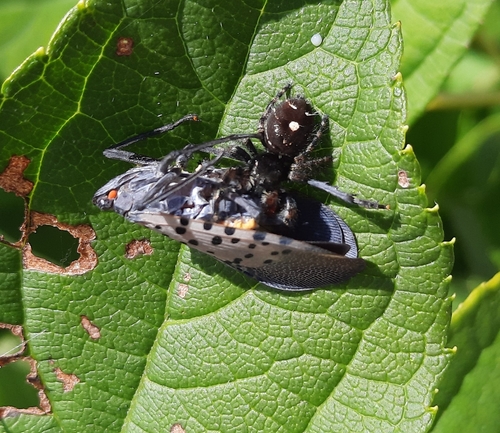
eating a Pantropical jumper]]
The hunting behaviour of the Salticidae is confusingly varied compared to that of most spiders in other families. Salticids hunt diurnally as a rule, which is consistent with their highly developed visual system. When it detects potential prey, a jumping spider typically begins orienting itself by swiveling its cephalothorax to bring the anterior median eyes to bear. It then moves its abdomen into line with its cephalothorax. After that, it might spend some time inspecting the object of its attention and determining whether a camouflaged or doubtful item of prey is promising, before it starts to stalk slowly forward. When close enough, the spider pauses to attach a dragline, then springs onto the prey.
Many variations on the theme and many surprising aspects exist. For one, salticids do not necessarily follow a straight path in approaching prey. They may follow a circuitous course, sometimes even a course that takes the hunter through regions from which the prey is not visible. Such complex adaptive behaviour is hard to reconcile with an organism that has such a tiny brain. Some jumping spiders, in particular some species of Portia, can negotiate long detours from one bush down to the ground, then up the stem of another bush to capture a prey item on a particular leaf. Such behaviour is the subject of research.
In hunting, the Salticidae also use their silk as a tether to enable them to reach prey that otherwise would be inaccessible. For example, by advancing towards the prey to less than the jumping distance, then retreating and leaping in an arc at the end of the tether line, many species can leap onto prey on vertical or even inverted surfaces, which of course would not be possible without such a tether.
Having made contact with the prey, hunting Salticidae administer a bite to inject rapid-acting venom that gives the victim little time to react. In this respect, they resemble the Mimetidae and Thomisidae, families that ambush prey that often are larger than the predator, and they do so without securing the victim with silk. Consequently they must immobilise it immediately and their venom is adapted accordingly.
📌 Reproduction
jumping spider]]
📌 Courtship and mating behavior
Jumping spiders conduct complex, visual courtship displays using movements and physical bodily attributes. A form of sexual dimorphism, the males possess plumose hairs, colored or iridescent hairs (particularly pronounced in the peacock spiders), front leg fringes, structures on other legs, and other, often bizarre, modifications. These characteristics are used in a courtship "dance" in which the colored or iridescent parts of the body are displayed. In addition to displaying colors, jumping spiders perform complex sliding, vibrational, or zigzag movements to attract females. Many males have auditory signals, as well. These amplified sounds presented to the females resemble buzzes or drum rolls. Species vary significantly in visual and vibratory components of courtship. The ability to sense UV light (see Vision section) is used by at least one species, Cosmophasis umbratica, in courtship behavior. Cosmophasis umbratica males have markings that are only visible in UV and the females use the markings for mate choice.
If receptive to the male, the female assumes a passive, crouching position. In some species, the female may vibrate her palps or abdomen. The male then extends his front legs towards the female to touch her. If the female remains receptive, the male climbs on her back and inseminates her with his palps.
📌 Consequences of sexual dimorphism
Maintaining colorful ornamentation may seem strictly beneficial to sexual selection, yet costs to maintain such distinguishing characteristics occur. While colorful or UV-reflecting individuals may attract more female spiders, it can also increase the risk of predation.
📌 Taxonomy
}}
}}
}}
}}
}}
}}
The monophyly of the family Salticidae is well established through both phylogenetic and morphological analyses. The sister group to Salticidae is the family Philodromidae. Synapomorphies of the two families include loss of cylindrical gland spigots and loss of tapeta in the indirect eyes.)
* Lyssomaninae Blackwall, 1877 – 4 extant genera (including Hindumanes)
* Spartaeinae Wanless, 1984 – 29 extant genera in 3 tribes
* Eupoinae Maddison, 2015 – 3 extant genera
* Hisponinae Simon, 1901 – 6 extant genera
* Salticinae Blackwall, 1841 – about 540 extant genera in 27 tribes
The relationships between these subfamilies is still up for debate. Below are the results of a 2017 phylogenomic study that attempted to resolve this question. The subfamily Eupoinae was unevaluated and its exact position is unclear.
}}
|3=
}}
}}
}}
📌 Models for mimicry
Some small insects are thought to have evolved an appearance or behavioural traits that resemble those of jumping spiders and this is suspected to prevent their predation, specifically from jumping spiders. Some examples appear to be provided by patterns on the wings of some tephritid flies, the nymph of a fulgorid and possibly some moths.
📌 Fossils
Very few jumping spider fossils have been found. Of those known, all are from Cenozoic era amber. The oldest fossils are from Baltic amber dating to the Eocene epoch, specifically, 54 to 42 million years ago. Other fossil jumping spiders have been preserved within Chiapas amber and Dominican amber.