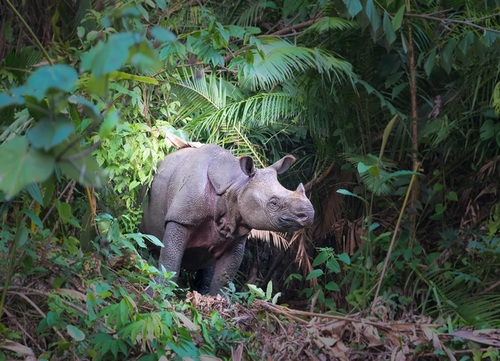
The Javan rhinoceros, also called Javan rhino, Sunda rhinoceros and lesser one-horned rhinoceros is a critically endangered member of the genus Rhinoceros of the family Rhinocerotidae, and one of the five remaining extant rhinoceros species. It has a plate-like skin with protective folds and is one of the smallest rhinoceros species with a body length of 3.1–3.2 m (10.2–10.5 ft) and a 1.4–1.7 m (4.6–5.6 ft) long tail. The heaviest specimens weigh around 2,300 kg (5,100 lb). Its horn is usually shorter than 25 cm (9.8 in).
🛡️ Conservation Status
critically endangered
cr
📌 Etymology
The generic name Rhinoceros is a combination of the ancient Greek words ῥίς (ris) meaning nose and κέρας (keras) meaning horn of an animal. The specific name sondaicus is derived from sunda, the biogeographical region that comprises the islands of Sumatra, Java, Borneo, and surrounding smaller islands. The Javan rhino is also known as the lesser one-horned rhinoceros (in contrast with the greater one-horned rhinoceros, another name for the Indian rhino).
📌 Taxonomy
Rhinoceros sondaicus was the scientific name used by Anselme Gaëtan Desmarest in 1822 for a rhinoceros from Java sent by Pierre-Médard Diard and Alfred Duvaucel to the National Museum of Natural History, France. In the 19th century, several zoological specimens of hornless rhinoceroses were described:
*Rhinoceros inermis proposed by René Lesson in 1838 was a female rhinoceros without horns shot in the Sundarbans.
*Rhinoceros nasalis and Rhinoceros floweri proposed by John Edward Gray in 1867 were two rhinoceros skulls from Borneo and one from Sumatra, respectively.
*Rhinoceros annamiticus proposed by Pierre Marie Heude in 1892 was a specimen from Vietnam.
As of 2005, three Javan rhinoceros subspecies are considered valid taxa:
* R. s. sondaicus, the nominate subspecies, known as the Indonesian Javan rhinoceros
* R. s. inermis, known as the Indian Javan rhinoceros or lesser Indian rhinoceros
* R. s. annamiticus, known as the Vietnamese Javan rhinoceros or Vietnamese rhinoceros
📌 Evolution
pictured here is the species most closely related to the Javan rhinoceros; they are the two members of the type genus Rhinoceros.]]
Ancestral rhinoceroses are held to have first diverged from other perissodactyls in the Early Eocene. Mitochondrial DNA comparison suggests the ancestors of modern rhinos split from the ancestors of the Equidae around 50 million years ago (Mya). The extant family, the Rhinocerotidae, first appeared in the Late Eocene in Eurasia, and the ancestors of the extant rhino species dispersed from Asia beginning in the Miocene.
The last common ancestor of living rhinoceroses belonging to the subfamily Rhinocerotinae is suggested to have lived around 16 Mya, with the ancestors of the genus Rhinoceros diverging from the ancestors of other living rhinoceroses around 15 Mya. The genus Rhinoceros has been found to be overall slightly more closely related to the Sumatran rhinoceros (as well as to the extinct woolly rhinoceros and the extinct Eurasian genus Stephanorhinus) than to living African rhinoceroses, though gene flow appears to have occurred between the ancestors of living African rhinoceroses and the genus Rhinoceros, as well as between the ancestors of the genus Rhinoceros and the ancestors of the woolly rhinoceros and Stephanorhinus.
A cladogram showing the relationships of recent and Late Pleistocene rhinoceros species (minus Stephanorhinus hemitoechus) based on whole nuclear genomes Molecular estimates suggest the Indian and Javan rhinoceros diverged from each other earlier, around 4.3 million years ago.
📌 Distribution and habitat
is the home of all remaining Javan rhinos.]]
Fossil remains of Javan rhinoceros have been found at the Neolithic site of Hemudu in Zhejiang, China, and the 4th century BCE Classic of Mountains and Seas appears to describe one living in the Yangtze River basin. Remains were also found in the Tam Hay Marklot cave site in northeastern Laos that date to the Pleistocene.
Historically, Javan rhinoceroses were widespread from Assam and Bengal, Today, the species only occurs in Ujung Kulon National Park in southwestern Java, where fewer than 100 individuals are estimated to survive.
By the end of the Vietnam War, the Vietnamese rhinoceros was thought extinct across all of mainland Asia. Local hunters and woodcutters in Cambodia claim to have seen Javan rhinos in the Cardamom Mountains, but surveys of the area have failed to find any evidence. The population in Vietnam's Cat Tien National Park was declared locally extinct in 2011.
The Javan rhinoceros primarily inhabits dense, lowland rain forests, grasslands, and reed beds with abundant rivers, large floodplains, or wet areas with many mud wallows. Although it historically preferred low-lying areas, the subspecies in Vietnam was pushed onto much higher ground (up to 2,000 m or 6,561 ft), probably because of human encroachment and poaching.
📌 Behavior and ecology
The Javan rhinoceros is a solitary animal with the exception of breeding pairs and mothers with calves. They sometimes congregate in small groups at salt licks and mud wallows. Wallowing in mud is a common behavior for all rhinos; the activity allows them to maintain cool body temperatures and helps prevent disease and parasite infestation. The Javan rhinoceros does not generally dig its own mud wallows, preferring to use other animals' wallows or naturally occurring pits, which it uses its horn to enlarge. Salt licks are also very important because of the essential nutrients the rhino receives from the salt. Bull home ranges are larger at compared to the cow, which are around . Bull territories overlap each other less than those of the cow. Whether territorial fights occur is unknown.
The Javan rhino is much less vocal than the Sumatran; very few Javan rhino vocalizations have ever been recorded. Adults have no known predators other than humans. The species, particularly in Vietnam, is skittish and retreats into dense forests whenever humans are near. Though a valuable trait from a survival standpoint, it has made the rhinos difficult to study. Nevertheless, when humans approach too closely, the Javan rhino becomes aggressive and will attack, stabbing with the incisors of its lower jaw while thrusting upward with its head. Its comparatively antisocial behavior may be a recent adaptation to population stresses; historical evidence suggests they, like other rhinos, were once more gregarious.
📌 Conservation
The main factor in the continued decline of the Javan rhinoceros population has been poaching for horns, a problem that affects all rhino species. The horns have been a traded commodity for more than 2,000 years in China, where they are believed to have healing properties. Historically, the rhinoceros' hide was used to make armor for Chinese soldiers, and some local tribes in Vietnam believed the hide could be used to make an antidote for snake venom. Because the rhinoceros' range encompasses many areas of poverty, convincing local people not to kill a seemingly (otherwise) useless animal which could be sold for a large sum of money has been difficult. When the Convention on International Trade in Endangered Species of Wild Fauna and Flora first went into effect in 1975, the Javan rhinoceros was listed under Appendix I, meaning commercial international trade in the Javan rhinoceros and products derived from it is prohibited. Surveys of the rhinoceros horn black market have determined that Asian rhinoceros horn fetches a price as high as $30,000 per kg, three times the value of African rhinoceros horn.
Loss of habitat because of agriculture has also contributed to its decline, though this is no longer as significant a factor because the rhinoceros only lives in one nationally protected park. Deteriorating habitats have hindered the recovery of rhino populations that fell victim to poaching. Even with all the conservation efforts, the prospects for their survival are grim. Because the population is restricted to one small area, they are very susceptible to disease and inbreeding depression. Conservation geneticists estimate a population of 100 rhinos would be needed to preserve the genetic diversity of this conservation-reliant species.
📌 Ujung Kulon
The Ujung Kulon peninsula of Java was devastated by the eruption of Krakatoa in 1883. The Javan rhinoceros recolonized the peninsula after the event, but humans never returned in large numbers, thus creating a haven for wildlife.
In May 2017, Director of the Biodiversity Conservation at the Ministry of Environment and Forestry, Bambang Dahono Adji announced plans to transfer the rhinos to the Cikepuh Wildlife Sanctuary located in West Java. The animals will first undergo DNA tests to determine lineage and risk to disease so as to avoid issues such as inbreeding or marriage kinship. As of December 2018, these plans had yet to happen.
In December 2018, the remaining Javan rhino population was severely endangered by the tsunami triggered by nearby volcano Anak Krakatau. At least four Javan rhinoceros calves have been recorded between August 2023 and 2024; one seen in May 2024 was estimated to have been three to five months old.
📌 Cat Tien
Once widespread in Southeast Asia, the Javan rhinoceros was presumed extinct in Vietnam in the mid-1970s, at the end of the Vietnam War. The combat wrought havoc on the ecosystems of the region through the use of napalm, extensive defoliation from Agent Orange, aerial bombing, use of landmines, and overhunting by local poachers.
In 1988, the assumption of the subspecies' extinction was challenged when a hunter shot an adult cow, proving the species had somehow survived the war. In 1989, scientists surveyed Vietnam's southern forests to search for evidence of other survivors. Fresh tracks belonging to up to 15 rhinos were found along the Dong Nai River. Largely because of the rhinoceros, the region they inhabited became part of the Cat Tien National Park in 1992.
By the early 2000s, their population was feared to have declined past the point of recovery in Vietnam, with some conservationists estimating as few as three to eight rhinos, and possibly no bulls, survived. Conservationists debated whether or not the Vietnamese rhinoceros had any chance of survival, with some arguing that rhinos from Indonesia should be introduced in an attempt to save the population, with others arguing that the population could recover.
Genetic analysis of dung samples collected in Cat Tien National Park in a survey from October 2009 to March 2010 showed only a single individual Javan rhinoceros remained in the park. In early May 2010, the body of a Javan rhino was found in the park. The animal had been shot and its horn removed by poachers. In October 2011, the International Rhino Foundation confirmed the Javan rhinoceros was extinct in Vietnam, leaving only the rhinos in Ujung Kulon.
📌 In captivity
A Javan rhinoceros has not been exhibited in a zoo for over a century. In the 19th century, at least four rhinos were exhibited in Adelaide, Calcutta, and London. At least 22 Javan rhinos have been documented as having been kept in captivity; the true number is possibly greater, as the species was sometimes confused with the Indian rhinoceros.
📌 In culture
The Javan rhinoceros occurred in Cambodia in the past and at least three depictions of rhinos are in the bas reliefs of the temple at Angkor Wat. The west wing of the North Gallery has a relief that shows a rhino mounted by a god thought to be the fire god Agni. The rhinos are thought to be Javan rhinoceros rather than the somewhat similar-looking one-horned Indian rhino on the basis of the skinfold on the shoulder that continues along the back in the Javan to give a saddle-like appearance. A depiction of the rhino in the east wing of the South Gallery shows a rhino attacking the damned in the panel depicting heaven and hell. An architect of the temple is thought to have been an Indian Brahmin priest named Divakarapandita (1040–1120 AD) who served king Jayavarman VI, Dharanindravarman I, as well as Suryavarman II, who constructed the temple. The Indian priest who died before the construction of the temple is thought to have influenced the use of tubercles on the skin, which are based on the Indian rhino, while the local Khmer artisans carved the other details of the rhinos based on the more familiar local Javan rhino. The association of the rhinoceros as the vahana of the god Agni is unique to Khmer culture. Another rhinoceros carving in the middle of a circular arrangement in a column with other circles containing elephants and water buffalo is known from the temple of Ta Prohm. Based on anachronistic speculation, it might represent a stegosaur due to the leaves behind it that give the impression of plates.
The mascot of the 2023 FIFA U-20 World Cup is a Javan rhinoceros named Bacuya.