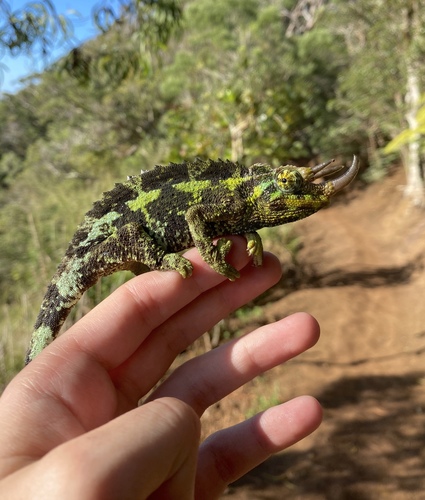
Jackson's chameleon, also known commonly as Jackson's horned chameleon, the three-horned chameleon, and the Kikuyu three-horned chameleon, is a species of chameleon, a lizard in the family Chamaeleonidae. The species is native to East Africa, and introduced to Hawaii, Florida, and California. There are three recognized subspecies.
📌 Taxonomy
Jackson's chameleon was described by Belgian-British zoologist George Albert Boulenger in 1896.
📌 Etymology
The generic name, Trioceros, is derived from the Greek τρί- (tri-) meaning "three" and κέρας (kéras) meaning "horns". This is in reference to the three horns found on the heads of males.
The specific name, jacksonii, is a Latinized form of the last name of English explorer and ornithologist Frederick John Jackson, who was serving as the first Governor of Kenya at the time of Boulenger's description.
📌 Subspecies
The following three subspecies are recognized as being valid, including the nominate subspecies.
* T. j. jacksonii – Jackson's chameleon
* T. j. merumontanus – dwarf Jackson's chameleon
* T. j. xantholophus – yellow-crested Jackson's chameleon
Nota bene: A trinomial authority in parentheses indicates that the subspecies was originally described in a genus other thanTrioceros.
📌 Habitat and geographic range
]]
Jackson's chameleon is an arboreal lizard. In these areas, the rainfall is seasonal but exceeds per year. Day temperatures are typically , and night temperatures are typically . This subspecies has also been introduced to Florida. In Hawaii, it is found mainly at altitudes of in wet, shady places. Historically this population was the primary source of Jackson's chameleons for the exotic pet trade in the United States, but exports from Hawaii are now illegal. This has been done to prevent opportunists from willfully establishing further feral animal populations to capture and sell them.
📌 Ecology
===Feeding habits===
Jackson's chameleon lives primarily on a diet of small insects. It also preys on centipedes, isopods, millipedes, spiders, lizards, small birds, and snails (Achatinella mustelina) in their native habitat.
There is a threat of devastating impact by introduced invasive Jackson's chameleons to native ecosystems in Hawaii, South Africa, the Marshal Islands, Morro Bay, California, Texas, and the Florida Keys. It was found with mainly insects in its stomachs: planthoppers (genus Oliarus), grasshoppers (genus Banza), casebearing caterpillars (genus Hyposmocoma), beetles (genus Oodemas), dragonflies (genus Pantala) and others. It also preys on land snails in Hawaii, including species from genera Achatinella, Auriculella, Lamellidea, and Philonesia, as well as Oxychilus alliarius. It swallows whole snails, including the shells. Jackson's chameleons introduced to Hawaii are a substantial threat to native biodiversity of invertebrates and a serious threat especially to endemic species, such as critically endangered O'ahu tree snails (genus Achatinella).
📌 Territoriality
T. jacksonii is less territorial than most species of chameleons. Males will generally assert dominance over each other through color displays and posturing in an attempt to secure mating rights, but usually not to the point of physical fights.
📌 Reproduction
]]
Most chameleons are oviparous, but Jackson's chameleon and several other highland species in the genus Trioceros are ovoviviparous, giving birth to offspring soon after they are ready to hatch from their egg sac; eight to thirty live young are born after a five- to six-month gestation. The subspecies T. j. merumontanus gives birth to five to ten live young.
📌 In captivity
In captivity, Jackson's chameleon requires high humidity, and is in general very needy of colder temperatures during the night. Too much heat, or excessive humidity, can cause eye infections and upper respiratory infections in this species. In captivity, Jackson's chameleon can be expected to live between five and ten years. Jackson's chameleon requires an array of different food options to remain healthy.