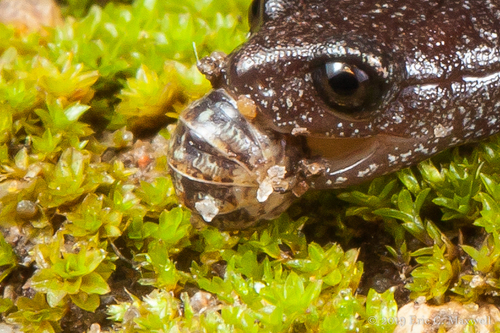
Isopoda is an order of crustaceans. Members of this group are collectively called isopods and include both aquatic species such as gribbles and terrestrial species such as woodlice. All have rigid, segmented exoskeletons, two pairs of antennae, seven pairs of jointed limbs on the thorax, and five pairs of branching appendages on the abdomen that are used in respiration. Females brood their young in a pouch under their thorax called the marsupium.
π Etymology
The name Isopoda is derived from the Greek roots (from , meaning "equal") and (from , the stem of , genitive , meaning "foot"). This refers to the fact that they have seven pairs of similarly shaped legs.
π Diversity and classification
Isopods belong to the larger group Peracarida, which are united by the presence of a special chamber under the thorax for brooding eggs. They have a cosmopolitan distribution and over 10,000 species of isopod, classified into 11 suborders, have been described worldwide. Around 4,500 species are found in marine environments, mostly on the sea floor. About 500 species are found in fresh water and another 5,000 species are the terrestrial woodlice, which form the suborder Oniscidea. In the deep sea, members of the suborder Asellota predominate, to the near exclusion of all other isopods, having undergone a large adaptive radiation in that environment.
Some isopod groups have evolved a parasitic lifestyle, particularly as external parasites of fish. In reef aquariums, parasitic isopods can become a pest, endangering the fish and possibly injuring the aquarium keeper. Some members of the family Cirolanidae suck the blood of fish, and others, in the family Aegidae, consume the blood, fins, tail and flesh and can kill the fish in the process.
π Taxonomy
The World Marine, Freshwater and Terrestrial Isopod Crustaceans database subdivides the order into eleven suborders:
* Cymothoida β Chiefly marine isopods with over 2,700 species. The previously recognised suborder Epicaridea is included as two superfamilies within this suborder and Cymothoida now includes part of the formerly recognised suborder Flabellifera.
* Phoratopidea β A single marine species, Phoratopus remex, which warrants its own suborder because of its unique characteristics.
* Phreatoicidea β Small suborder of freshwater isopods resembling amphipods, limited to South Africa, India, Australia and New Zealand.
* Tainisopidea β Freshwater isopods in a "relictual environment".
* Valvifera β A large group of benthic, marine isopods with respiratory pleopods inside a branchial chamber under the abdomen.
π Evolutionary history
Isopods first appeared in the fossil record during the Carboniferous period of the Paleozoic some 300 million years ago. They were primitive, short-tailed members of the suborder Phreatoicidea. At that time, Phreatoicideans were marine organisms with a cosmopolitan distribution. Nowadays, the members of this formerly widespread suborder form relic populations in freshwater environments in South Africa, India and Oceania, the greatest number of species being in Tasmania. Other primitive, short-tailed suborders include Asellota, Microcerberidea, Calabozoidea and the terrestrial Oniscidea.
The short-tailed isopods have a short pleotelson and terminal, stylus-like uropods and have a sedentary lifestyle on or under the sediment on the seabed. The long-tailed isopods have a long pleotelson and broad lateral uropods which can be used in swimming. They are much more active and can launch themselves off the seabed and swim for short distances. The more advanced long-tailed isopods are mostly endemic to the southern hemisphere and may have radiated on the ancient supercontinent of Gondwana soon after it broke away from Laurasia 200 million years ago. The short-tailed forms may have been driven from the shallow seas in which they lived by increased predatory pressure from marine fish, their main predators. The development of the long-tailed forms may also have provided competition that helped force the short-tailed forms into refugia. The latter are now restricted to environments such as the deep sea, freshwater, groundwater and dry land. Isopods in the suborder Asellota are by far the most species-rich group of deep sea isopods.
π Biology
Unlike amphipods within the same ecosystem, marine and freshwater isopods are entirely benthic. This gives them little chance to disperse to new regions and may explain why so many species are endemic with restricted ranges. Crawling is the primary means of locomotion, and some species bore into the seabed, the ground or timber structures. Some members of the families Sphaeromatidae, Idoteidae and Munnopsidae are able to swim pretty well, and have their front three pairs of pleopods modified for this purpose, with their respiratory structures limited to the hind pleopods. Most terrestrial species are slow-moving and conceal themselves under objects or hide in crevices or under bark. The semi-terrestrial sea slaters (Ligia spp.) can run rapidly on land and many terrestrial species can roll themselves into a ball when threatened, a feature that has evolved independently in different groups and also in the marine sphaeromatids.
π Terrestrial isopods
The majority of crustaceans are aquatic, though the isopods are one of the few groups with terrestrial members. The other terrestrial crustaceans are sandhoppers (Amphipoda) along with land crabs and some hermit crabs (Decapoda). Macro-detritivores, including terrestrial isopods, are absent from arctic and subarctic regions, but have the potential to expand their range with increased temperatures in high latitudes.
π Woodlice
The woodlice of the suborder Oniscidea are the most successful group of terrestrial crustaceans and show various adaptations for life on land. They are subject to evaporation, especially from their ventral area, and as they do not have a waxy cuticle, they need to conserve water, often living in a humid environment and sheltering under stones, bark, debris or leaf litter. Desert species like Hemilepistus reaumuri are usually nocturnal, spending the day in a burrow and emerging at night. Moisture is achieved through food sources or by drinking, and some species can form their paired uropodal appendages into a tube and funnel water from dewdrops onto their pleopods. In many taxa, the respiratory structures on the endopods are internal, with a spiracle and pseudotrachaea, which resemble lungs. In others, the endopod is folded inside the adjoining exopod (outer branch of the pleopod). Both these arrangements help to prevent evaporation from the respiratory surfaces.
Many species can roll themselves into a ball β a behaviour known as volvation β which is used in defense that also conserves moisture. Members of the families Ligiidae and Tylidae, commonly known as rock lice or sea slaters, are the least specialised of the woodlice for life on land. They inhabit the splash zone on rocky shores, jetties and pilings, may hide under debris washed up on the shore and can swim if immersed in water.
π Feeding ecology
(Cymothoidae) parasitising the fish Spicara maena, Italy]]
Isopods have a simple gut which lacks a midgut section; instead there are caeca connected to the back of the stomach in which absorption takes place. Food is sucked into the esophagus, a process enhanced in the blood-sucking parasitic species, and passed by peristalsis into the stomach, where the material is processed and filtered. The structure of the stomach varies, but in many species there is a dorsal groove into which indigestible material is channelled and a ventral part connected to the caeca where intracellular digestion and absorption take place. Indigestible material passes on through the hindgut and is eliminated through the anus, which is on the pleotelson. Some exhibit coprophagia and will also consume their own fecal pellets. Cymothoa exigua is a parasite of multiple fish species, such as the spotted rose snapper Lutjanus guttatus in the Gulf of California; it causes the tongue of the fish to atrophy and takes its place in what is believed to be the first instance discovered of a parasite functionally replacing a host structure in animals.
π Reproduction and development
In most species, the sexes are separate (dioecy) and there is little sexual dimorphism, but a few species are hermaphroditic and some parasitic forms show large differences between the sexes. Males have a pair of penises, which may be fused in some species. The sperm is transferred to the female by the modified second pleopod which receives it from the penis and which is then inserted into a female gonopore. The sperm is stored in a special receptacle, a swelling on the oviduct close to the gonopore. Fertilisation only takes place when the eggs are shed soon after a moult, at which time a connection is established between the semen receptacle and the oviduct.