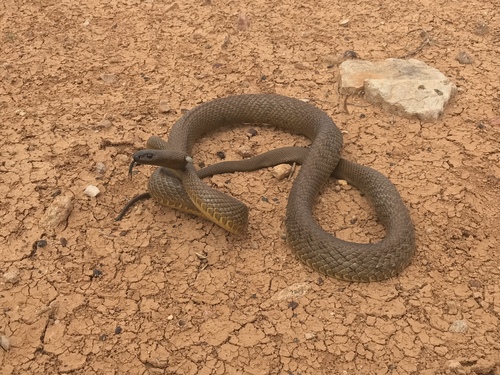
The inland taipan, also commonly known as the western taipan, small-scaled snake, or fierce snake, is a species of extremely venomous snake in the family Elapidae. The species is endemic to semiarid regions of central east Australia. Aboriginal Australians living in those regions named it dandarabilla. It was formally described by Frederick McCoy in 1879 and William John Macleay in 1882, but for the next 90 years, it was a mystery to the scientific community; no further specimens were found, and virtually nothing was added to the knowledge of the species until its rediscovery in 1972.
๐ Taxonomy
To the Aboriginal people from the place now called Goyder Lagoon in north-east South Australia, the inland taipan was called dandarabilla. James Roy Kinghorn regarded ferox as a synonym for microlepidotus and proposed the genus Parademansia. In 1963, Eric Worrell considered Parademansia microlepidotus and Oxyuranus scutellatus (coastal taipan, named simply "taipan" in those days) to be the same species. The generic name Oxyuranus is from Greek oxys "sharp, needle-like", and ouranos "an arch" (specifically the arch of the heavens) and refers to the needle-like anterior process on the arch of the palate. The specific name microlepidotus means "small-scaled" (Latin). Hence the common name, "small-scaled snake". Since Covacevich et al., 1981, determined that the fierce snake (formerly: Parademansia microlepidota) is actually part of the genus Oxyuranus (taipan), another species, Oxyuranus scutellatus, which was previously known simply as the "taipan" (coined from the aboriginal snake's name dhayban), was renamed the "coastal taipan" (or "eastern taipan"), while the now newly classified Oxyuranus microlepidotus became commonly known as the "inland taipan" (or "western taipan").
๐ Distribution and habitat
The inland taipan inhabits the black soil plains in the semiarid regions where the Queensland and South Australia borders converge.
In Queensland, the snake has been observed in Channel Country region (e.g., Diamantina National Park, Durrie Station, Morney Plains Station and Astrebla Downs National Park) and in South Australia it has been observed in the Marree-Innamincka NRM District (e.g., Goyder Lagoon Tirari Desert, Sturt Stony Desert, Coongie Lakes, Innamincka Regional Reserve and Oodnadatta). An isolated population also occurs near Coober Pedy, South Australia.
Two old records exist for localities further south-east, i.e., the junction of the Murray and Darling Rivers in northwestern Victoria (1879) and Bourke, New South Wales (1882), but the species has not been observed in either state since then.
๐ Conservation status
Like every Australian snake, the inland taipan is protected by law.
Conservation status for the snake was assessed for the IUCN Red List for the first time in July 2017, and in 2018, was designated as least concern, stating, "This species is listed as least concern, as it is widespread and overall, it is not considered to be declining. Although the impact of potential threats requires further research, these are likely to be localized within the snake's range."
* South Australia: (Outback regional status) - least concern
* New South Wales: Presumed extinct, because it "hasn't been recorded in its habitat...despite surveys in a time frame appropriate to their life cycle and type"
* Victoria: Regionally extinct, based on the criterion: "As for Extinct but within a defined region (in this case the state of Victoria) that does not encompass the entire geographic range of the taxon. A taxon is presumed Regionally Extinct when exhaustive surveys in known and/or expected habitat, at appropriate ), throughout the region have failed to record an individual. Surveys should be over a time frame appropriate to the taxon's life cycle and life form." The Australian Museum lists it as presumed extinct.
๐ In captivity
Inland taipans are held in several zoo collections in Australia and overseas including the Adelaide Zoo and Taronga Zoo in Sydney.
The inland taipan is also on public display in Australia at the Australia Zoo, Australian Reptile Park, Billabong Sanctuary, Lone Pine Koala Sanctuary and Shoalhaven Zoo.
The snake is also on display at several locations outside of Australia. In the United States, inland taipans are held at the Reptile Gardens in South Dakota, at Kentucky Reptile Zoo and at Animal World & Snake Farm Zoo in Texas.
In Europe, inland taipans are held in Sweden at the Stockholm Skansen Zoo and Gothenburg Universeum Moscow Zoo in Russia, (in the Moscow Zoo they are kept in the House of Reptiles, which is not usually open to the general public.) and in the UK at the London Zoo. Amateur zoo listings also report the snake at the tropicarium park in Jesolo, Italy, in Gifttierhaus Eimsheim, Welt der Gifte Greifswald, and Terra Zoo Rheinberg, Germany, in Lausanne vivarium Lausanne, Switzerland, in Randers Tropical Zoo Denmark, in Plzeล Zoo Czech Republic, and in Reptilienzoo Nockalm Patergassen Austria.
In Asia, inland taipans are held in the Singapore Zoo.
๐ Private ownership law
In New South Wales, private ownership of an inland taipan is legal only with the highest class of venomous reptile licence.
๐ Seasonal adaptation
Inland taipans adapt to their environments by changing the colour of their skin during seasonal changes. They tend to become lighter during the summer and darker during the winter. This seasonal colour change facilitates thermoregulation, allowing the snake to absorb more radiant heat in the colder months.
๐ Breeding
Inland taipans produce clutches of one to two dozen eggs. The eggs hatch in about two months. They are usually laid in abandoned animal burrows and deep crevices. Reproduction rate depend in part on their diet: if not enough food is available, then the snake reproduces less.
Captive snakes generally live for 10 to 15 years. An inland taipan at the Australia Zoo lived to be over 20 years old.
๐ Feeding
In the wild, the inland taipan consumes only mammals, mostly rodents, such as the long-haired rat (Rattus villosissimus), the plains rat (Pseudomys australis), the introduced house mouse (Mus musculus), and other dasyurids. In captivity, it may also eat day-old chicks.
๐ Natural threats
The mulga snake (Pseudechis australis) is immune to most Australian snake venom, and is known to also eat young inland taipans. The perentie (Varanus giganteus), a large monitor lizard, shares the same habitat. As it grows large enough, it readily tackles large venomous snakes as prey.
๐ Interaction with humans
Many reptile keepers consider it a placid snake to handle. However, caution should be exercised and a safe distance maintained as it can inflict a potentially fatal bite. The inland taipan will defend itself and strike if provoked, et al. have stated in Toxicon journal (October 2017) "There have been 11 previously well-documented envenomings by O. microlepidotus, but only 2 were inflicted by wild snakes. When clinically indicated, prompt provision of adequate antivenom is the cornerstone of managing O. microlepidotus envenoming. Rapid application of pressure-bandage immobilization and efficient retrieval of victims envenomed in remote locales, preferably by medically well-equipped aircraft, probably improves the likelihood of a positive outcome."
๐ Snakebite victims
A case of survival without antivenom was recorded in 1967; on 15 September, a tour guide was bitten while trying to capture a snake for a tour group in the Channel Country. He was conveyed to Broken Hill Hospital and then to Queen Elizabeth Hospital in Adelaide, but was not given antivenom, as he reported he was severely allergic to horse serum and believed he had been bitten by a brown snake. He spent four weeks in the hospital overall; his condition was likened to severe myasthenia gravis. Meanwhile, the snake was sent to Eric Worrell, who confirmed it was a coastal taipan. After its rediscovery in 1972, it was identified as an inland taipan.
In September 2012, in the small city of Kurri Kurri, New South Wales, north of Sydney, more than 1000 km away from the snake's natural environment, a teenaged boy was bitten on the finger by an inland taipan. The teenager's rapid self-application of a compression bandage above the wound and the availability and administration of a polyvalent (broad-spectrum) antivenom in the local hospital saved his life. The police worked to find out how the inland taipan got to this part of Australia. The snake was most likely a stolen or illegal pet and the boy had tried to feed it.
In December 2013, reptile handler Scott Grant, who was conducting a demonstration in front of 300 people at the annual building union's picnic in Portland, Victoria, had just finished showing the crowd an inland taipan and was trying to put it into a bag when it struck him. He got into his utility and tied a bandage around his arm. A few minutes later, however, he was lying on the ground and convulsing. He was flown in a serious condition to Essendon Airport and driven to the Royal Melbourne Hospital, where his condition was stabilised, and over time, he recovered. Only a tiny amount of venom from the inland taipan had entered his body, and the adverse reaction he felt shortly after was an allergic one, presumably due to his past snake bites.
In October 2017, Weinstein et al. published a case report in Toxicon, writing, "The victim was seeking to observe members of an isolated population of this species and was envenomed while attempting to photograph an approximately 1.5 m specimen. He reported feeling "drowsiness" and blurred vision that progressed to ptosis; he later developed dysphagia and dysarthria. The patient was treated with one vial of polyvalent antivenom, which was later followed by an additional two vials of taipan monovalent. He was intubated during retrieval, and recovered after 3 days of intensive care. He had a right ophthalmoplegia that persisted for approximately 1 week post-envenoming.".
Almost all positively identified inland taipan bite victims have been herpetologists handling the snakes for study or snake handlers, such as people who catch snakes to extract their venom, or keepers in wildlife parks. All were treated successfully with antivenom. No recorded incidents have been fatal since the advent of monovalent (specific) antivenom therapy, though weeks are needed to recover from such a severe bite.
๐ Venom
The average quantity of venom delivered by this species is 44 mg, and the maximum dose recorded is 110 mg, compared to the Indian cobra (Naja naja) 169 mg/max 610 mg, and the North American eastern diamondback rattlesnake (Crotalus adamanteus) 410 mg/max 848 mg.
The median lethal dose (LD50), subcutaneous (the most applicable to actual bites) for mice is 0.025 mg/kg Compared to the beaked sea snake (Enhydrina schistosa) 0.164 mg/kg, Indian cobra 0.565 mg/kg, North American eastern diamondback rattlesnake 11.4 mg/kg, One bite's worth of venom is enough to kill 100 fully grown men.
Intravenous, intraperitoneal, and intramuscular LD50s for the inland taipan venom have not been tested.
Belcher's sea snake (Hydrophis belcheri), which many times is mistakenly called the hook-nosed sea snake (Enhydrina schistosa), has been erroneously popularized as the most venomous snake in the world, due to Ernst and Zug's published book Snakes in Question: The Smithsonian Answer Book from 1996. Bryan Grieg Fry, a prominent venom expert, has clarified the error: "The hook-nosed myth was due to a fundamental error in a book called Snakes in Question. In there, all the toxicity testing results were lumped in together, regardless of the mode of testing (e.g. subcutaneous vs. intramuscular vs. intravenous vs. intraperitoneal). As the mode can influence the relative number, venoms can only be compared within a mode. Otherwise, it's apples and rocks." and 0.155 mg/kg,
The inland taipan's venom consists of:
* Neurotoxins: Presynaptic neurotoxins; paradoxin (PDX), alpha-oxytoxin 1, alpha-scutoxin 1 โ affecting the nervous system.
* Hemotoxins (procoagulants) โ affecting the blood
* Myotoxins โ affecting the muscles
* Possibly nephrotoxins โ affecting the kidneys
* Possibly haemorrhagins โ affecting the blood vessels (endothelium)
*Hyaluronidase enzyme โ increases the rate of absorption of venom
Paradoxin (PDX) appears to be one of the most potent, if not the most potent, beta-neurotoxins yet discovered. Beta-neurotoxins keep nerve endings from liberating the neurotransmitter acetylcholine.
According to researcher Ronelle Welton of James Cook University, most of the contents in the venom have not been characterized and little molecular research has been undertaken on taipan (Oxyuranus) species at large. As of 2005, the amino acid sequences of only seven proteins from inland taipan have been submitted to SWISS-PROT databases.
๐ Clinical effects
The mortality rate is high in untreated cases:
* Dangerousness of bite: severe envenomation likely, high lethality potential
* Rate of envenoming: >80%
* Untreated lethality rate: >80%
The first local and general symptoms of a bite are local pain and variable nonspecific effects, which may include headache, nausea, vomiting, abdominal pain, diarrhea, dizziness, collapse, or convulsions leading to major organ effects - neurotoxicity, coagulopathy, rhabdomyolysis or kidney failure/damage, and finally death. Presynaptic neurotoxins disrupt neurotransmitter release from the axon terminal. This takes days to resolve and does not respond to antivenom. Postsynaptic neurotoxins competitively block acetylcholine receptors, but the effect can be reversed by antivenom. Envenoming causes a progressive descending flaccid paralysis; ptosis is usually the first sign, then facial (dysarthria) and bulbar involvement occur, progressing to dyspnea and respiratory paralysis leading to suffocation and peripheral weakness. The development of general or respiratory paralysis is of paramount concern in that these are often difficult to reverse once established, even with large amounts of antivenom. Prolonged intubation and ventilatory support (perhaps up to a week or longer) may be required. Early diagnosis of neurotoxic symptoms and prompt and adequate dosages of antivenom are critical to avoid these complications.
Causes of death:
* Paralysis โ primary, e.g., respiratory failure; secondary, e.g., pneumonia
* Coagulopathy โ primary, e.g., cerebral haemorrhage; secondary, e.g., kidney failure
* Kidney failure โ includes secondary complications such as infections
* Anaphylaxis โ acute allergic reaction to venom in a patient previously exposed to taipan snake venom (e.g., reptile keeper)
* Cardiac complications โ likely to be secondary
๐ Antivenom
Until 1955, the only antivenom available for general distribution for Australian snakes was the monovalent (specific) tiger snake (Notechis) antivenom, which gave varying degrees of cross-protection against the bites of most other dangerous Australian snakes. Thereafter followed specific antivenom for other common snakes, among them the coastal taipan, and finally, a polyvalent (broad-spectrum) antivenom for the bites of any unidentified snake from Australia.
The coastal taipan antivenom, known as "taipan antivenom", is effective against the inland taipan venom, as well, but it is not as effective in bite victims of the inland taipan as in those of the coastal taipan.