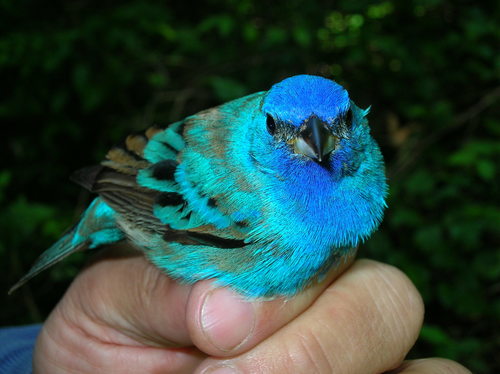
The indigo bunting is a small seed-eating bird in the cardinal family, Cardinalidae. It is migratory, ranging from southern Canada to northern Florida during the breeding season, and from southern Florida to northern South America during the winter. It often migrates by night, using the stars to navigate. Its habitat is farmland, brush areas, and open woodland. The indigo bunting is closely related to the lazuli bunting and interbreeds with the species where their ranges overlap.
๐ Taxonomy
The indigo bunting is included in the family Cardinalidae, which is made up of passerine birds found in North and South America, and is one of seven birds in the genus Passerina. It was originally described as Tanagra cyanea by Linnaeus in his 18th-century work, Systema Naturae. The current genus name, Passerina, is derived from the Latin term passer for true sparrows and similar small birds, while the species name, cyanea, is Latin for cyan, the color of the male's breeding plumage.
The indigo bunting is a close relative of the lazuli bunting and interbreeds with the species where their ranges overlap, in the Great Plains. They were declared to form a superspecies by the American Ornithologists' Union in 1983. However, according to sequencing of the mitochondrial cytochrome-b gene of members of the genus Passerina, it was determined that the indigo bunting and lazuli bunting are not, in fact, sister taxa. The indigo bunting is the sister of two sister groups, a "blue" (lazuli bunting and blue grosbeak) and a "painted" (rose-bellied bunting, orange-breasted bunting, varied bunting, and painted bunting) clade. This genetic study shows these species diverged between 4.1 and 7.3 million years ago. This timing, which is consistent with fossil evidence, coincides with a late-Miocene cooling, which caused the evolution of a variety of western grassland habitats. Evolving to reduce size may have allowed buntings to exploit grass seeds as a food source.
๐ Distribution and habitat
The habitat of the indigo bunting is brushy forest edges, open deciduous woods, second growth woodland, and farmland. Increases in population size have been seen in the event of forest clearings and development of land into farms. The breeding range stretches from southern Canada to Maine, south to northern Florida and eastern Texas, and westward to southern Nevada. The winter range begins in southern Florida and central Mexico and stretches south through the West Indies and Central America to northern South America.
๐ Ecology and behavior
===Vocalizations===
The indigo bunting communicates through vocalizations and visual cues. A sharp chip! call is used by both sexes, and is used as an alarm call if a nest or chick is threatened. A high-pitched, buzzed zeeep is used as a contact call when the indigo bunting is in flight. The song of the male bird is a high-pitched buzzed sweet-sweet chew-chew sweet-sweet, lasting two to four seconds, sung to mark his territory to other males and to attract females. Each male has a single complex song, In areas where the ranges of the lazuli bunting and the indigo bunting overlap, the males defend territories from each another.
๐ Migration
Migration takes place in April and May and then again in September and October. This is not an unusual proposal, for many other birds such as the blackcaps or red-backed shrikes were used to test if birds have orientated migratory behavior or Zugunruhe. Research indicates that indigo buntings placed in funnel cages outside on cloudless autumn nights or in artificial planetariums made more southern directional choices. When introduced to increasingly overcast nights, many bunting's abilities to distinctively make southern directional changes decreased, possibly indicating a negative correlation between Zugunruhe and cloud coverage. When in the artificial planetarium scenario and in the presence of a magnetic field similar to Earth's, birds were unable to orientate themselves in a no-star environment, indicating that past hypotheses supporting that birds use geophysical clues as well may be incorrect.
Indigo buntings do not rely on individual stars or the general brightness of groups of stars, but instead use them as clues in navigation. Prior experiments removing certain constellations and stars (Big Dipper, Cassiopeia or Polaris) from the sky had minimal effect on Zugunruhe. Indigo buntings do use the northern sky to help navigate both in the fall and in the spring. It was thought that the bunting has an internal clock, being able to compensate for the movement of stars. However, temporal compensation for stellar motion is not a part of their migratory methods.
In captivity, since it cannot migrate, it experiences disorientation in April and May and in September and October if it cannot see the stars from its enclosure.
While debate has occurred over the years about how birds migrate near the Gulf of Mexico, indigo buntings migrate to South America by flying both over the Gulf of Mexico and around the Gulf of Mexico, with a majority of buntings choosing the trans-Gulf path. Past evidence indicated that indigo buntings did not have a high enough fat content to travel across the Gulf, but that evidence is misleading since most of those birds supporting that study were immature, not having a high body fat content.
Since indigo buntings and many other birds are at their lightest after mating season, questions arose whether increases in overall weight were attributed to fat or other factors such as water weight, or carbohydrates. Research indicates that most if not all weight gain is a gain in fat content.
Quantitative methods of estimating flight range instead look at metabolic rates of the bunting and how much fat it has to use as fuel. Research indicates that the metabolic rate of a lean indigo bunting is 0.64 kcal/hour. With an average speed of 20 mph, 5 extra grams of fat (47.5 kcal of energy) extends a bunting's range to . is equivalent to . Given that the trip across the Gulf of Mexico from Florida is approximately , buntings weighing at least 18 g could make the trip without any stops.
๐ Breeding
These birds are generally monogamous but not always faithful to their partner. In the western part of their range, they often hybridize with the lazuli bunting. Nesting sites are located in dense shrub or a low tree, generally above the ground, but rarely up to . The eggs are incubated for 12 to 13 days and the chicks are altricial at hatching.
The brown-headed cowbird may parasitize this species.
๐ Predators and parasites
Indigo bunting nests are vulnerable to a variety of climbing and flying predators, including Virginia opossum (Didelphis virginiana), red fox (Vulpes vulpes), domestic cat (Felis catus), blue jay (Cyanocitta cristata), eastern racer (Coluber constrictor) and raccoon (Procyon lotor).
๐ Conservation status
The criteria for a change in conservation status are a decline of more than 30% in ten years or over three generations. The species is classified as being of least concern according to the International Union for Conservation of Nature, with an estimated range of and a population of 28 million individuals. Global population trends have not been quantified, but the species is not believed to approach the thresholds for a population decline warranting an upgrade in conservation status.